




Scroll Arm Chaise Longue
A scroll arm chaise longue combines the posture of a sofa with the single raised end of a daybed, designed for reclining in nineteenth-century interiors.
Scroll Arm Chaise Longue
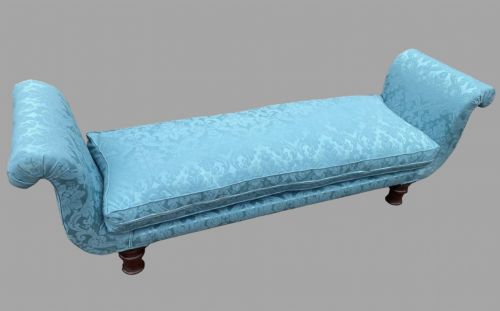
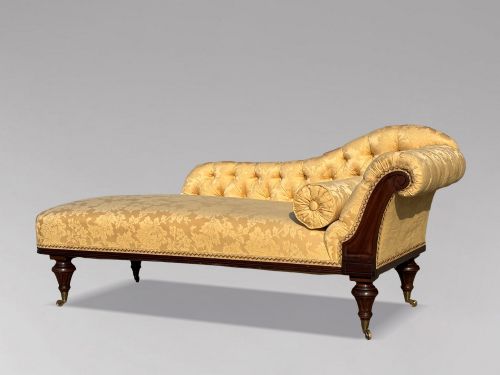
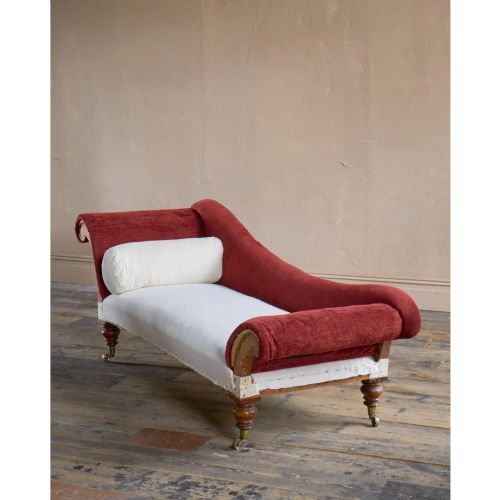
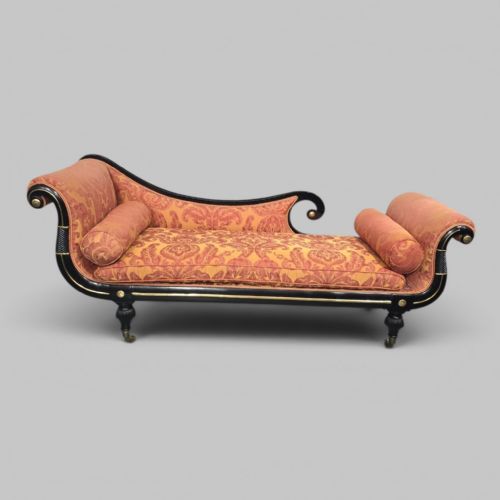
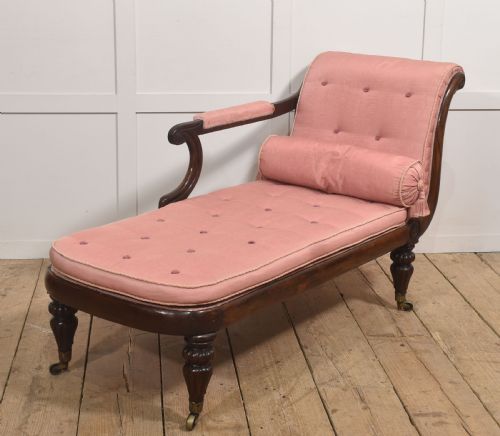
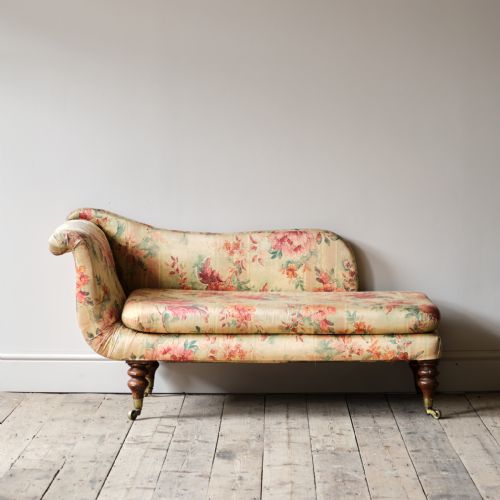
The scroll arm chaise longue is an asymmetrical seating form designed for reclining, featuring one prominent curved end and a long seat body. These pieces appear frequently across nineteenth-century styles, including Regency, William IV, and Victorian periods.
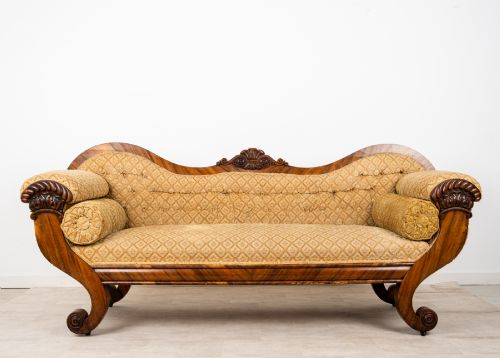
The version most commonly encountered in these listings is a mahogany or rosewood frame constructed with a single scroll end, often upholstered in damask, velvet, or contemporary fabric. They serve equally as daybeds, settees, and sculptural sofa alternatives in traditional rooms.
Origins span English cabinet makers alongside French Empire examples, encompassing both full-scale country house daybeds and compact ebonised variants. The fundamental architecture relies on a continuous backrest that curves down into the signature scroll.
How they were made
Frames are built from dense timbers like mahogany, rosewood, and ebonised wood, which provide the structural strength needed to support cantilevered scroll ends. Cabinet makers utilised the natural grain of these hardwoods, often leaving polished surfaces exposed along the showwood frames and carved rails.
Upholstery techniques involve traditional stuffing secured over webbing, finished with textiles such as patterned damask, velvet, or plain upholstery fabric. Brass castors are frequently fitted to the feet to allow movement of these heavy timber frames across floor surfaces.
Listings feature nineteenth-century periods including Regency, William IV, and Victorian eras, constructed primarily from mahogany, rosewood, and ebonised wood.
What varies in quality
Quality rests in the sculptural ambition of the carved scroll end and the crispness of any applied wood ornamentation. Finer examples display fluid, continuous timber turning and deeply figured mahogany or rosewood veneers that wrap seamlessly around complex curves.
Proportion and frame integrity dictate the upper tier of pieces, where the transition from the backrest to the scroll arm feels unified rather than assembled in parts. Lesser examples rely on heavier, blockish joinery with simpler secondary timbers beneath the polished exterior.
Holland and Sons·Gillows·Willian Trotter
The Scroll Arm Chaise Longue Glossary
- Scroll end
- The characteristic sweeping timber terminal that forms the headrest of a chaise longue. It dictates the primary silhouette of the piece.
- Showwood
- The exposed polished wooden frame visible around the upholstered portions of a settee or daybed. Cabinet makers carved these areas to display the grain of mahogany or rosewood.
- Récamier
- A specific form of daybed with two raised symmetrical or asymmetrical ends, sometimes grouped alongside traditional single-ended chaise longues. It references the classical furniture style popular in the early nineteenth century.
- Damask fabric
- A reversible figured textile traditionally woven with patterns visible on both sides in contrasting matte and lustrous finishes. It frequently appears as the upholstery covering on nineteenth-century seating.
- Ebonised wood
- Timber stained or treated to imitate dense, black ebony. This dark finish was applied to nineteenth-century frames for a dramatic decorative effect.
Scroll Arm Chaise Longue: Frequently Asked Questions
How were scroll arm chaise longues used?
These pieces were designed for semi-recumbent resting, reading, and receiving visitors in nineteenth-century drawing rooms and boudoirs. The elevated scroll end supported the head while the long seat accommodated the body.
They occupied prominent positions along walls rather than in the centre of rooms, functioning as a hybrid between a sofa and a bed for daytime relaxation.
How do I identify a Regency chaise longue?
Regency examples typically exhibit rich mahogany or rosewood timbers, sabre legs, and classical scroll ends inspired by ancient Greek and Roman forms. The carving remains restrained and architectural.
Cabinet makers of this period emphasised clean lines and figured wood grain over heavy ornamentation, distinguishing them from later Victorian iterations.
How do I fit a nineteenth-century chaise longue into a modern room?
A scroll arm chaise longue works effectively as a statement piece in a living room, positioned perpendicular to a wall or floating opposite a modern sofa. Its low back profile ensures it does not block light or sightlines.
Pair the antique timber frame with neutral walls to let the wood grain and upholstery texture become the visual focal point of the space.