


Deep Buttoned Daybed
A deep buttoned daybed brings nineteenth century comfort to a room, offering a long seat designed for reclining in the afternoon.

Deep Buttoned Daybed
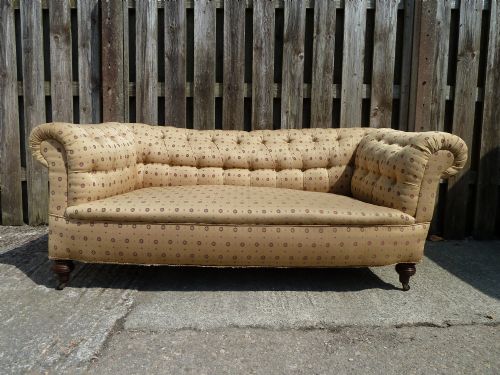
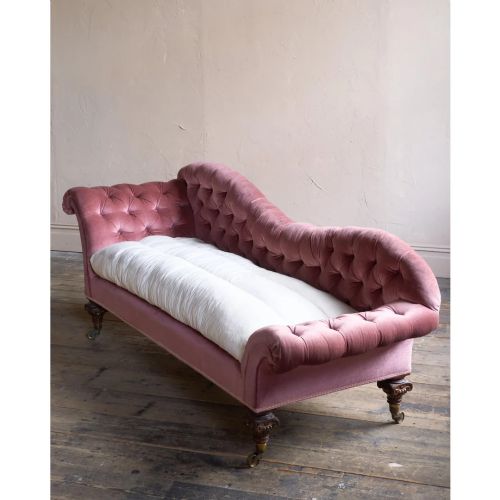
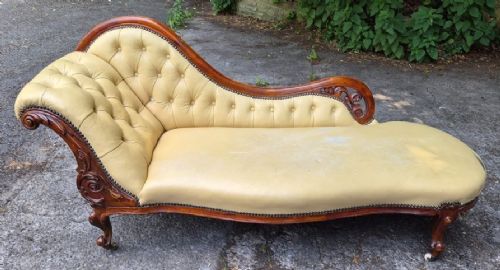
A deep buttoned daybed combines the function of a sofa and a bed, appearing in nineteenth century forms such as Victorian chaise longues, Chesterfield sofas, and scroll end settees. Buyers looking for a deep buttoned daybed will mostly encounter nineteenth century Victorian examples featuring rolled scroll ends or open arms.
The selection ranges from mahogany and walnut framed chaise longues to substantial Chesterfield sofas and kidney shaped daybeds. Makers such as Howard and Sons and Jas Shoolbred occasionally appear among nineteenth century pieces.
Originating across the Victorian period, these items serve as principal seating furniture designed for reclining in domestic interiors. They combine wooden frames with extensive upholstery and characteristic buttoning.
How they were made
Makers constructed the structural frames of these pieces using solid timbers like mahogany and walnut, often carving details directly into the show wood. These wooden supports provide the rigidity needed to sustain long horizontal seating forms.
Upholstery defines the character of the surface, utilising materials such as leather, velvet, fabric, and damask. Artisans secured the padding with deep buttoning techniques, fastening the textiles down into regular geometric patterns.
Brass fittings and turned or carved components, including Ionic column legs, complete the construction of the frames. Each element combines structural woodwork with traditional upholstery methods typical of the nineteenth century.
The object forms comprise chaise longues, Chesterfield sofas, and scroll end settees incorporating buttoned leather, velvet, and damask.
What varies in quality
The calibre of timber used for the frame establishes the baseline of quality, with dense hardwoods like mahogany and walnut providing superior structural integrity compared to secondary woods. Carved architectural details, such as Ionic column legs, reflect the level of craftsmanship invested in the woodwork.
Upholstery execution separates standard examples from exceptional ones, particularly in the precision of the deep buttoning and the choice of covering material. Higher grade pieces utilise durable leathers, rich velvets, or fine damask fabrics that hold their tension across the springs and webbing.
Attribution to notable makers or firms adds distinct distinction to a piece, separating anonymous workshop productions from documented nineteenth century works. The integrity of the frame combined with the preservation of original materials governs the overall standing of an individual daybed.
Howard and Sons·Jas Shoolbred
The Deep Buttoned Daybed Glossary
- Chesterfield
- A large sofa characterised by deep buttoning and arms of the same height as the back. This form provides a formal yet comfortable seating arrangement.
- Chaise longue
- A long chair for reclining, essentially a chair combined with an extended seat. Victorian examples often feature a single raised scroll end.
- Damask fabric
- A reversible figured fabric woven on a jacquard loom, featuring patterns created through contrasting weaves. It appears frequently as an upholstery choice on nineteenth century seating.
- Ionic column
- A classical architectural column style featuring scroll shaped volutes on the capital. Some nineteenth century daybeds incorporate this motif into their wooden leg supports.
Deep Buttoned Daybed: Frequently Asked Questions
What is a deep buttoned daybed?
A deep buttoned daybed is a nineteenth century reclining seat or sofa featuring tufted upholstery secured with buttons. These pieces combine wooden frames in mahogany or walnut with extended platforms for lying down.
Such furniture originated in the Victorian era as luxurious lounging seating for the home. They combine the back support of a sofa with the length of a bed.
How do I date a Victorian daybed?
Dating relies on observing the timber types, leg styles, and upholstery framing methods visible in the piece. Victorian examples span from the mid to late nineteenth century, showing shifts from heavy mahogany frames to walnut.
Stylistic markers like Ionic column legs or scroll ends help narrow down the period of manufacture. Documented makers from the era also assist in establishing a tighter timeframe.
Where should I place a daybed?
These pieces suit living rooms, studies, or large bedrooms where they can function as primary seating or auxiliary reclining spots. Their long profile makes them effective when positioned against a wall or floating in a spacious room.
Consider the orientation of the scroll end or backrest relative to natural light and walkways. The visual weight of wood and upholstery requires adequate surrounding space to sit comfortably within a room.
What fabrics were used originally?
Original upholstery materials included leather, velvet, and damask fabric stretched over internal padding. These textiles were chosen for durability as well as their ability to hold deep buttoning securely.
Leather provided a hardwearing surface for heavy use, while velvet and damask offered softer textures for formal reception rooms. The choice of fabric often reflects the intended room and status of the original furniture.