


Scottish Highland Cattle Artwork
These scottish highland cattle artwork pieces capture majestic long-horned beasts within dramatic northern landscapes, offering a timeless window into nineteenth-century pastoral romance.
Scottish Highland Cattle Artwork
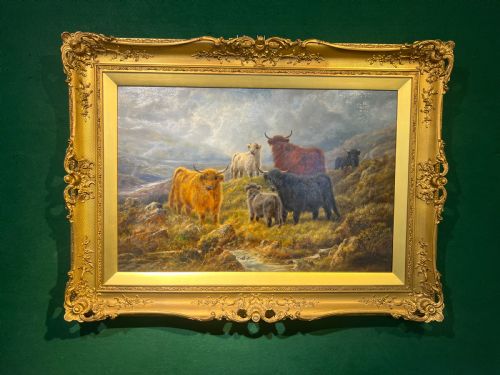
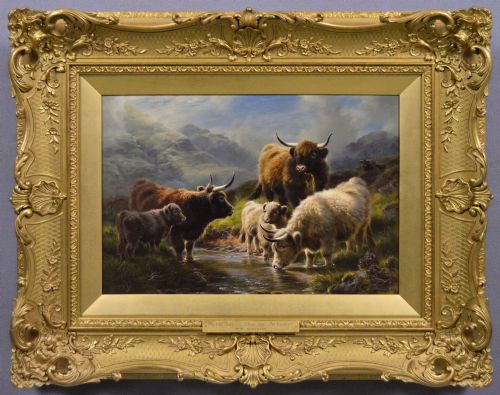
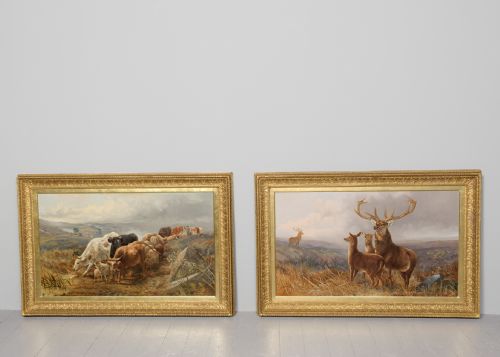
When you search for scottish highland cattle artwork, you encounter nineteenth-century and early twentieth-century oil paintings depicting iconic horned cattle grazing amidst dramatic lochs and glens.
The pieces on this page span from the Victorian era into the Edwardian period, showcasing pastoral realism and Scottish impressionism created by established British artists.
Most examples place the shaggy beasts centrally within mountainous terrain, often beside still waters or under moody skies characteristic of the Scottish highlands.
How these paintings were constructed
Artists applied rich oil paint onto woven canvas substrates, building up texture to render the thick, layered coats of the cattle and the rugged heather of the landscape.
Original framing materials consistently feature wood bases finished with gesso, plaster, and gold leaf.
What separates the finest works
Superior quality rests in the naturalistic rendering of the cattle's anatomy and the luminous handling of atmospheric mist over lochs, whereas lesser examples rely on formulaic compositions.
The depth of the palette and the subtlety of light dictate overall merit, with master painters achieving a palpable sense of Highland weather and texture.
Robert Watson·William Watson Jnr·Robert Cleminson·Henry Robinson Hall·Sidney Yates Johnson·Charles Jones·George Turner·John W Morris·Daniel Sherrin·Alfred de Breanski Snr·Henry Birtles·Louis Bosworth Hurt·Aster Richard Chilton Corbould·Sidney Richard Percy·James Kay
The Scottish Highland Cattle Artwork Glossary
- Oil on Canvas
- A traditional painting medium utilising pigments bound with drying oils applied to a stretched woven fabric support. This technique allowed artists to achieve rich colour depth and gradual tonal blending.
- Giltwood
- Timber carved and coated with a thin layer of gold leaf or metallic powder. It provides a reflective, decorative border that enhances the tones of the oil painting within.
- Gesso
- A paint mixture consisting of a neutral binder mixed with chalk, gypsum, or pigment used as a prepared foundation on wood frames. It accepts gilding smoothly and allows for intricate moulded relief ornament.
- Victorian Pastoral
- An artistic genre focusing on idealized rural life, agricultural scenes, and domesticated animals in serene natural settings. It reflects nineteenth-century romanticism towards the countryside.
- Scottish Impressionism
- A regional painting style characterised by looser brushwork, vibrant light effects, and rapid capture of atmospheric conditions. It emerged as artists moved outdoors to paint en plein air.
Scottish Highland Cattle Artwork: Frequently Asked Questions
How do I date a Scottish cattle painting?
Examine the stylistic cues, clothing of any figures, and framing materials. Victorian works often display heavy giltwood frames and romantic realism, while Edwardian pieces lean towards impressionistic brushwork.
Maker signatures and biographical dates provide the most precise chronological anchor for authenticating the period of creation.
Where should I hang these large canvases?
These substantial oil paintings suit principal reception rooms or hallways with high ceilings where their expansive highland vistas command the wall space.
Keep them away from direct sunlight and excessive humidity to protect both the oil pigments and the delicate antique gesso frames.
What subjects accompany the cattle?
Herdsmen, sheep, and fishing boats frequently share the canvas with highland cattle, adding human scale and narrative depth to the wilderness scenes.
Artists also integrated specific landmarks, such as Loch Tay, Ben Lawers, and Glen Tay, to ground the pastoral compositions in identifiable Scottish geography.
Are watercolours common in this genre?
While oil on canvas dominates the surviving corpus, works on paper do appear, offering a more delicate depiction of highland mists and moorlands.
Watercolour pieces require protective glazing and archival framing to preserve the pigments from fading over time.