
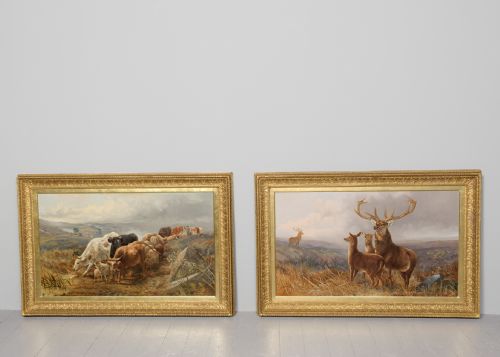


Highland Cattle Canvas Painting
A highland cattle canvas painting brings the dramatic Scottish landscape and its iconic livestock directly into your interior.
Highland Cattle Canvas Painting
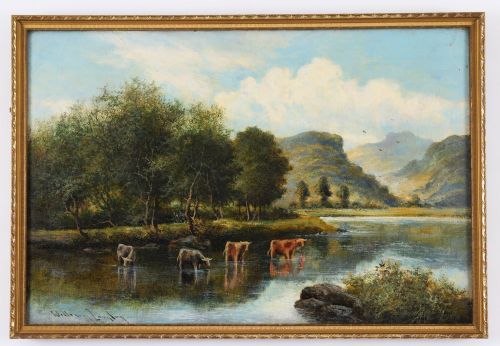
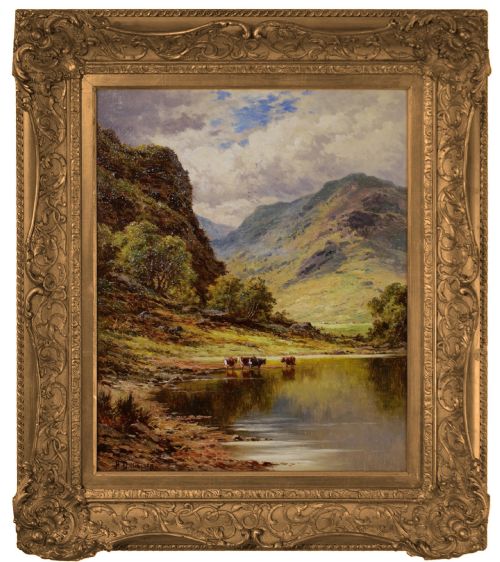
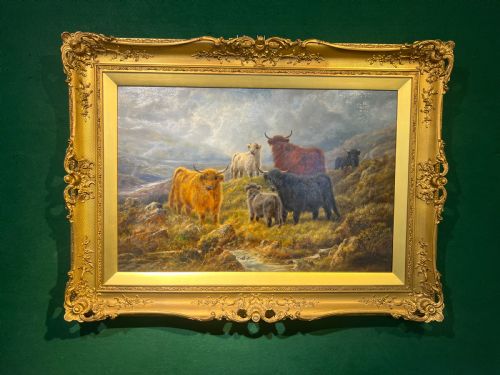
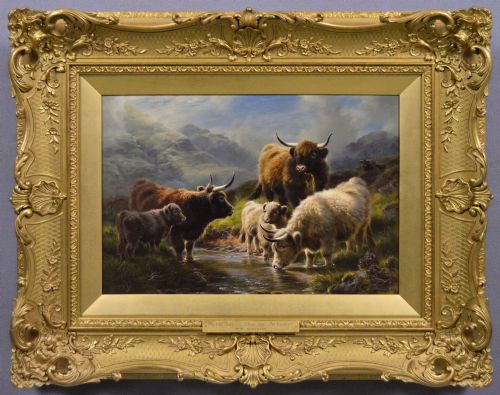
A highland cattle canvas painting depicts the majestic longhaired cattle within expansive Scottish landscapes, often beside lochs, rivers, or misty mountains. These works capture pastoral scenes from the nineteenth and early twentieth centuries, spanning Victorian, Edwardian, and Scottish Impressionist styles.
Most pieces encountered on this page belong to the Victorian and Edwardian periods, stretching from the 1860s through the 1920s. Painters utilised oil paint on canvas to render realistic atmospheric effects, tranquil waters, and detailed animal forms.
The compositions frequently feature named Scottish locations such as Loch Tay, Ben Lawers, and Glen Tay, placing the animals in specific topographic contexts. Smaller pastoral studies sit alongside huge framed works designed as principal interior focal points.
Materials and construction
Artists painted primarily with oil paint on stretched canvas, building rich textures and deep tones that capture the shifting light of northern skies and moorlands. The canvas sits within heavy wooden frames, often ornamented with gesso, plaster, and gold leaf or giltwood finishes.
The physical depth of the framing complements the scale of the oil paintings, protecting the canvas while adding substantial weight and decorative presence to the finished artwork.
Several canvases squeeze woolly sheep right in beside the cattle, proving even nineteenth-century Highlanders enjoyed a crowded commute.
Factors of quality
Quality rests upon the artist's ability to render the anatomy and texture of the cattle alongside convincing atmospheric depth in the surrounding landscape. Skilled brushwork distinguishes dynamic water reflections and the soft undercoat of the longhorns from stiff, formulaic representations.
The integrity of the original canvas, oil paint layer, and the accompanying ornate giltwood or gesso frame influences the overall preservation and visual impact of the piece.
Robert Watson·Alfred de Breanski Sr·Charles Jones·Henry Hillier Parker·Robert Cleminson
The Highland Cattle Canvas Painting Glossary
- Oil on Canvas
- A traditional painting medium where coloured pigments are suspended in drying oils and applied to a stretched woven fabric support. This combination allows for rich blending and lasting durability.
- Giltwood
- Timber carved and coated with a thin layer of gold leaf or metallic powder. Frames finished in this manner provide a reflective border that enhances the tones of the oil painting within.
- Gesso
- A plaster-like mixture applied to wooden frames as a smooth base before gilding. It allows craftsmen to mould intricate decorative reliefs around the perimeter of the artwork.
- Pastoral
- A genre of art that romanticises rural life and natural scenery. These paintings focus on herds grazing peacefully in remote valleys rather than industrial subjects.
- Victorian Realism
- An artistic approach focused on depicting subjects with truthful accuracy rather than idealised abstraction. Works in this style pay close attention to natural light, weather conditions, and animal behaviour.
Highland Cattle Canvas Painting: Frequently Asked Questions
What periods do these paintings come from?
The available works span the Victorian and Edwardian eras, primarily dating from the 1860s through the 1920s. This period saw a strong demand for romanticised Scottish landscape art.
Artists of this time frequently travelled north to sketch lochs and mountains directly before finishing their canvases in the studio.
How should I hang a framed oil painting?
These works often feature substantial wooden frames finished with giltwood or gesso, making them quite heavy. Use robust wall fixings anchored directly into masonry or wall studs to support the weight safely.
Position the painting away from direct sunlight and strong heat sources to protect the canvas and oil paint over time.
Are these paintings signed by the artists?
Many of the canvases bear signatures, monograms, or dates applied by the original nineteenth or early twentieth-century painters. Some examples also include inscriptions on the reverse identifying specific Scottish locations.
Unsigned pieces occasionally appear, attributed instead through stylistic comparisons with known contemporaries of the period.
Where were these landscape scenes usually painted?
The compositions commonly depict recognised Scottish locations such as Loch Tay, Glen Tay, and the West Highlands. Painters focused on remote valleys, mist-covered mountains, and quiet watering places.
These settings reflected contemporary enthusiasm for the wild scenery of the Scottish Highlands.