


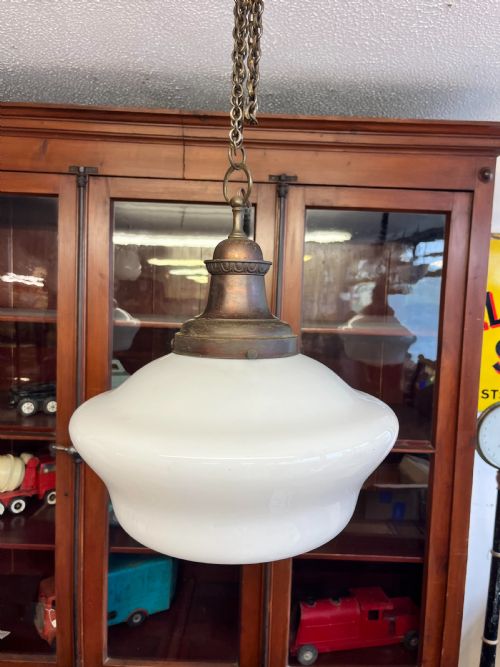


Schoolhouse Glass Pendants
Schoolhouse glass pendants bring direct industrial utility and soft diffusion to a room, driven by clean globe or bell profiles.
Schoolhouse Glass Pendants
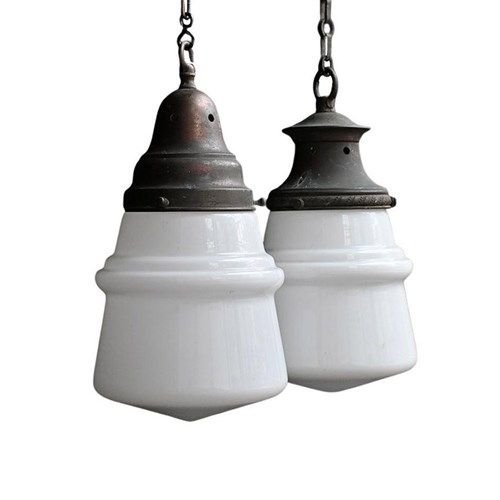
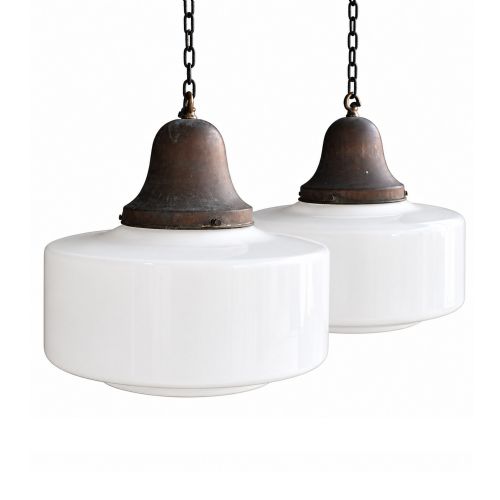
Schoolhouse glass pendants are practical ceiling lights designed for public buildings and domestic spaces alike, emerging strongly across the early twentieth century. Buyers seeking schoolhouse glass pendants will encounter pieces primarily from the nineteen-twenties and nineteen-thirties, spanning Edwardian to Art Deco and industrial designs.
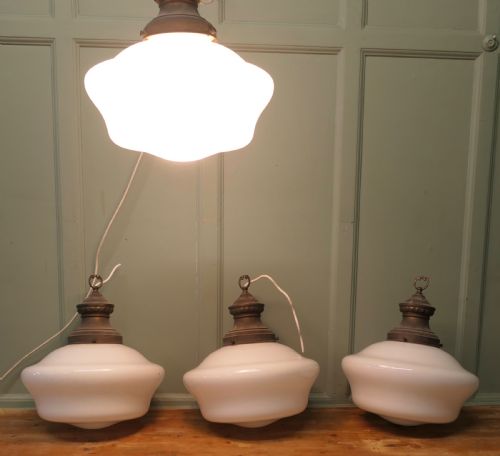
The forms here include single pendant lights and sets of ceiling lights, often scaled up for chapels, churches, and hallways. Opaline glass, opal glass, and clear glass dominate the shades, paired with fixtures of brass, copper, iron, chrome, and general metal.
Matched pairs and larger sets appear alongside individual statement lights, offering options for both singular focal points and uniform runs of illumination. The overall aesthetic unites utility with simple geometric elegance, suiting modern interiors as naturally as period properties.
How they were made
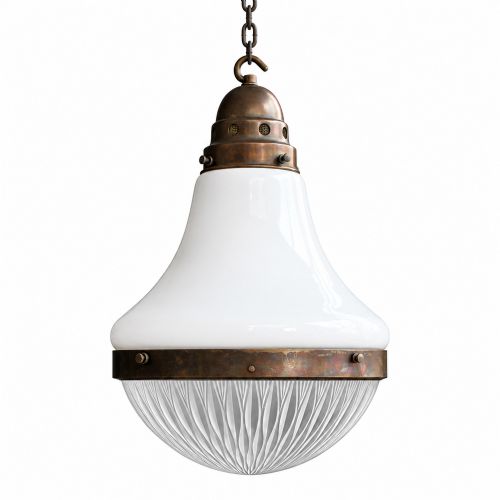
The shades were formed from opaline, opal, or clear glass, sometimes shaped into reeded designs or double prismatic configurations like those by Holophane. Glass production of this era relied on skilled blowing and moulding to achieve even diffusion and structural durability.
Metal components utilise brass, copper, iron, chrome, and standard metal to suspend and secure the glass globes. These hardware elements were cast or spun to withstand institutional use in schools, churches, and industrial settings.
Schoolhouse Glass Pendants Retail Price Guide 2026
Typical asking prices for schoolhouse glass pendants among the pieces listed under this phrase on Sellingantiques today, from the lower quarter to the upper quarter. They describe what is for sale here now, not the wider market.
Listings span the nineteen-twenties and nineteen-thirties, featuring opaline glass, brass, copper, and iron across industrial and Art Deco styles.
What varies in quality
Quality rests in the substance and integrity of the glass, where dense opaline or complex prismatic mouldings command greater visual weight than simple clear alternatives. The weight and finish of the suspension metal, whether cast brass, iron, or chrome, also define the tier of a piece.
Scale and consistency elevate certain items, particularly matched pairs or sets of four industrial ceiling lights where uniformity matters. Superior examples maintain crisp mould lines in the glass and robust, well-proportioned metal galleries.
The Schoolhouse Glass Pendants Glossary
- Opaline glass
- A milky, translucent glass type that diffuses light softly without glaring. It was widely utilised in the nineteen-twenties for schoolhouse and industrial shades.
- Prismatic glass
- Glass moulded with precise geometric ribs or prisms to refract and direct light efficiently. Holophane utilised this technique for commercial and church lighting.
- Pendant light
- A single light fixture suspended from the ceiling by a cord, chain, or metal rod. These dominate the early twentieth-century lighting inventory.
- Art Deco
- A design style characterised by sleek geometric shapes and streamlined forms. It heavily influenced lighting aesthetics during the nineteen-thirties.
Schoolhouse Glass Pendants: Frequently Asked Questions
Where do schoolhouse pendants work best?
These lights suit hallways, kitchens, and high-ceilinged living spaces where their downward diffusion provides clear illumination. Their industrial and Edwardian roots allow them to anchor both traditional and contemporary interiors.
Single pendants fit smaller spaces, while sets of four work well over long surfaces or down a corridor.
How do I date these lights?
Dating relies on materials, electrical fittings, and the stylistic cues of the shade and gallery. Pieces from the nineteen-twenties often display heavier brass or iron work, while nineteen-thirty examples lean toward Art Deco geometries or industrial utility.
Examining the manufacturing techniques of the glass provides further clues to the exact period.
What is opaline glass?
Opaline glass is a semi-translucent material that softens and diffuses bulb glare into an even glow. It became the standard for institutional and schoolhouse lighting in the early twentieth century.
Its milky appearance looks equally striking unlit or illuminated.
Are matched sets available?
Matched pairs and sets of four appear regularly, originating from institutional buildings, churches, and industrial settings. These groups offer a uniform look for larger rooms or extended hallways.
Individual statement pendants are also common for smaller focal points.