

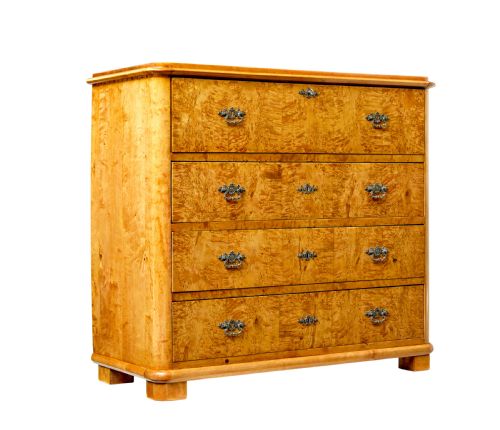


Scandinavian Biedermeier Cabinet
A Scandinavian Biedermeier cabinet offers practical storage defined by clean architectural lines and striking figure-rich wood veneers.
Scandinavian Biedermeier Cabinet
When searching for a scandinavian biedermeier cabinet, buyers encounter nineteenth-century forms ranging from secretaire chests of drawers to glazed corner cabinets and sideboards. Swedish and Danish workshops predominate, producing pieces designed for functional elegance in domestic interiors.
Buyers frequently meet upright cupboards, bookcases, and serpentine shaped storage units that showcase the characteristic warmth of Northern European cabinet-making traditions.
Materials and construction
Cabinet-makers utilised solid pine and robust timber carcases as foundations for decorative veneers. Birch, satin birch, masur birch, and flame mahogany were expertly sliced and laid to create symmetrical grain patterns across large flat surfaces.
Details such as ebonised wood accents and cast brass hardware provide contrast against the pale blonde timber tones. Glass panels are incorporated into bookcases and corner display units, while fitted interiors often organise secretaire compartments with numerous small drawers.
Scandinavian Biedermeier Cabinet Retail Price Guide 2026
Typical asking prices for scandinavian biedermeier cabinet among the pieces listed under this phrase on Sellingantiques today, from the lower quarter to the upper quarter. They describe what is for sale here now, not the wider market.
Listings span the nineteenth century up to nineteen-thirty, demonstrating how Scandinavian cabinet-making evolved from classical Biedermeier roots into early twentieth-century Swedish Grace and Empire revival styles.
Quality and craftsmanship
The distinction between tiers rests upon the selection and matching of wood veneers. Highly figured burr birch and birds-eye maple require exceptional skill to lay seamlessly across large door panels and drawer fronts.
Construction integrity is demonstrated by the precision of internal drawer dovetails, the smoothness of secretaire drop-front mechanisms, and the retention of original brass fittings. The depth and clarity of the polished finish further separate standard utility pieces from masterworks.
The Scandinavian Biedermeier Cabinet Glossary
- Secretaire
- A cabinet or chest featuring a hinged writing flap that conceals a fitted interior of small drawers and pigeonholes. This dual-purpose form allows a storage unit to function as a compact desk.
- Satin Birch
- A timber possessing a natural golden sheen and smooth texture, frequently utilised by Scandinavian cabinet-makers for decorative veneer work. It brings luminous warmth to nineteenth-century case furniture.
- Masur Birch
- A decorative wood growth characterised by distinctive dark swirls and flecks across the pale grain. Biedermeier craftsmen prized this material for creating highly ornate drawer fronts and panels.
- Empire Revival
- A design movement drawing inspiration from early nineteenth-century classical motifs, appearing in pieces produced around the turn of the twentieth century. It often incorporates bolder architectural proportions and brass mounts.
- Ebonised Wood
- Timber treated with a chemical stain or pigment to imitate the deep black colour of genuine ebony. This dark finish provides sharp linear contrast against lighter birch veneers.
Scandinavian Biedermeier Cabinet: Frequently Asked Questions
How do I identify a genuine period piece?
Examine the construction methods visible inside the drawers and at the carcase joints. Nineteenth-century pieces typically display hand-cut dovetails and timber construction appropriate to the era.
Check the timber species and veneer thickness, as modern reproductions often utilise different core materials and machine-sawn laminates that lack period character.
Where should I place a cabinet in my home?
These versatile storage pieces suit living rooms, dining spaces, or studies, depending on whether you choose a sideboard, bookcase, or secretaire. Their restrained forms allow them to blend effectively into contemporary and traditional interiors alike.
Keep wooden cabinets away from direct sunlight and sudden temperature shifts to protect the delicate birch and mahogany veneers from drying out.
What is the difference between Biedermeier and Empire styles?
Biedermeier design focuses on domestic comfort, clean lines, and celebration of natural wood grain without excessive ornamentation. It evolved from the stricter classical geometry of the earlier Empire period.
Revival pieces from later decades often combine elements of both, introducing larger scale and decorative brass mounts while retaining the functional spirit of Scandinavian cabinet-making.
How should I clean the wood surface?
Dust the cabinet regularly with a soft, dry cloth to prevent particle build-up on the polished veneer. Avoid silicone-based sprays or harsh chemical cleaners that can degrade the traditional polish over time.
Apply a quality furniture wax occasionally if the timber appears dry, buffing gently to maintain the natural lustre of the birch or mahogany.