


Scagliola Top Table
A scagliola top table brings simulated marble richness into a room, offering the decorative weight of stone without the crushing heft.
Scagliola Top Table
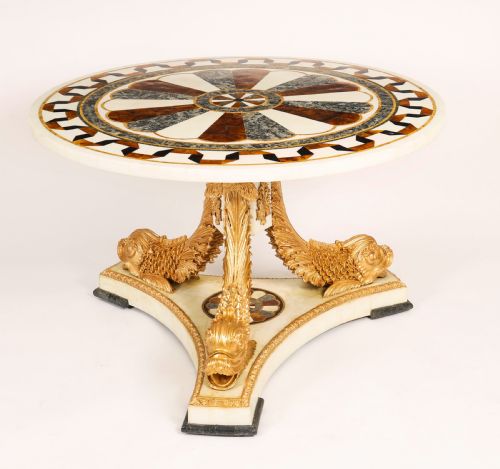
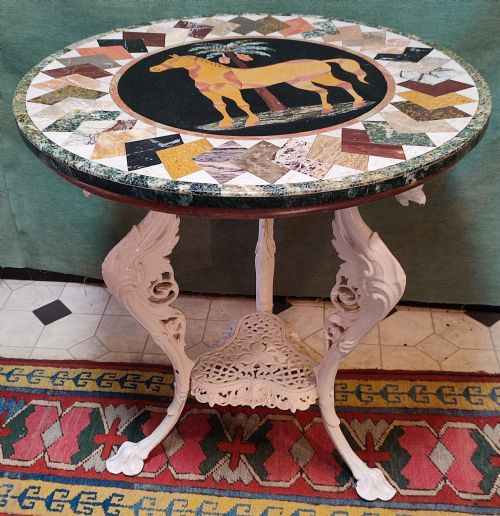
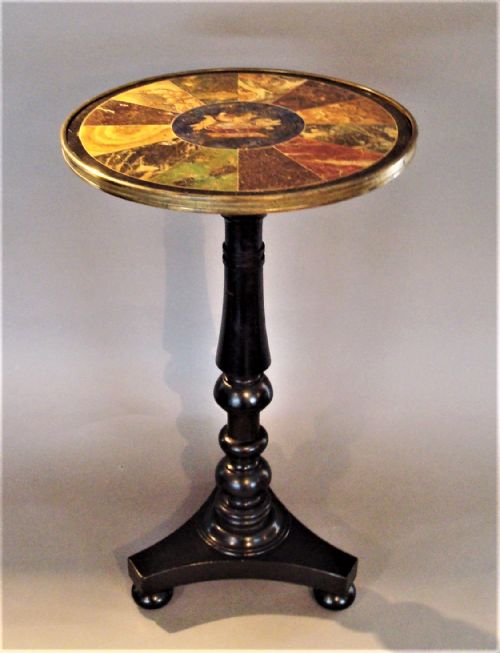
When you search for a scagliola top table, you find pieces featuring pigmented plaster compositions designed to imitate costly marbles and hardstones. These surfaces sit upon timber or metal frames, ranging from occasional tables to grand centre tables and console tables.
The versions you meet most often on this page date from the nineteenth century, though eighteenth century examples appear in styles such as Italian Rococo, Venetian Rococo, and Neoclassical Revival. They draw heavily on Italian craftsmanship, translating classical motifs into domestic furniture.
The supporting bases vary widely in material, spanning mahogany, walnut, kingwood, cast iron, and giltwood. Some tables employ simple turned legs, whilst others showcase elaborate carved dolphins or gilded foliage.
How they were made
Makers produced scagliola by mixing pigmented selenite plaster with glue and natural colours, laying the paste into carved channels within a base matrix. Artisans then polished the hardened surface with oils and waxes to achieve a lustrous, stone-like finish.
The underlying structures combined traditional cabinetmaking with architectural forms, utilising mahogany, walnut, and giltwood. Some simpler nineteenth century iterations paired these composite tops with sturdy cast iron bases.
What varies in quality
The sophistication of the paste inlay defines the upper tier of these pieces, separating simple geometric patterning from intricate pictorial or botanical compositions. Finer tops display subtle colour gradation and sharp definition within the simulated veining.
The ambition of the supporting base dictates overall stature, moving from utilitarian cast iron or plain mahogany to heavily carved giltwood console frames. The harmony between the decorative top and its carved support determines the piece's visual success.
The Woodley family
The Scagliola Top Table Glossary
- Scagliola
- A composite material made from pigmented plaster, glue, and pigments, applied to mimic the appearance of marble and hardstone inlay. Artisans polish the dried surface to create a smooth, reflective finish that resembles genuine stone.
- Console table
- A table designed to stand against a wall, frequently supported by sculptural legs or brackets rather than four freestanding posts. These pieces often feature elaborate carving and gilding.
- Centre table
- A freestanding table intended to occupy the middle of a room rather than sit against a partition. They present finished decoration on all sides.
- Giltwood
- Timber coated with a thin layer of gold leaf over a prepared gesso ground. It provides a brilliant, reflective surface common in eighteenth century decorative furniture.
- Specimen marble
- Compositions formed from numerous small fragments of different coloured marbles fitted together into a geometric or pictorial mosaic. They often appear alongside scagliola surfaces in decorative table tops.
Scagliola Top Table: Frequently Asked Questions
What is scagliola?
Scagliola is a composite technique using pigmented plaster to imitate marble and hardstone inlay. Craftsmen carve patterns into a matrix, fill them with coloured pastes, and polish the surface until smooth.
This method allowed makers to create elaborate multicolored designs that would prove prohibitively expensive or structurally impossible in solid stone.
How do I clean the top?
Maintenance requires only a soft, dry cloth to remove dust. Moisture and harsh chemical cleaners damage the polished plaster surface and should be avoided entirely.
Applying a specialist wax occasionally helps preserve the sheen on the composite top without harming the historical finish.
Are these tables heavy?
The weight depends primarily on the base construction and the thickness of the top. While the plaster composite is lighter than solid marble, timber and cast iron frames still add substantial heft.
Larger centre tables require two people for safe movement across a room.
Where did they originate?
The technique developed extensively in Italy during the seventeenth and eighteenth centuries as a sophisticated alternative to pietra dura inlay. British and European makers later adopted these methods for grand neoclassical interiors.
Many surviving nineteenth century examples retain strong ties to Italian workshops and stylistic traditions.