


Savonarola Chair
A savonarola chair offers the commanding presence of an X-frame seat, blending historical revival design with practical folding utility.
Savonarola Chair
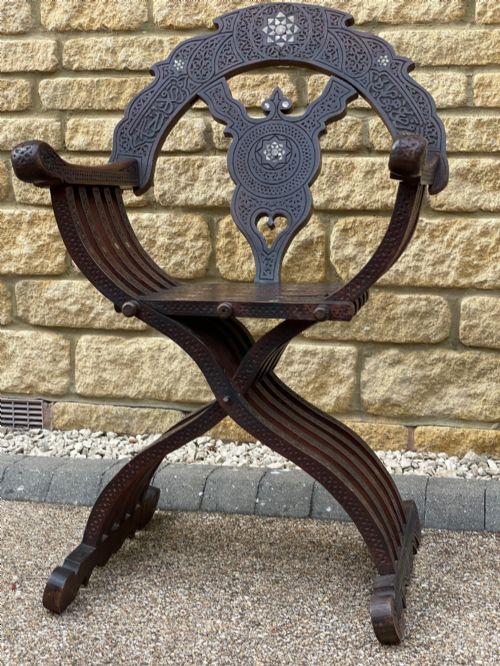
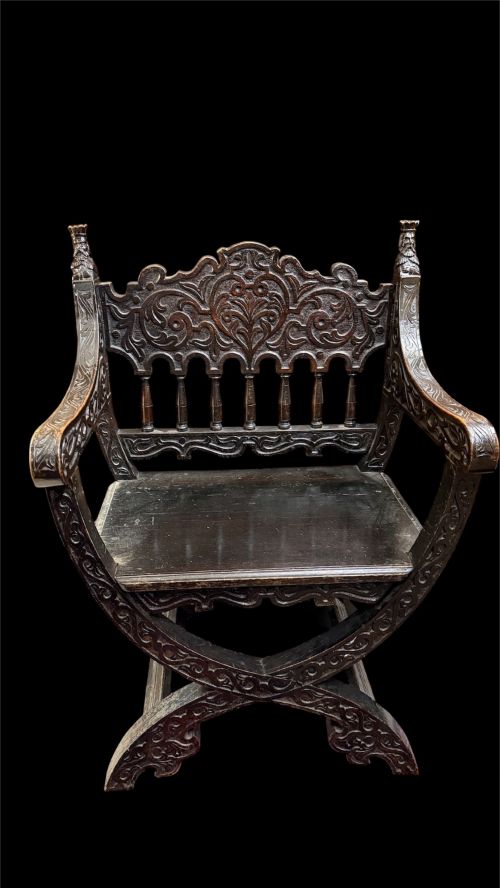
A savonarola chair is a folding armchair constructed from multiple curved wooden slats that intersect in an X-shape to support a backrest and arm rests. When you examine the pieces gathered here, you encounter examples spanning the nineteenth and early twentieth centuries, drawn from diverse global traditions including Italian Renaissance Revival, Syrian mother-of-pearl work, and Indian Hoshiarpur brass inlay.
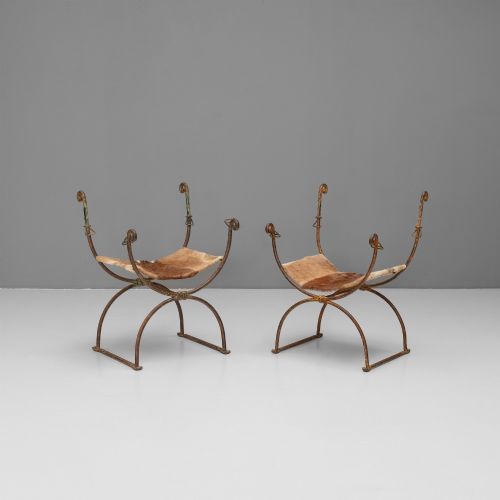
The variants most frequently met on this page range from walnut and oak armchairs to elaborately inlaid Syrian and Moorish examples utilising fruitwood, nacre shell, and bone. Alongside traditional armchairs, the selection includes related cross-frame seating such as side chairs, stools, benches, and hall chairs designed in corresponding revival styles.
Materials and Construction
Makers constructed the foundational X-frame using dense timbers such as walnut, oak, and fruitwood, shaping the curved slats to allow the seating structure to fold flat when needed. Joinery relied on precise interlocking wooden members, often reinforced with brass pins, iron braces, or hinged joints depending on the regional workshop tradition.
Surface ornamentation defines many pieces, incorporating intricate inlay work of mother-of-pearl, bone, and brass wire set into dark woods like ebonised walnut or teak. Upholstered variants integrate textiles including leather, velvet, and decorative fabrics across the seat pads and back panels.
Listings feature periods from the nineteenth century through the nineteen-thirties, utilising walnut, oak, brass, mother-of-pearl, and leather.
Judging Quality and Execution
The distinction between ordinary and superior pieces rests in the depth of the carving and the precision of the inlay. Master craftsmen executed crisp relief carvings on the crest rails and arms, whereas lesser examples display shallow, mechanical incision.
Structural integrity also separates the grades, as finer chairs maintain rigid alignment in the intersecting slats without excessive play at the central pivot. The complexity of the geometric or floral nacre-shell patterns further indicates the level of artisan labour invested in the work.
White, Allom & Co.·James Shoolbred
The Savonarola Chair Glossary
- X-frame
- A structural furniture base formed by pairs of curved slats crossing each other in a scissors configuration. This design allows the chair to be folded for transport or storage.
- Curule
- An ancient form of cross-frame seating associated with Roman magistrate chairs. In later furniture, it describes X-shaped supports derived from this classical lineage.
- Nacre
- An iridescent organic-inorganic composite material produced by the inner layer of mollusc shells, commonly known as mother-of-pearl. Craftsmen shaped it into delicate geometric plaques for furniture inlay.
- Renaissance Revival
- A nineteenth-century design movement that drew inspiration from fifteenth and sixteenth-century European art and architecture. It favored heavy carved woods, classical motifs, and formal symmetry.
- Inlay
- A decorative technique where small pieces of contrasting materials such as bone, brass, or shell are set into recesses flush with the wooden surface.
Savonarola Chair: Frequently Asked Questions
What is a savonarola chair?
A savonarola chair is a traditional folding armchair with an X-frame structure made of intersecting curved wooden slats. Named after the fifteenth-century Florentine friar Girolamo Savonarola, this furniture type evolved from Renaissance folding chairs into elaborate revival seating.
Makers across Europe and the Middle East adapted the scissor-action frame, incorporating rich carvings, arms, and backrests. Today, these chairs serve as striking focal points in studies, hallways, and living rooms.
How were they used historically?
Historically, X-frame chairs served as portable seating for nobility, clergy, and civic leaders who travelled between residences. Their folding design allowed servants to pack and transport them easily across estates or military camps.
Over subsequent centuries, the form transitioned from utility to status, appearing in formal libraries and reception rooms. Victorian and Edwardian revival versions continued this tradition of combining decorative presence with functional versatility.
How do I style one at home?
Living with a savonarola chair involves placing it where its sculptural silhouette can be appreciated from multiple angles. A hallway or corner serves well, allowing the intersecting wooden slats and inlay work to catch the light.
Pair the chair with minimalist surroundings to let the intricate carving or mother-of-pearl patterns stand out. Avoid overcrowding the piece with heavy textiles so the architectural frame remains visible.
How do I tell periods apart?
Telling periods apart requires examining the wood finish, carving style, and inlay materials used in the construction. Nineteenth-century Italian and Spanish revival pieces typically feature dark ebonised walnut, deep relief carvings, and Renaissance motifs.
By contrast, pieces from around nineteen hundred often display Middle Eastern or Anglo-Indian influences, characterised by dense brass wirework, bone inlay, and nacre shell. Arts and Crafts interpretations from the early twentieth century lean toward simpler ebonised slats and slatted forms.