


Savonarola Armchair
A savonarola armchair brings folding convenience and grand lineage together, offering a striking X-frame silhouette that draws the eye in any room.
Savonarola Armchair
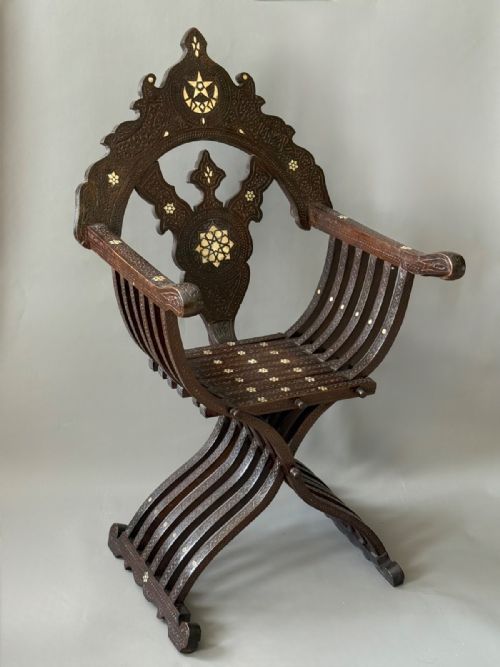
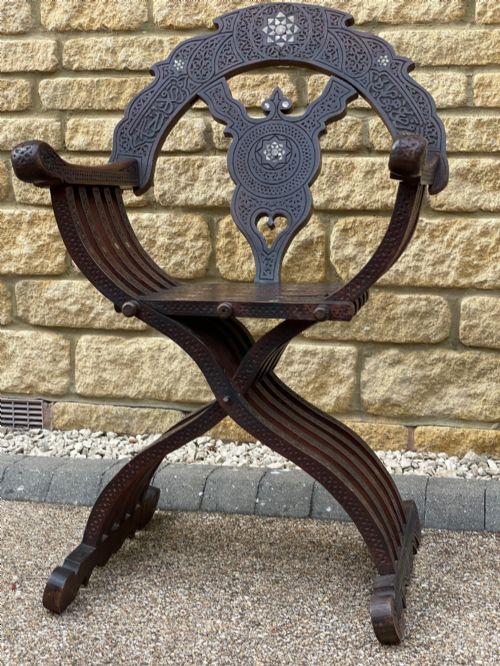
When searching for a savonarola armchair, collectors look at distinctive X-frame or curule seating structures that fold or dismantle for transport. These historic seats draw inspiration from Italian Renaissance models, reinterpreted through various regional craft traditions across the nineteenth and early twentieth centuries.
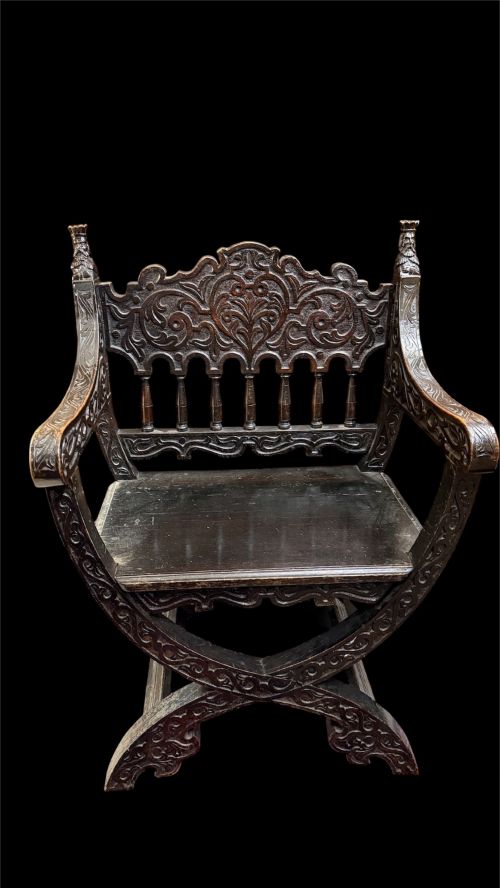
The most common examples encountered on this page date from the nineteenth century and the Edwardian era, spanning Renaissance Revival, Syrian, Anglo-Indian, and Gothic Revival styles. Woods like walnut, oak, and mahogany form the structural framework, often complemented by intricate decorative surfaces.
Makers adapted the classic scissor form into diverse domestic settings, producing armchairs, hall chairs, and accent chairs. Some pieces feature solid timber carving, whilst others rely on elaborate geometric inlays to achieve their visual impact.
How they were made
Craftsmen built these chairs using interlocking curved slats of timber, principally walnut, oak, and mahogany, creating the characteristic folding X-frame construction. This method allowed the structural members to pivot or slot together securely without losing rigidity.
Surface decoration defined the finer pieces, incorporating mother-of-pearl, bone inlay, brass wire, and nacre-shell to form complex geometric or floral patterns. Carved wooden elements added depth, while secondary materials such as velvet, leather, and woven textiles provided upholstery and comfort.
Listings feature pieces spanning the nineteenth and early twentieth centuries, executed in walnut, oak, mahogany, brass, and fabric.
What varies in quality
Quality rests in the precision of the joinery and the complexity of the surface ornamentation. A tightly fitted X-frame mechanism operates smoothly and maintains structural stability without excessive play in the pivots.
The sophistication of the materials elevates certain examples, particularly where intricate mother-of-pearl or bone inlay covers the wooden ground without gaps or losses. Master workshops also demonstrated superior depth and clarity in their timber carving, distinguishing bespoke commissions from standard production pieces.
White, Allom & Co.·James Shoolbred
The Savonarola Armchair Glossary
- X-frame
- A chair structure formed by intersecting curved slats that cross to support the seat and back, allowing the frame to fold. This ancient form dates back to classical antiquity and remains the defining feature of these chairs.
- Curule
- An ancient chair design characterised by two pairs of curved legs crossing to form an X shape. The term connects these nineteenth-century revivals directly to Roman magistrate seating.
- Nacre-shell
- The iridescent internal layer of mollusc shells, commonly known as mother-of-pearl. Craftsmen cut this material into tiny geometric tiles for intricate surface inlay.
- Renaissance Revival
- A nineteenth-century design movement that drew inspiration from sixteenth-century artistic forms and decorative motifs. Pieces in this style utilise heavy carving, dark timbers, and classical proportions.
Savonarola Armchair: Frequently Asked Questions
What is a savonarola armchair?
A savonarola armchair is a folding seat constructed from multiple curved wooden slats that cross to form an X-shaped frame. Named after the sixteenth-century Florentine friar, the design evolved from ancient curule chairs into a portable domestic seat.
Nineteenth-century cabinetmakers revived the form across Europe and the Middle East, incorporating local timbers and decorative techniques such as intarsia, carving, and mother-of-pearl inlay.
How were these folding chairs used?
Historically, X-frame chairs served as portable seating that nobility and officials could transport between residences. Because the frame collapses or dismantles easily, they functioned as convenient armchairs that could be moved around great halls.
In later domestic interiors, they served as decorative accent pieces in libraries, reception rooms, and hallways rather than everyday lounging furniture.
How do I style a savonarola armchair?
These chairs work well as statement pieces in a study, hallway, or drawing room where their architectural silhouette can stand out. Pairing them with a simple wooden desk or placing them beside a fireplace allows the intricate woodwork to become a focal point.
Because of their historic character, they integrate comfortably into both traditional period settings and eclectic modern interiors as occasional seating.
How do I tell regional styles apart?
Regional variations appear primarily in the decorative vocabulary and secondary materials used on the wooden frame. Syrian and Middle Eastern examples frequently feature dense mother-of-pearl and bone inlay set into walnut or fruitwood.
European revival pieces from the nineteenth century lean heavily on dark oak or walnut with deep relief carving, echoing Gothic or Renaissance architectural motifs.