

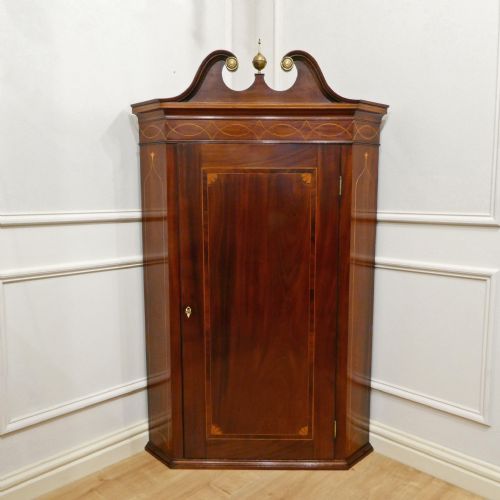


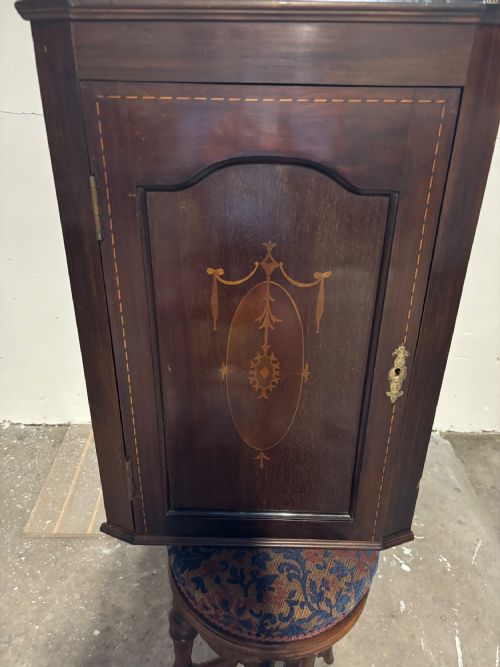


Satinwood Inlay Corner Cupboard
A satinwood inlay corner cupboard is a fitted storage piece that makes use of overlooked rooms, bringing warmth and crisp contrast to empty angles.
Satinwood Inlay Corner Cupboard
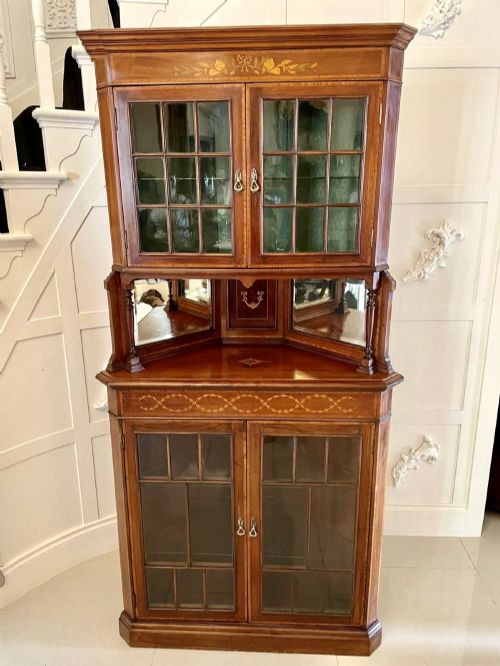
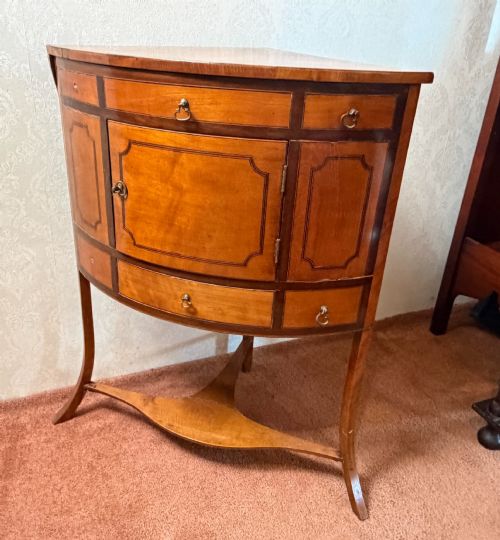
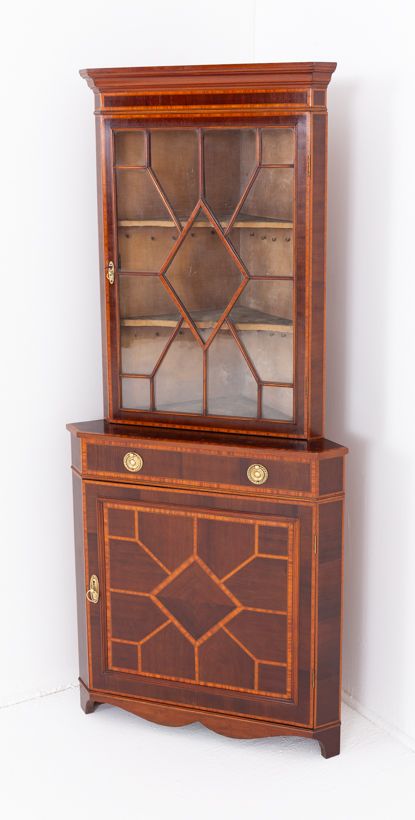
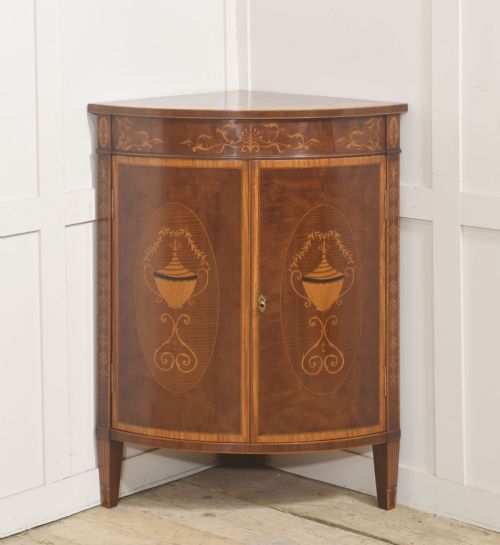
A satinwood inlay corner cupboard is designed to fit flush into a room junction, turning wasted space into a display or storage asset. The evidence on this page demonstrates that buyers encounter wall-hanging versions, single-door standing pieces, and towering double-height display cabinets.
Most examples found here date from the Georgian period through to the Edwardian era and the Sheraton Revival of around nineteen hundred. They are typically constructed with a mahogany carcase, housing glass doors for display or solid timber panels to keep contents hidden.
How they were made
Cabinet makers relied primarily on solid and veneered mahogany as the main structural timber, shaping the carcase to fit precise ninety-degree angles. To create visual contrast on the doors and cornices, workshops integrated lighter timbers such as satinwood and boxwood.
Marquetry and stringing techniques defined the decorative surface, with contrasting veneers carefully cut and set into the primary timber. Brass hardware, including hinges and escutcheons, completed the construction, whilst glazed panels were fitted into display doors.
Satinwood Inlay Corner Cupboard Retail Price Guide 2026
Typical asking prices for satinwood inlay corner cupboard among the pieces listed under this phrase on Sellingantiques today, from the lower quarter to the upper quarter. They describe what is for sale here now, not the wider market.
Listings span from the eighteenth century through the Georgian and Victorian eras to the Edwardian Sheraton Revival of nineteen hundred.
What varies in quality
The distinction between standard and superior pieces rests on the crispness of the timber selection and the precision of the inlay work. Finer cabinets display harmonious grain matching in the mahogany and meticulously fitted satinwood and boxwood banding rather than crude painted approximations.
Proportion and scale also separate simpler utility cupboards from grander architectural forms, particularly in standing double-height or glazed display cabinets. The architectural detailing, from the cornice mouldings down to the bracket feet, dictates the visual weight and balance of the piece.
The Satinwood Inlay Corner Cupboard Glossary
- Satinwood inlay
- A decorative technique using a fine, pale tropical timber set into recesses within a darker wood to create contrasting borders and motifs.
- Sheraton Revival
- A late nineteenth and early twentieth century design movement that recreated the lightness, neoclassical motifs, and refined proportions associated with eighteenth century cabinet maker Thomas Sheraton.
- Corner cabinet
- A specialist form of case furniture built with angled sides specifically to occupy the junction where two walls meet.
- Marquetry
- The art of forming decorative patterns by fitting together thin slices of various coloured veneers onto a structural surface.
- Stringing
- Very narrow strips of contrasting timber inlaid into shallow channels to outline panels, drawers, or door edges.
Satinwood Inlay Corner Cupboard: Frequently Asked Questions
How do I fit a corner cupboard?
Wall-hanging versions require secure fixing directly into wall studs or masonry to support the weight of the timber and its contents. Standing models simply require a level floor and gentle adjustment to ensure the doors close squarely against the frame.
Because these pieces are engineered for ninety-degree angles, measure the wall junction carefully before purchase. Older walls can be slightly out of true, which affects how a standing cupboard sits in the corner.
What is the difference between wall hanging and standing versions?
Wall-hanging cupboards are lighter, often featuring a single door, and are designed to be mounted at eye level or above other furniture. Standing versions rest on the floor and frequently include lower cupboards or taller double-height display sections.
Both forms utilise the same space-saving geometry, but standing models offer significantly more internal volume and architectural presence within a room.
How do I distinguish Georgian from Edwardian pieces?
Georgian examples date from the eighteenth and early nineteenth centuries, displaying the deeper patination and hand-working marks characteristic of the period. Edwardian pieces and Sheraton Revival items typically date from around nineteen hundred, often showing lighter mahogany selections and machine-standardised inlay.
Construction joints and secondary woods inside the cabinet help confirm the age. Earlier pieces rely on hand-cut dovetails and older framing techniques, while later revivals utilise more uniform manufacturing methods.
Are these cupboards suitable for modern homes?
These cabinets excel in contemporary interiors by utilising awkward room angles that standard rectangular furniture cannot occupy. They provide practical storage or display space while introducing period character and warmth.
Glass-fronted display versions work well for ceramics and glassware, while solid door cabinets conceal everyday items efficiently. Their compact footprint makes them adaptable to hallways, dining rooms, and living spaces alike.