



Satinwood Inlay Caddy
A satinwood inlay caddy is a timber tea chest finished with pale exotic veneer and contrasting stringing, prized for holding precious leaves securely.
Satinwood Inlay Caddy
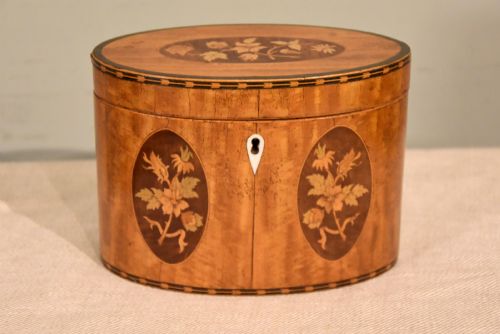
A satinwood inlay caddy is a lidded container designed for dry tea storage during the Georgian and Regency periods. These boxes appear in oval, octagonal, hexagonal, and sarcophagus forms, often dating from the late 18th century down to the Edwardian era.
The objects seen here range from dedicated tea caddies to converted stationary boxes, teapoys, and decorative wooden caskets. Most examples rely on the distinctive golden sheen of satinwood paired with contrasting stringing and wood inlay.
Buyers will find oval tea caddies featuring butterfly or shell motifs alongside larger boxes incorporating harewood, mahogany, and ebony. The selection spans George III, Regency, and later Edwardian interpretations of classic forms.
How they were made
Cabinet makers built these pieces using a foundation of solid timber, such as mahogany, before applying fine veneers of satinwood and harewood to the exterior surfaces. Contrasting woods like boxwood, ebony, and bone were then cut to create intricate geometric stringing and pictorial motifs.
Craftsmen utilised specialised hand saws to recess delicate wood inlay into the primary surfaces, securing the pieces with traditional animal glues. Many examples incorporated brass handles, escutcheons, and silver mounts to complete the construction.
Listings feature satinwood combined with boxwood, ebony, bone, and harewood across Georgian, Regency, and Edwardian periods.
What varies in quality
The standard of a satinwood inlay caddy depends heavily on the precision of the marquetry and the choice of secondary timbers. Finer pieces display crisp, tight borders where boxwood and ebony meet the pale satinwood without gaps.
Proportion and the sophistication of the decorative motifs separate simpler boxes from superior examples. Pieces featuring natural shell or butterfly designs executed in varied shaded woods command greater appreciation than basic linear banding.
The Satinwood Inlay Caddy Glossary
- Satinwood
- A hard, durable tropical timber with a lustrous, golden-yellow sheen that takes a high polish. It forms the primary visual surface on these decorative boxes.
- Inlay
- The technique of embedding contrasting pieces of wood, bone, or metal flush into a solid wood base to create patterns. This method defines the ornamentation on Georgian caddies.
- Harewood
- Sycamore wood stained grey using chemical treatments or iron solutions. Makers utilised this material to introduce cool grey tones into floral and shell marquetry.
- Sarcophagus
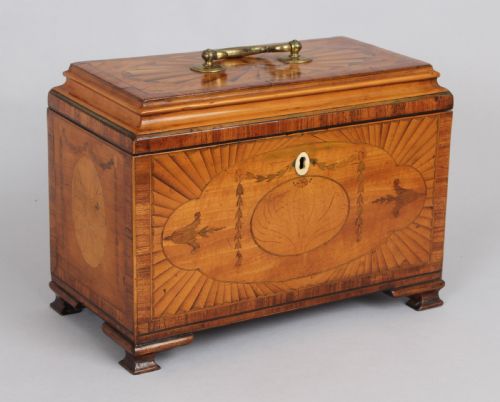
- A box form with a sloping or domed lid resting on a rectangular base, popular during the Regency period. These containers often house internal compartments for loose tea.
- Escutcheon
- A small protective plate surrounding a keyhole, commonly cast in brass. It serves both a functional purpose and an ornamental role on the front of the caddy.
Satinwood Inlay Caddy: Frequently Asked Questions
How were these tea caddies used?
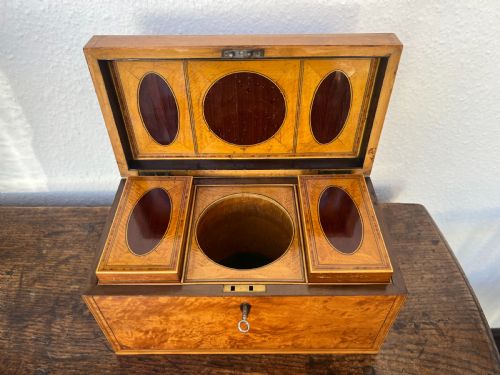
Tea was an expensive commodity in the 18th and 19th centuries, requiring secure storage away from servants and damp air. These caddies featured internal lidded compartments to separate green and black teas.
Wealthy households kept the tea caddy locked in the parlour or dining room, with the master or mistress retaining the key to dispense the leaves for each pot.
How do I date a satinwood caddy?
Dating relies on observing the overall form, construction methods, and prevailing decorative styles of the period. George III pieces often favour oval or octagonal shapes with delicate shell inlays.
Regency examples frequently introduce sarcophagus forms with bold brass feet and heavy ring handles, while Edwardian versions revive these classic shapes using lighter machine-cut veneers.
Can I still use an antique caddy for tea?
While the interior compartments were built to hold loose leaves, storing modern tea directly in antique wood is generally discouraged. Natural oils and aromas in old wood can affect the flavour.
These boxes function well today as decorative containers for trinkets, jewellery, or stationery while retaining their historic appearance on display.