

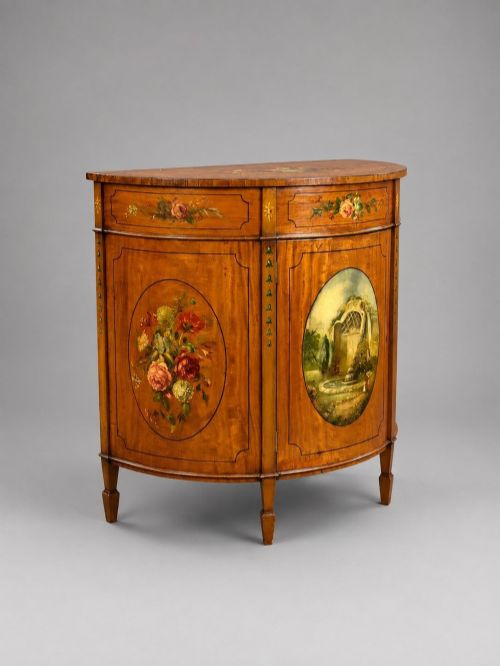


Satinwood Half Moon Cabinet
A satinwood half moon cabinet is a curved timber piece shaped to hug a wall, combining subtle timber tones with delicate neoclassical ornament.
Satinwood Half Moon Cabinet
A satinwood half moon cabinet takes the form of a demi-lune or half-round commode, side cabinet or display piece designed to fit flush against a wall in a drawing room or hallway. The pieces met here span the eighteenth century, the Victorian and Edwardian eras, and the early twentieth century.
The most frequent examples encountered on this page belong to the Sheraton Revival and Neoclassical Revival styles, alongside genuine eighteenth-century pieces. Makers such as James Hicks and painters like Kaufman appear among the records, showing both Irish and continental European output.
These items function variously as sideboards, display cabinets and commodes with painted panels or inlaid marquetry. They offer storage behind curved doors whilst presenting a flat, decorative top surface for lamps or ornaments.
How they were made
Makers built these cabinets using timber carcases faced with satinwood veneers, often incorporating mahogany, rosewood and burr elm. Details and stringing relied on boxwood to create sharp contrasts along the curved edges and drawer fronts.
Decoration involved hand painting directly onto the wood or applying intricate marquetry panels. Brass hardware finished the drawers and doors, complementing the lighter golden hues of the primary wood.
Satinwood Half Moon Cabinet Retail Price Guide 2026
Typical asking prices for satinwood half moon cabinet among the pieces listed under this phrase on Sellingantiques today, from the lower quarter to the upper quarter. They describe what is for sale here now, not the wider market.
Listings feature satinwood, mahogany, rosewood, and boxwood applied to cabinets spanning from the eighteenth century to the 1930s.
What varies in quality
Quality rests upon the precision of the curved veneer work and the crispness of the inlay or painted panels. Eighteenth-century origins command attention for their timber selection, such as burr yew and burr elm, whilst later revival pieces depend on the skill of the painter and marquetry cutter.
The integration of the curved doors within the frame dictates how well the piece survives daily use. Superior examples display seamless joins and harmonious grain matching across the half-moon shape.
James Hicks·Kaufman
The Satinwood Half Moon Cabinet Glossary
- Demi-lune
- A half-moon shape used for tables and cabinets designed to stand flat against a wall. This profile defines the footprint of the furniture listed here.
- Marquetry
- The art of forming decorative patterns by fitting together small pieces of wood veneer of different colours and grains. It decorates the surface of many revival and antique cabinets.
- Satinwood
- A hard, durable timber with a natural golden sheen that takes a fine polish. It serves as the primary surface veneer for these specific cabinets.
- Commode
- A low cabinet with drawers or doors, originating in France and adopted by English makers. Many pieces sharing this form function as side cabinets.
- Sheraton Revival
- A late nineteenth and early twentieth century design movement drawing inspiration from the late eighteenth century style of Thomas Sheraton. It accounts for a large portion of the revival pieces seen here.
Satinwood Half Moon Cabinet: Frequently Asked Questions
What rooms suit a half moon cabinet?
These cabinets suit hallways, drawing rooms and dining spaces where floor space is limited. Their curved front projects less into the room than a rectangular piece.
They provide surface space for lamps or decorative objects while offering enclosed storage beneath.
How do I date a satinwood cabinet?
Dating relies on timber characteristics, construction methods, and stylistic cues such as painted panels or marquetry. Eighteenth-century pieces show different carcass construction compared to Edwardian or Sheraton Revival examples.
Makers' marks or signatures occasionally provide a specific point of origin.
Are these cabinets purely decorative?
While highly decorative with painted surfaces and inlaid woods, they were built as functional furniture. The internal shelving and cupboards accommodated household items and documents.
They continue to serve storage and display roles in modern interiors.