
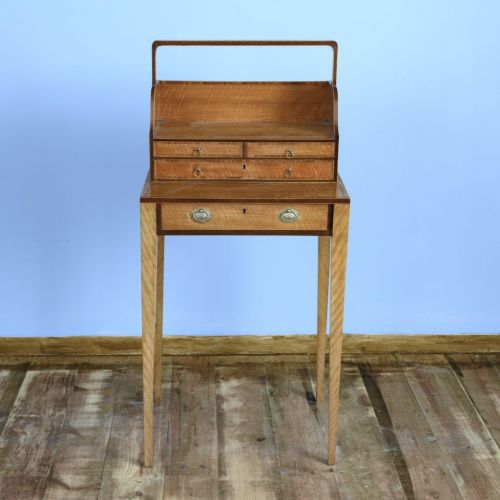


Satinwood Book Table
These satinwood book table pieces combine polished timber with practical storage, offering a compact way to keep volumes close at hand.

Satinwood Book Table
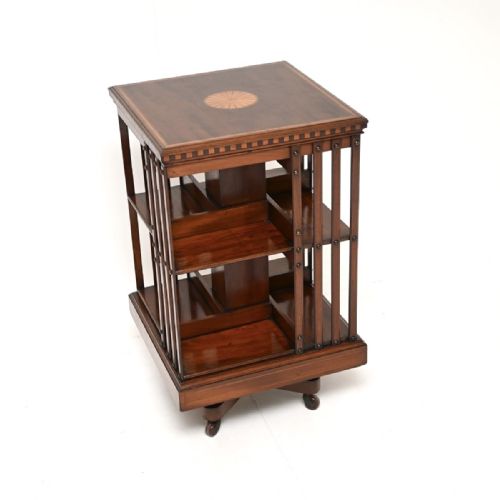
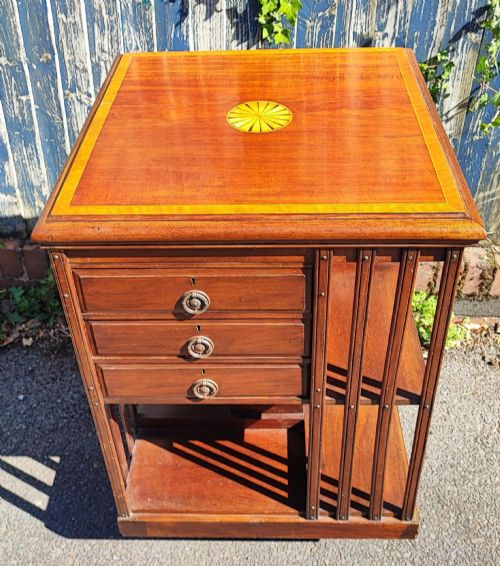
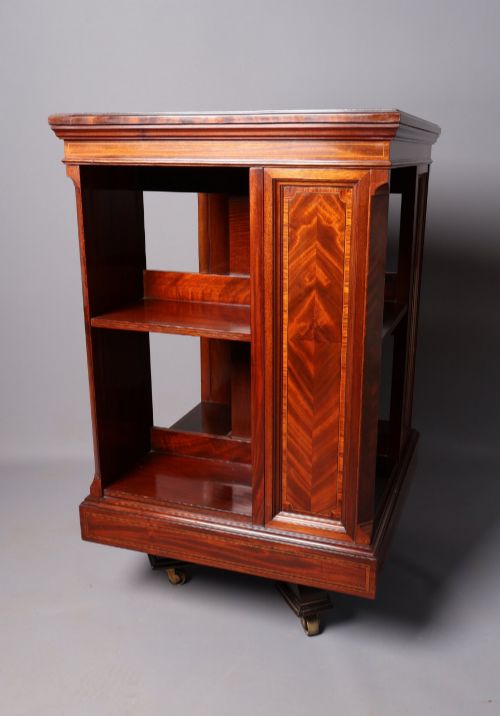
A satinwood book table serves as both a small surface and a repository for volumes, appearing most often on this page in revolving forms and reading tables. Buyers seeking a satinwood book table will encounter pieces originating from the Edwardian era, the nineteenth century, and the Georgian period.
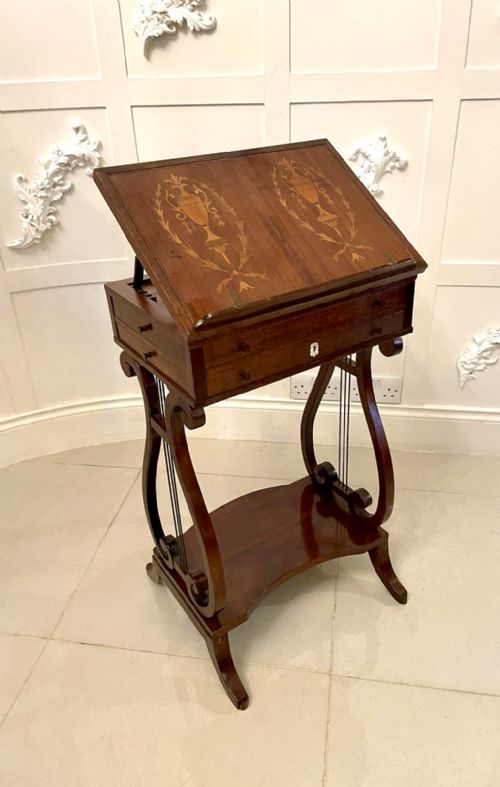
The selection ranges from revolving bookcases and reading tables to stationary table top book stands, side tables, and occasional forms. Makers constructed these items primarily in mahogany and satinwood, frequently embellishing the timber with distinct inlay work and banding.
Edwardian Sheraton Revival examples sit alongside eighteenth-century pieces such as the Georgian cheveret, demonstrating how cabinetmakers adapted the form across decades. Each variant offers a specific method for keeping books within arm's reach while introducing figured grain to a room.
Markers of quality
The standard of timber preparation separates the finest examples from standard production, visible in the depth of the satinwood grain and the precision of the veneer matching. Superior pieces display crisp, tightly executed inlay work without gaps or misalignment in the banding.
Mechanical execution distinguishes top-tier revolving book tables, where the internal pivot mechanism operates silently and evenly without listing to one side. The integration of secondary woods, solid brass hardware, and careful hand-finishing indicates a higher level of workshop attention.
Early makers ensured that even when completely loaded with heavy volumes, these tables spun with a gentle push of a single finger.
Maples of London·Thomas Shearer·Gillows
The Satinwood Book Table Glossary
- Satinwood
- A lustrous tropical hardwood known for its pale golden-yellow colour and natural chatoyancy. Cabinetmakers utilised it as a veneer to create bright, reflective surfaces.
- Cheveret
- A small freestanding table featuring a revolving or fixed bookstand mounted above a writing drawer. Eighteenth-century examples often incorporated sliding ledges and compartments.
- Sheraton Revival
- A late nineteenth and early twentieth century design movement drawing inspiration from late eighteenth-century neoclassical furniture. It prioritised light proportions, satinwood veneers, and delicate inlay.
- Revolving bookcase
- A compact shelving unit mounted on a concealed pivot and cross-base. It allows multiple directions of access to stored volumes within a small footprint.
- Banding
- A narrow strip of contrasting veneer applied around the perimeter of a tabletop or panel. This technique frames the primary timber and accentuates geometric lines.
Satinwood Book Table: Frequently Asked Questions
How do revolving book tables work?
These tables rely on a hidden central pivot and cross-base mechanism beneath the tier. This allows the stacked shelving section to turn smoothly in either direction.
Craftsmen designed the internal bearing to distribute the heavy weight of books evenly. This ensured the tiers remained balanced during rotation.
How do I care for satinwood furniture?
Satinwood surfaces require protection from direct sunlight to preserve their golden colour and prevent the veneer from fading. Regular dusting with a soft, dry cloth maintains the polished finish.
Avoid placing damp items directly onto the wood. Use wax sparingly to nourish the timber without building up a heavy residue.
How do I distinguish Edwardian Sheraton Revival pieces?
Edwardian Sheraton Revival pieces replicate the lighter proportions and decorative vocabulary of the late eighteenth century. They frequently feature mahogany frames banded with satinwood and delicate floral inlay.
Examining the secondary woods inside drawers and the ageing of the internal fixings helps confirm the Edwardian period of manufacture.