

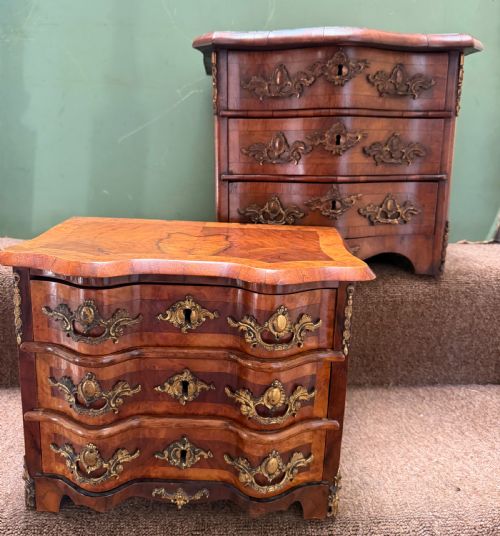
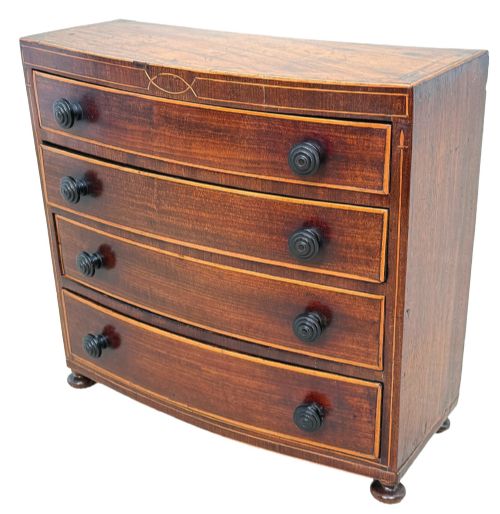


Salesman Sample Commode
These salesman sample commode pieces are small-scale furniture models built by makers to demonstrate craftsmanship or present designs to clients.
Salesman Sample Commode
When you search for a salesman sample commode, you encounter miniature furniture forms including miniature chests of drawers and miniature commodes. These pieces span the 18th century, Georgian, Regency, 1860, 19th century, and 1900 periods.
The versions you meet most frequently on this page are mahogany and walnut examples, alongside oak, burr yew, kingwood, and tulipwood pieces. Styles range from Georgian and Regency to French Louis XV Revival, George II style, Victorian folk art, Dutch rococo, and French provincial.
How they were made
Makers constructed these miniature chests using cabinet timbers such as mahogany, walnut, oak, burr yew, kingwood, and tulipwood, often applying decorative veneers. Details such as stringing utilised boxwood, while handles and mounts incorporated brass, gilt bronze, and bone.
Some examples departed from traditional timber construction entirely, employing slate to form the carcase and drawers of the model. Surface finishes relied on traditional polish to highlight the grain of the wood or the texture of the stone.
Salesman Sample Commode Retail Price Guide 2026
Typical asking prices for salesman sample commode among the pieces listed under this phrase on Sellingantiques today, from the lower quarter to the upper quarter. They describe what is for sale here now, not the wider market.
Listings feature walnut, mahogany, oak, burr yew, kingwood, and tulipwood across 18th century, Georgian, Regency, and 19th century periods.
What varies in quality
The sophistication of the timber selection dictates the visual impact of the piece, with figured grains, burr veneers, and exotic woods marking out superior examples. Plain oak or standard domestic timbers often indicate simpler domestic work or folk art production.
The refinement of the hardware and mounts distinguishes workshop standards, ranging from plain wooden pulls to finely cast ormolu and gilt bronze mounts. Precision in scaling and drawer construction separates careful model-making from simpler rustic pieces.
The Salesman Sample Commode Glossary
- Apprentice piece
- A small item of furniture created by a craftsman to demonstrate skill before gaining full guild membership. These objects share techniques with full-sized furniture.
- Bowfront
- A furniture front that curves outward in a convex shape. This profile appears frequently on Georgian miniature chests.
- Ormolu
- Gilded bronze used for decorative furniture mounts and hardware. It provides a metallic contrast against dark cabinet timbers.
- Veneer
- A thin layer of decorative wood applied to a carcase of secondary timber. Kingwood and tulipwood veneers decorate French commodes.
Salesman Sample Commode: Frequently Asked Questions
What is a salesman sample commode?
These small-scale furniture pieces represent miniature versions of full-sized chests of drawers and commodes.
Cabinetmakers built them as portable examples to show clients or as practice pieces by aspiring craftsmen.
How were these miniature chests used?
Makers used them to demonstrate technical skill to guild masters or to display furniture designs to prospective buyers without transporting heavy items.
Later owners treasured them as decorative ornaments for display on tables and desks.
What woods do makers use?
Makers utilised dense cabinet woods including mahogany, walnut, oak, and burr yew for their structural carcases.
Exotic timbers like kingwood and tulipwood appear as decorative veneers alongside boxwood stringing.
How do I date an antique miniature commode?
Dating relies on identifying the prevailing style, such as Georgian, Regency, or French Louis XV Revival, combined with timber choices.
Construction methods and secondary woods also offer clues to whether a piece originates in the eighteenth or nineteenth century.