




Sabre Leg Desk
A sabre leg desk or chair brings crisp architectural line and fluid movement to a study, rooted primarily in the Regency period.
Sabre Leg Desk
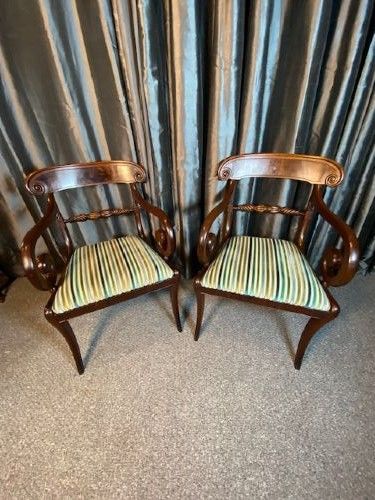
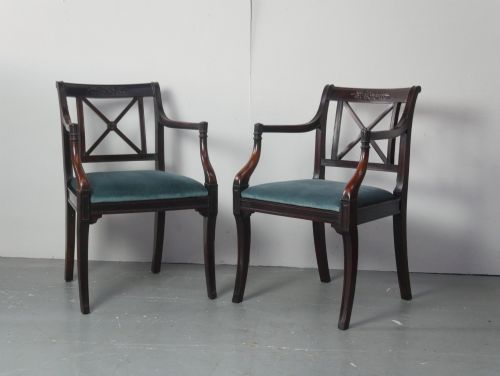
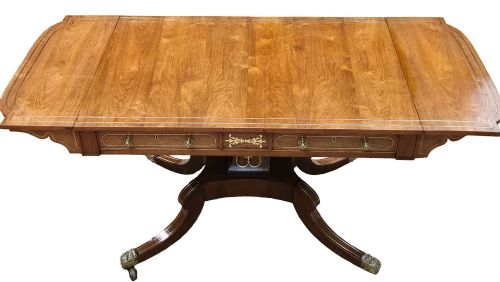
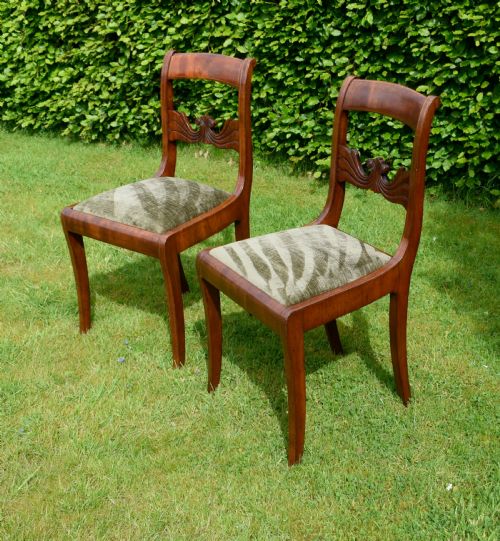
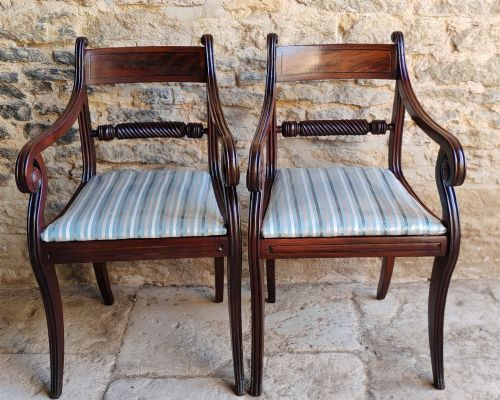
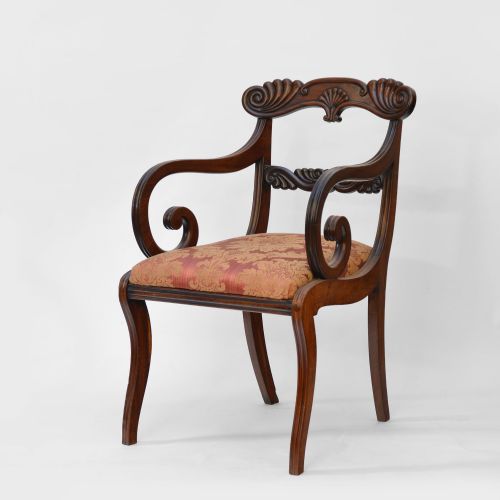
When you search for a sabre leg desk, you enter a domain dominated by the Regency and Georgian eras, where writing chairs, library tables, and sofa tables share distinctive curved supports. The most frequent encounters on this page are mahogany desk chairs and armchairs featuring the characteristic concave outward sweep of the leg, alongside rosewood and mahogany sofa tables.
Makers and cabinet-makers of the early nineteenth century designed these pieces for principal rooms and libraries, balancing weight with outward-curving momentum. Alongside original pieces from around eighteen hundred and the Regency period, you will find later revivals from the nineteenth and twentieth centuries utilising similar vocabulary.
Construction and materials
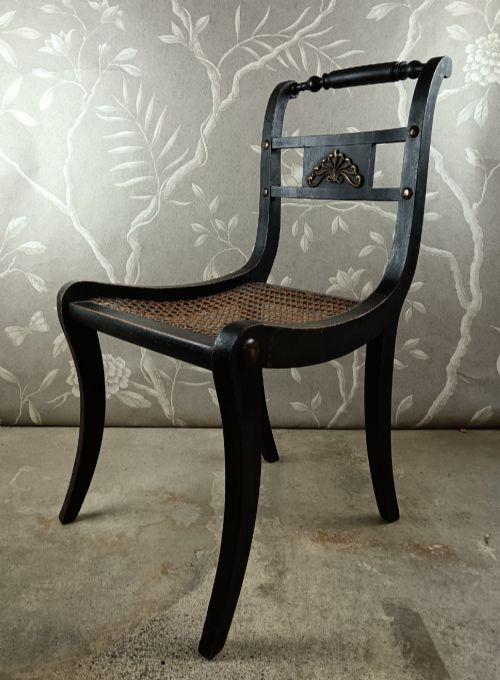
The primary timber across the selection is mahogany, frequently enriched with rosewood veneers, ebonised wood, and subtle brass or ebony inlay. Craftsmen shaped the signature sabre legs directly from solid stock or laminated timber to ensure structural integrity along the outward curve.
Seating variants incorporate cane seats, brass mounts, and traditional upholstery fabrics including green velvet, whilst library tables and sofa tables display finely turned supports and drop leaves constructed with traditional joinery.
Several armchairs retain original green velvet, ready to receive a tired modern reader.
Judging quality and proportion
Quality rests in the drawing of the curve and the crispness of the turned or carved details, separating robust vernacular pieces from masterworks of the Regency period. Timber selection and figure, particularly in rosewood and mahogany surfaces, dictate visual depth.
Proportion and scale dictate the distinction between simpler study seats and grander library armchairs or sofa tables attributed to established workshops.
Gillows·Gillingtons Dublin·Henry Maxwell
The Sabre Leg Desk Glossary
- Sabre leg
- A concave tapering leg curving outwards from the seat rail, typical of Regency furniture. This profile mimics the sweep of a cavalry sabre.
- Bergère
- An enclosed upholstered armchair with wooden framing exposed around the sides and back. It provides a comfortable seat for reading in a library or drawing room.
- Sofa table
- A rectangular occasional table with drop leaves on either side, originally designed to stand in front of a sofa. They often feature trestle ends or pillar supports.
- Ebonised
- Wood treated with a dark finish to imitate ebony. This technique gained particular popularity during the Regency period for striking contrast.
- Carver
- An armchair designed to match a set of dining chairs, usually positioned at the head of the table. They share the stylistic traits of their smaller side chair counterparts.
Sabre Leg Desk: Frequently Asked Questions
What is a sabre leg?
A sabre leg is a concave furniture leg that tapers and curves outwards from the frame, reminiscent of a cavalry sword. It provides both stability and a sense of forward motion.
Cabinet-makers of the Regency period adopted this classical Greek form extensively for chairs, desks, and small tables to lighten heavy silhouettes.
How do I date a Regency desk chair?
Dating relies upon timber choice, joinery methods, and the specific profile of the curved supports. Genuine pieces from the early nineteenth century often show dense mahogany grain and hand-cut dovetails.
Later revivals from the late nineteenth or early twentieth centuries typically display different secondary woods and mechanical saw marks beneath the seat rail.
Are sofa tables practical for daily use?
Sofa tables function well as writing surfaces, sofa-side stands, or narrow centre tables when the drop leaves remain down. Their drawers provide compact storage for modern desk accessories.
Placing them in studies or drawing rooms allows you to utilise their original nineteenth-century purpose while accommodating contemporary lamps and books.
What is the difference between a library table and a desk?
Library tables generally feature finished backs and robust proportions intended to stand free in the centre of a room rather than against a wall. They accommodate books and reading materials across a broad top.
Desks often incorporate fitted drawers, pigeonholes, or leather writing surfaces specifically configured for correspondence and paperwork.