






Saber Leg Sofa Table
Saber leg sofa tables are versatile centrepieces defined by outward-curving supports, offering practical drop-leaf surfaces and rich timbers for any interior.
Saber Leg Sofa Table
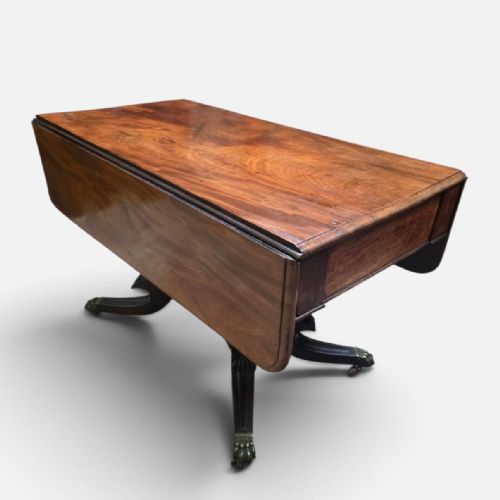
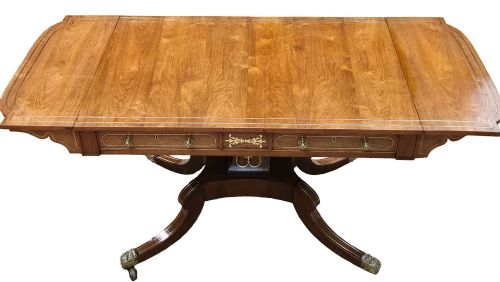
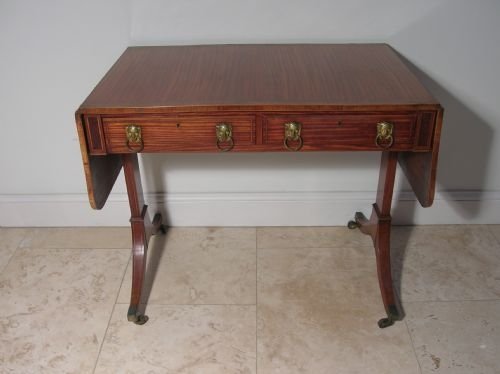
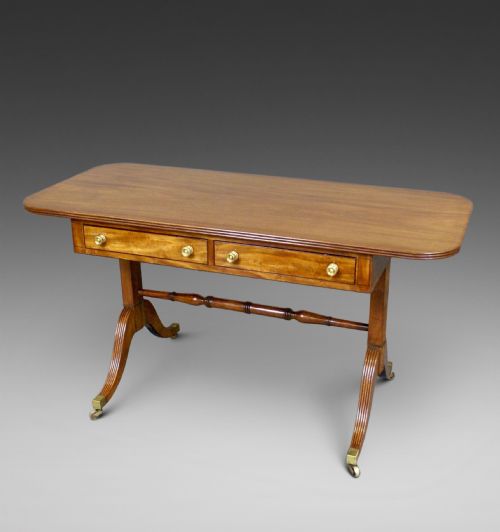
A saber leg sofa table provides a long, narrow surface flanked by drop leaves, historically positioned near a sofa or in the middle of a room. The most common examples seen here belong to the Regency period, alongside items from the 18th century, 19th century, and 1920.
Makers shaped these utilitarian yet elegant forms primarily as sofa tables, side tables, card tables, occasional tables, and console tables. Mahogany and rosewood dominate the selections, accompanied by occasional satinwood, ebony, and ebonised wood.
Regional variations include Irish Regency pieces, reflecting specific cabinet-making traditions of the era. Buyers encounter simple drop-leaf formats alongside elaborately inlaid and mounted variations designed for formal reception rooms.
How they were made
Cabinet-makers relied heavily on dense tropical hardwoods like mahogany and rosewood, often figuring the grain to create striking visual patterns across the table tops and drop leaves. Satinwood provided bright contrasting banding, while ebony and ebonised wood added sharp dark accents to linear details.
Brass formed an integral part of the construction, appearing as fine stringing, intricate inlay, or cast mounts that highlighted the curves of the frame. Joinery relied on traditional methods to support the hinged drop leaves and the distinctive outward-swept saber legs.
Saber Leg Sofa Table Retail Price Guide 2026
Typical asking prices for saber leg sofa table among the pieces listed under this phrase on Sellingantiques today, from the lower quarter to the upper quarter. They describe what is for sale here now, not the wider market.
Cabinet-makers designed saber legs to echo the curve of a cavalry officer's sword, bringing military flair straight into the drawing-room.
What varies in quality
The distinction between standard examples and superior pieces rests on the choice of timber and the precision of decorative details. Finer tables exhibit highly figured mahogany or richly grained rosewood matched symmetrically across the expanses of the leaves.
Artisans invested greater skill in the execution of brass inlay, gilt mounts, and the graceful sweep of the saber legs. The integration of functional drawers, stable drop-leaf mechanisms, and crisp carving defines the upper tier of surviving examples.
Gillingtons Dublin
The Saber Leg Sofa Table Glossary
- Saber leg
- A concave sweeping leg that curves outward towards the foot, characteristic of Regency furniture. This form provides both structural stability and a light silhouette.
- Drop leaf
- A hinged flap on either side of a table top that raises to extend the surface area. It rests on folding brackets or swing legs when in use.
- Figured mahogany
- Timber cut to reveal distinctive grain patterns such as flame, ripple, or fiddleback. Cabinet-makers reserved these visually striking boards for prominent surfaces.
- Brass inlay
- Thin strips or motifs of brass embedded flush into the timber surface. This technique creates geometric or floral patterns popular during the Regency period.
Saber Leg Sofa Table: Frequently Asked Questions
What is a saber leg sofa table used for?
Originally designed to sit directly behind a sofa, these pieces functioned as writing desks, small dining surfaces, or serving tables. The drop leaves allowed households to expand the surface area only when needed for specific tasks.
Today, they serve equally well as hallway consoles, occasional side tables, or compact desks in modern interiors. Their narrow profile ensures they occupy minimal floor space while offering substantial tabletop utility.
How do I identify a Regency period table?
Regency pieces typically display classical restraint, clean architectural lines, and specific timber choices like rosewood and figured mahogany. Details such as brass inlay, gilt mounts, and outward-sweeping saber legs point directly to this early nineteenth-century aesthetic.
Construction methods also aid identification, including hand-cut dovetails within the drawers and traditional timber shrinkage patterns. Pieces from this era reflect an interest in ancient Greek, Roman, and Egyptian design motifs.
Are all sofa tables made of mahogany?
While mahogany forms the vast majority of surviving examples, cabinet-makers utilised several other premium timbers. Rosewood appears frequently, valued for its deep dark tones and dramatic figuring.
Satinwood and ebonised wood also occur within these listings, used either for entire surfaces or as contrasting inlay. Each timber imparts a distinct colour and weight to the finished furniture.
How do I care for a rosewood or mahogany table?
Protect the polished wood surfaces by keeping tables away from direct sunlight and sudden temperature fluctuations, which can cause the timber to split. Use coasters and placemats to prevent moisture rings or heat damage to the historic polish.
Apply traditional beeswax periodically to nourish the grain and maintain a soft sheen without building up synthetic residues. Gentle dusting with a dry, soft cloth prevents surface abrasion.