



Rustic Spanish Desk
A rustic spanish desk brings raw timber and wrought iron straight from the Iberian interior into a modern study.
Rustic Spanish Desk
A rustic spanish desk sits firmly within a lineage of Iberian utility tables, console tables, and centre tables spanning from the seventeenth century to the early twentieth century. When searching for a rustic spanish desk, buyers encounter heavy timber furniture built for function rather than delicate display.
The materials and construction lean heavily on walnut, oak, and pine, often reinforced with wrought iron stretchers. Pieces range from seventeenth-century walnut examples to later interpretations styled in Spanish Baroque or Spanish Provincial traditions.
Materials and construction
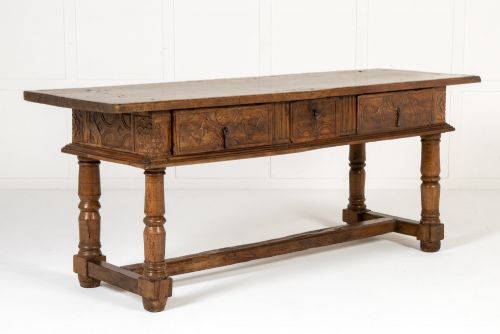
Carpenters relied on dense domestic hardwoods like walnut and oak, occasionally incorporating fruitwood or pine for secondary timbers. Planks were cut thick to withstand heavy daily use in domestic and monastic settings.
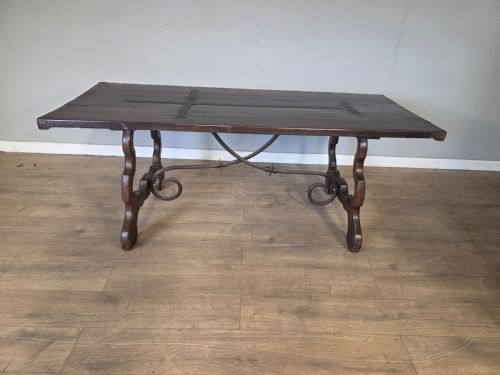
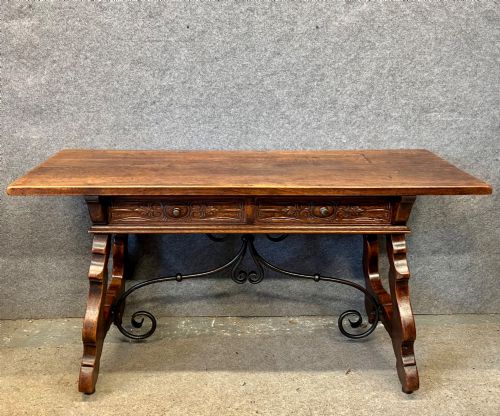
Joinery involved sturdy pegging and mortise and tenon methods, frequently supported by wrought iron braces and scrolling stretchers beneath the top. Surfaces show the marks of hand planes and simple saws rather than factory finishing.
Materials across these listings span walnut, oak, pine, fruitwood, and wrought iron.
Judging quality in Iberian furniture
Quality rests in the choice of primary timber and the integrity of the original joins. A piece fashioned from well-figured walnut with substantial board thickness commands more attention than a later pine or lighter oak rendition.
Proportion and restraint dictate the visual success of the piece. The best examples balance heavy tops with balanced ironwork, avoiding clumsy proportions found in lesser revival pieces.
The Rustic Spanish Desk Glossary
- Wrought iron
- Iron worked by hand while hot, commonly shaped into scrolling stretchers and braces on Iberian tables and desks.
- Trestle table
- A form supported by two or more upright frames connected by a central beam or stretcher.
- Fruitwood
- Dense timber gathered from orchard trees, used alongside walnut for its fine grain and pleasing warm tone.
- Refectory table
- A long, narrow dining or work table traditionally used in communal halls and monastic dining rooms.
Rustic Spanish Desk: Frequently Asked Questions
How do I spot a seventeenth-century piece?
Seventeenth-century examples display deep patination on solid walnut or oak, with hand-forged ironwork that shows hammer marks. The construction relies entirely on pegged joints without modern metal screws.
Examine the underside of the top boards for adze marks and uneven thickness, which reveal the work of early hand tools.
Are these desks comfortable for daily work?
Many historical tables adapted as desks were originally built as side tables or refectory surfaces. Check the knee clearance and height carefully before daily use.
Adding a supportive chair at the correct height ensures comfortable writing without altering the historic structure.
What is the difference between baroque and rustic styles?
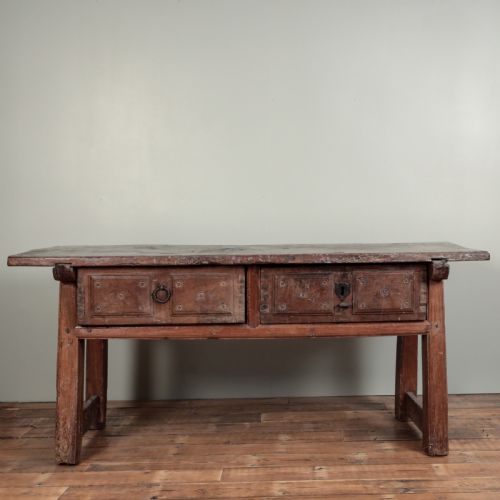
Spanish Baroque pieces incorporate more carved detail, turned legs, and formal geometric arrangement. Rustic farmhouse or provincial versions keep decoration to a minimum.
Both share heavy construction, but rustic pieces let the natural grain and simple plank form take precedence.
How should I care for antique timber?
Keep wooden surfaces away from direct heat sources and sudden humidity shifts to prevent splitting. Regular dusting with a dry cloth preserves the finish.
Applying a microcrystalline wax occasionally helps nourish dry oak and walnut without leaving a sticky residue.