


Rustic Cottage Scene Painting
When you search for a rustic cottage scene painting, you are looking for framed depictions of rural domestic life from the nineteenth and early twentieth centuries.
Rustic Cottage Scene Painting
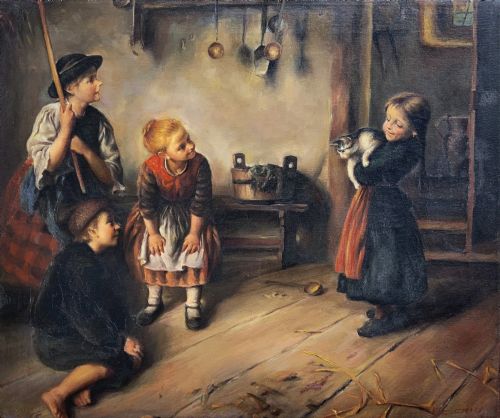
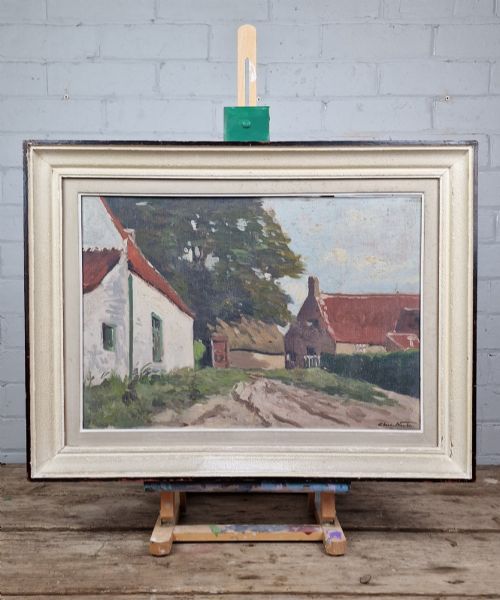
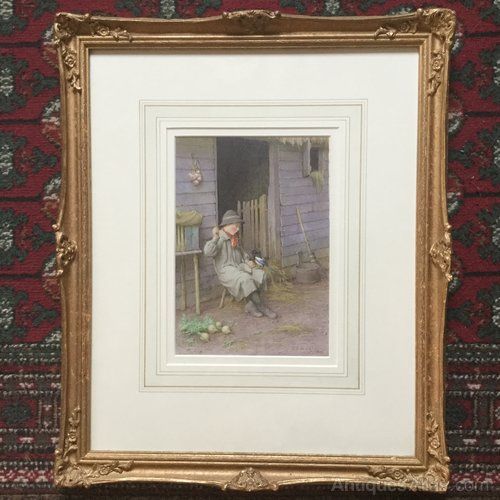
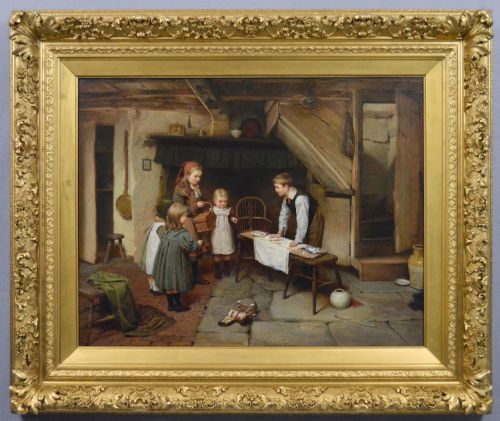
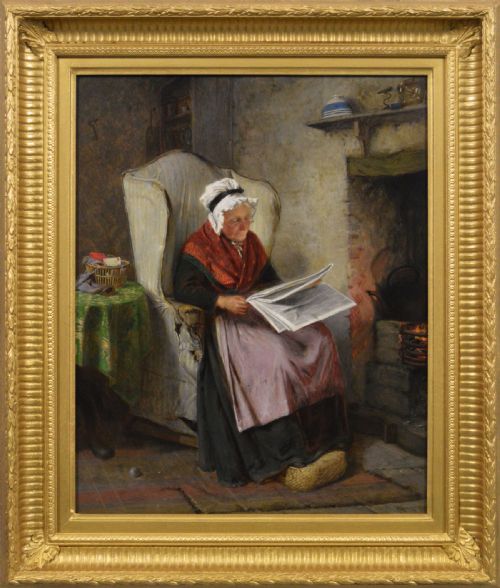
A rustic cottage scene painting captures the quiet rhythms of countryside living, focusing on rural homes, farmhouses, and village domesticity. These works frequently depict figures engaged in everyday tasks such as spinning wool, feeding hens, or resting by the hearth inside or outside a modest dwelling.
Most pieces encountered on this page originate from the nineteenth century, the Victorian era, and the Edwardian period, stretching into the early decades of the twentieth century. Painters of these decades favoured pastoral observation, often recording the architecture and inhabitants of rural England, Wales, Scotland, and continental Europe.
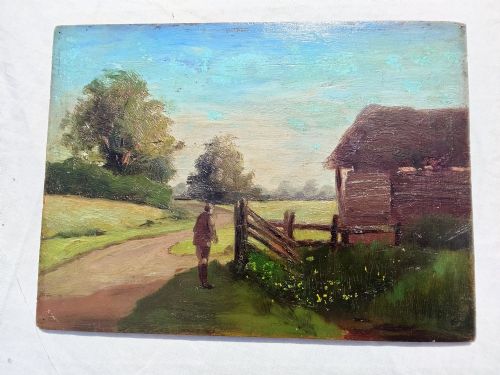
The physical formats vary between detailed oil paintings on canvas, wooden panel, or board, and delicate watercolours on paper. Framed prints and lithographs after original works also appear, alongside occasional primitive folk art interpretations of rural street scenes.
How They Were Made
Artists built their oil paintings using oil paint applied to prepared canvases, wooden panels, or boards, often layering pigments to achieve depth in domestic interiors and open landscapes. Watercolours rely on translucent washes of pigment on paper, frequently supported by preparatory pencil lines that define the figures and cottage architecture.
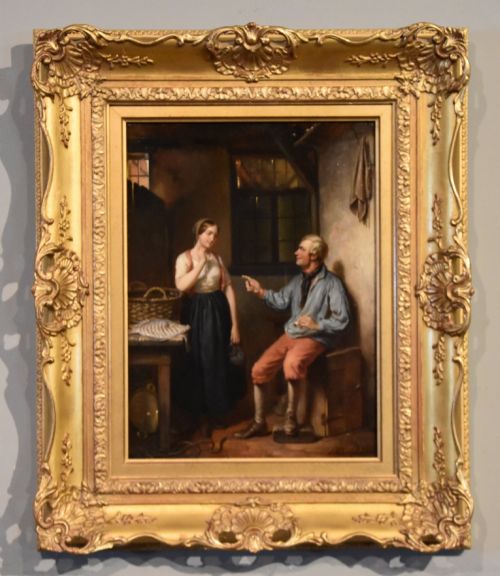
Many of these artworks are housed within their period surrounds, utilising gilt wood, gesso, and gold leaf frames that reflect the decorative tastes of the Victorian and Edwardian eras. The choice of substrate and framing method directly mirrors the workshop practices of nineteenth and early twentieth-century painters.
Several cottage scenes squeeze an improbable assembly of donkeys, pigs, guinea pigs, rabbits, and dogs into a single yard.
What Varies in Quality
The distinction between a standard piece and a finer work rests upon the artist's ability to render light, texture, and individual expression within the domestic setting. Superior examples demonstrate skilled handling of interior illumination, such as chiaroscuro effects near a hearth, and convincing anatomical drawing of human figures and farm animals.
The handling of materials also separates the output, with finely ground pigments and confident brushwork on stable wooden panels or stretched canvases outperforming rigid or formulaic student copies. Furthermore, the integrity and period suitability of the original gilt wood and gesso framing contribute to the overall standing of the artwork.
Charles Houben·Jacob Akkersdijk·Charles Edward Wilson·Harry Brooker·Haynes King·James Kyd·Charles Vickers·Thomas James Lloyd·David Woodlock·Henry Spernon Tozer·Henry Sylvester Stannard·Walter Henry Sweet·Thomas Nicholson Tyndale·T B Garvie·William Greaves·James Ward·George Morland·Alfred Provis·Henry Silkstone Hopwood·Jonathan Pratt·James Hughes Clayton·Charles Hunt Jnr·John F Pasmore·G R Vaughan·Joseph Thors
The Rustic Cottage Scene Painting Glossary
- Genre Painting
- Depictions of aspects of everyday life by depicting ordinary people engaged in common activities. These works often focus on domestic interiors or cottage thresholds.
- Chiaroscuro
- The use of strong contrasts between light and dark, usually bold contrasts affecting a whole composition. Painters used this technique to draw attention to figures gathered around a cottage hearth.
- Gesso
- A plaster mixture used as a paint substrate or as a base for moulding decorative details on frames. It is applied to wood before gilding with gold leaf.
- Lithograph
- A print made from a planographic process in which a design is drawn on stone or metal with a greasy crayon. Many Edwardian examples reproduce earlier painted compositions.
- Watercolour
- Artists' paint made with water-soluble binders and finely ground pigments. It was widely utilised by British landscape painters working outdoors or in studio settings.
Rustic Cottage Scene Painting: Frequently Asked Questions
What subjects appear in these cottage paintings?
The compositions generally portray rural domestic life, featuring farmworkers, spinning maids, and children playing outside thatched cottages or farmhouses. Animals such as donkeys, pigs, and dogs frequently accompany the human figures.
Specific regional settings, from Highland cottages to Welsh farmhouses and Fenland villages, give these artworks a distinct sense of local geography and traditional community.
How do I distinguish oil paintings from watercolours?
Oil paintings utilise thick pigments applied to canvas, wood, or panel, offering a textured surface that catches the light. Watercolours are executed on paper under glass, presenting a smooth, translucent finish.
Examining the substrate under magnification reveals the woven threads of canvas, the grain of wooden boards, or the absorbent texture of antique paper.
Where were these scenes typically painted?
Artists travelled through the British countryside and across continental Europe, sketching farmyards, village streets, and rural dwellings from direct observation. Many works reflect specific locales in Cumberland, Leeds, Devon, Somerset, and various European farming communities.
These compositions combine observed topographical details with staged genre interactions involving local peasants or farm labourers.
How should I care for an antique painted panel?
Antique panels and canvases require stable environmental conditions away from direct sunlight, high humidity, and rapid temperature fluctuations. Maintaining a consistent indoor climate prevents the wooden support from warping and the paint layers from cracking.
Glazed watercolours on paper need protection from direct ultraviolet light to prevent the fading of delicate pigments over time.