
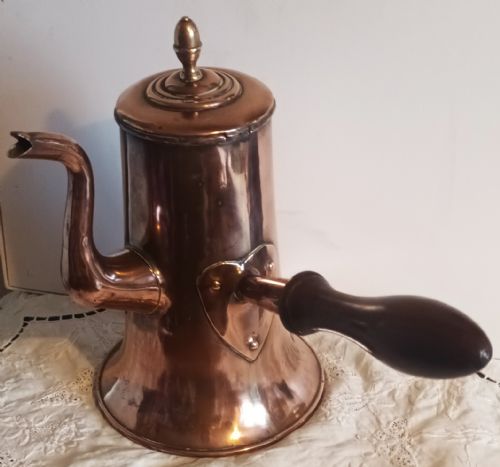
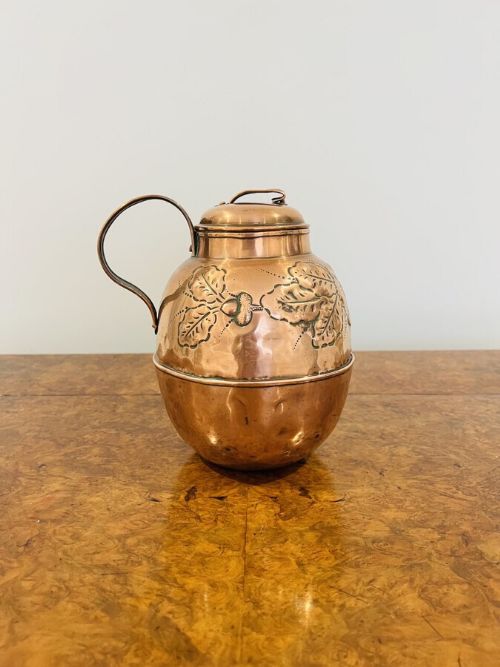


Rustic Copper Pitcher
A rustic copper pitcher brings tactile warmth to a room, offering functional utility in hand-hammered metal shaped across the Georgian, Victorian, and Arts and Crafts periods.
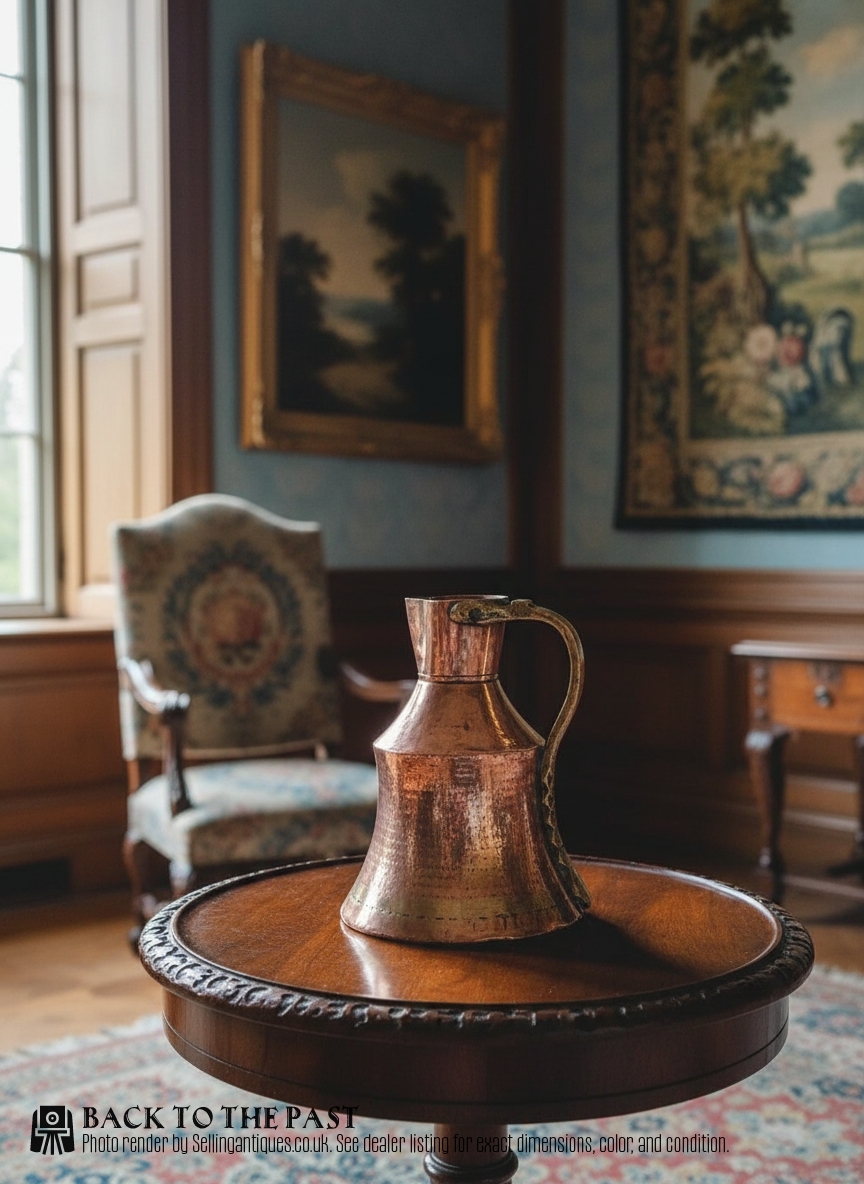
What these pieces are
A rustic copper pitcher search reveals heavy metal vessels designed for carrying liquids, commonly catalogued as jugs, pitchers, and flagons. These items span periods including the Georgian era, 1850, 1860, the broader nineteenth century, and 1910.
The domestic and utilitarian forms vary from small milk jugs holding three pints to large decorative flagons and two-gallon vessels. Makers applied these pieces to daily agrarian and household tasks before collectors repurposed them as display items.

How they were made
Artisans constructed these vessels primarily from sheet copper, sometimes combining the reddish metal with contrasting brass details as seen in later Arts and Crafts examples. Metalworkers beat and joined the sheets to form robust containers capable of holding volumes up to two gallons.
Construction techniques relied on traditional hand-shaping methods appropriate for utilitarian vessels. The resulting objects display the robust physical characteristics typical of nineteenth-century metalworking traditions.
Retail Price Guide 2026
Typical UK retail prices for rustic copper pitcher, calculated from the Sellingantiques database of over a million retail prices indexed since 2003. This retail price guide relies exclusively on Sellingantiques data; no external sources or auction records are used, so the figures do not describe the wider market.
Current listings include vessels made from copper and brass across Georgian, Victorian, and Arts and Crafts styles.
What varies in quality
Quality differences rest in the scale and decorative ambition of the vessel, moving from simple milk jugs to large, decorative flagons denoted as outstanding quality. Larger capacity vessels and those bearing specific historical attribution or mixed-metal Arts and Crafts detailing occupy the upper tier of the range.
The presence of contrasting materials, such as brass elements on a copper body, elevates certain pieces above standard utilitarian kitchenware. Proportion and capacity also dictate the hierarchy, separating modest three-pint containers from substantial two-gallon flagons.
S Hancock
The Rustic Copper Pitcher Glossary
- Flagon
- A large vessel with a handle and spout, traditionally used for holding and pouring beverages. These pieces often have substantial capacities, such as two gallons.
- Georgian
- Pertaining to the period of British history spanning the reigns of the first four Georges, noted here in early jug forms. Items from this era show traditional domestic metalworking styles.
- Victorian
- Relating to the reign of Queen Victoria, encompassing pieces dated to 1850 and 1860. Metalware from this stretch often combines utility with decorative scale.
- Arts and Crafts
- A design movement valuing handcraftsmanship and traditional materials, represented here by a mixed copper and brass milk jug from 1910. This style emphasises the honest display of construction and metal texture.
Frequently Asked Questions
What were copper pitchers used for?
These vessels served practical domestic roles involving the storage and transportation of liquids like milk and water around the household.
Larger variants functioned as flagons for holding substantial quantities of beverages in daily domestic or communal settings.
How do I date a copper pitcher?
Dating relies on stylistic clues, historical periods, and specific manufacturing markers recorded in the titles, ranging from Georgian examples to 1910 Arts and Crafts pieces.
Design shifts from plain Georgian forms to ornate Victorian items and later Arts and Crafts mixed-metal styling help establish the age of each vessel.
What materials are used in these pitchers?
The primary material across all examples is copper, shaped into robust jugs, pitchers, and flagons of varying capacities.
Some later pieces also incorporate brass elements to create contrasting decorative details on the metal body.
How do I display a copper pitcher at home?
These pieces integrate easily into interior spaces as decorative objects, highlighting their warm metallic tones and historic form.
Displaying vessels of different sizes, from small milk jugs to large flagons, adds textural variety to a room.