

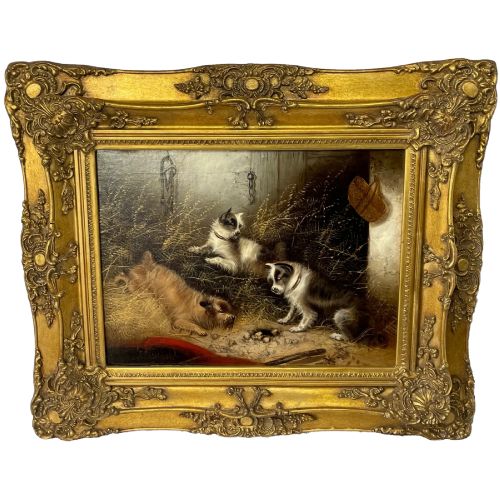


Rustic Barn Artwork
These rustic barn artwork pieces capture agricultural life in oil and watercolour, offering a glimpse into pastoral history.
Rustic Barn Artwork
Rustic barn artwork encompasses paintings and watercolours depicting farmyards, stables, and livestock from the Victorian era into the early twentieth century. These works capture rural scenes created across periods such as the nineteenth century, eighteen-fifty, nineteen-twenty, and nineteen-thirty.
The pieces on this page lean heavily into Victorian pastoral and realist traditions, alongside British and Scottish impressionism. You will find canvases showing sheltered livestock, cart sheds, and terrier dogs alongside watercolour paintings framed in burr wood.
Originating from British artistic traditions, these works document agricultural architecture and farm life with varying degrees of realism and genre painting. Painters recorded daily scenes of sheep, cattle, and horses housed within rustic timber structures.
Materials and methods
Artists painted these rural scenes using oil paint on canvas or watercolour on paper, applying pigments to capture the textures of weathered timber and animal coats. Canvas supports dominate the oil paintings, while watercolours offer finer detail on paper.
Many works retain their period framing, utilising gilt wood, gesso, and burr wood moulding. These frames enhance the visual weight of the paintings and reflect the framing conventions of nineteenth and early twentieth-century workshops.
Rustic Barn Artwork Retail Price Guide 2026
Typical asking prices for rustic barn artwork among the pieces listed under this phrase on Sellingantiques today, from the lower quarter to the upper quarter. They describe what is for sale here now, not the wider market.
Listings feature canvas and wood materials combined with oil paint, gesso, and gilt wood across Victorian, nineteen-twenty, and nineteenth-century periods.
Assessing the work
Quality in these pastoral scenes rests upon the artist's ability to render light, shadow, and anatomical precision within the livestock and architecture. Works by named painters or accomplished followers show greater confidence in brushwork and composition than anonymous studio pieces.
The integration of the frame contributes to the overall integrity of the piece, particularly where original gilt wood or burr framing survives intact. The depth of the impasto and the preservation of the canvas or paper surface also distinguish finer examples.
James Kyd·Percival Glenfern·Thomas Sidney Cooper·Robert Russell MacNee·Ernest Higgins Rigg·George Armfield·Nora Munro Summers·Frank Moss Bennett·Louis Marie Dominique Robbe·William Shayer Snr
The Rustic Barn Artwork Glossary
- Oil on Canvas
- Pigment mixed with drying oil applied to a woven fabric support. This combination allows for rich colour layering and texture.
- Genre Painting
- A pictorial representation of scenes from everyday life. These works focus on ordinary people and animals engaged in routine activities.
- Impressionism
- A style of painting emphasising light and its changing qualities rather than minute detail. British and Scottish variations interpret rural subjects with looser brushstrokes.
- Gesso
- A plaster-like mixture applied to wood frames before gilding or painting. It provides a smooth surface for decorative mouldings.
- Burr Wood
- Wood harvested from tree growths that produce swirling grain patterns. It is often utilised for decorative picture frames.
Rustic Barn Artwork: Frequently Asked Questions
What periods do these paintings date from?
The works span the nineteenth century, including Victorian productions from eighteen-fifty and eighteen-sixty-seven, alongside early twentieth-century pieces from nineteen-twenty and nineteen-thirty.
This range encompasses Victorian realism, pastoral scenes, and British and Scottish impressionist movements.
What subjects appear in these scenes?
The artworks primarily depict agricultural subjects, including farmyards, stables, barns, cart sheds, and livestock such as cattle, sheep, and horses.
Several pieces also feature working animals, including terrier dogs engaged in ratting scenes within rural settings.
What materials were used?
Painters utilised oil paint on canvas and watercolour on paper to create these pastoral compositions. Supports often include stretched canvas and paper sheets.
Frames incorporate wood, gilt wood, gesso, and burr wood surrounds.
How should I display them?
These works suit traditional interiors, studies, or living spaces that complement historical oil paintings and watercolours. Protecting them from direct sunlight preserves the canvas and pigments.
Keeping the original gilt and wood frames conditioned helps maintain the physical context of the artwork.