




Russian Orthodox Religious Art
Russian Orthodox religious art brings centuries of devotion into your home through sacred panel paintings and icons rendered in tempera, gold leaf, and silver.
Russian Orthodox Religious Art
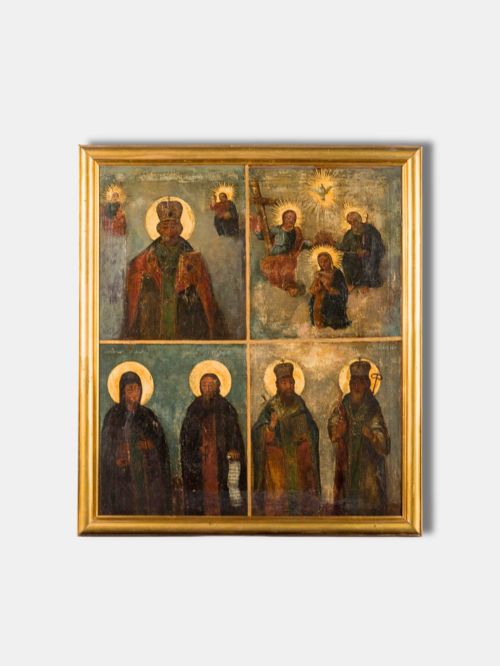
Russian Orthodox religious art encompasses devotional panel paintings and sacred artefacts produced across several centuries of spiritual tradition. When searching for Russian Orthodox religious art, buyers encounter traditional panel paintings created for prayer and veneration in domestic and liturgical settings.
The pieces available here span from the early eighteenth century through to the early twentieth century, reflecting shifting artistic approaches within Imperial Russian workshops. Most items take the form of religious icons and wall art rendered on wooden panels or canvas.
Examples range from simple painted surfaces to elaborate works featuring metal covers. Collectors will find both modest devotional pieces and significant works associated with specific regional schools.
Materials and construction
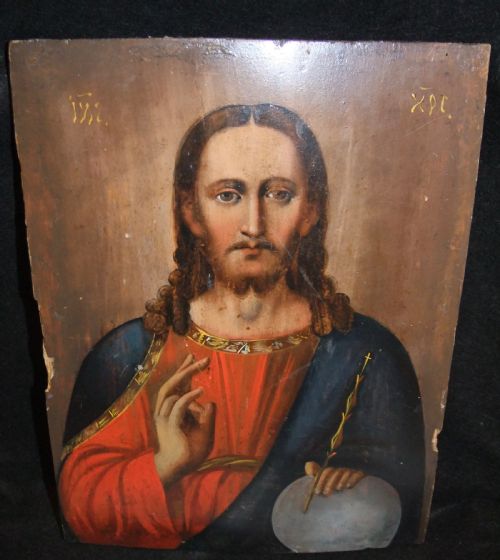
Traditional creation relies upon tempera, egg tempera, and oil applied directly to prepared wood panels or canvas surfaces. Artisans built these sacred images using organic pigments layered carefully to achieve depth and luminosity.
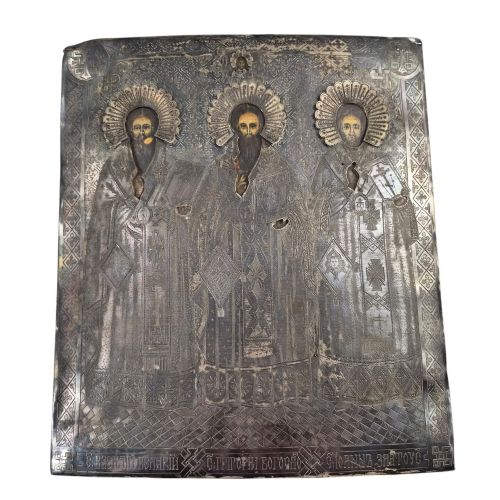
Many works incorporate precious metals through gold leaf backgrounds, silver elements, or full metal oklads and rizas. These protective and decorative metal covers were fashioned by skilled metalsmiths to frame and safeguard the painted imagery beneath.
Listings feature works spanning the eighteenth, nineteenth, and early twentieth centuries, utilising wood, canvas, tempera, gold leaf, silver, and brass.
Assessing quality and execution
The presence of precious metals and finely chased metalwork elevates a piece, particularly when executed by documented silversmiths. The preservation of the original painted surface and any accompanying metal oklad directly influences the desirability of the artwork.
Heinrich Grünbaum·Volga Masters
The Russian Orthodox Religious Art Glossary
- Icon
- A sacred panel painting depicting Christ, the Virgin Mary, saints, or biblical scenes, intended for veneration. These objects serve as focal points for prayer within the Orthodox tradition.
- Tempera
- A permanent, fast-drying painting medium consisting of coloured pigments mixed with a water-binder agent, commonly egg yolk. This technique creates a matte, durable finish seen on early panels.
- Oklad
- A protective metal cover placed over an icon, leaving visible only the painted faces and hands of the figures. Often fashioned from silver or brass, it shields the underlying paint layer.
- Riza
- A specific term often used interchangeably with oklad, denoting a metal cover or dress adorning an icon. These metal mounts frequently feature repoussé and chase decoration.
- Gold leaf
- Gold beaten into extremely thin sheets used to gild backgrounds and halos. This technique imparts a luminous quality that symbolises heavenly light.
Russian Orthodox Religious Art: Frequently Asked Questions
What is an icon?
An icon is a sacred wooden panel painting that depicts holy figures and serves as a window to the divine in Orthodox worship. These works are created according to strict canonical traditions.
They were traditionally displayed in homes and churches for personal prayer and communal liturgy.
What is an oklad?
An oklad is a metal protective covering fitted over the surface of an icon. These covers are typically made from brass or silver and feature detailed decorative work.
They were added to honour the sacred image and protect the tempera paint from candle smoke and physical wear.
How are different periods identified?
Dating relies upon stylistic shifts in the painting technique, the structure of the wooden panel, and accompanying metal hallmarks. Eighteenth-century pieces often display different compositional layouts compared to later nineteenth-century examples.
Examination of the preparation layers and pigments also assists in determining the era of creation.