
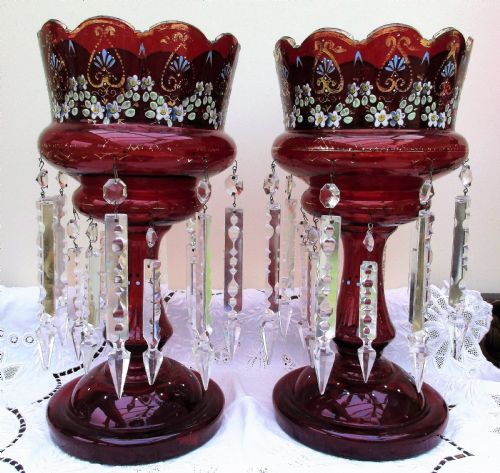


Ruby Glass Crystal Drop
Ruby glass crystal drop pieces are striking mantel ornaments and lighting fixtures combining rich coloured glass with dangling prisms that catch the light.
Ruby Glass Crystal Drop
When you search for ruby glass crystal drop items, you are looking at mantel lustres, mantle lustres, and small chandeliers that serve as decorative focal points. These items date from the nineteenth century and the early twentieth century, including Victorian and Edwardian examples.
The most common forms on this page are pairs of mantel lustres featuring deep red glass bodies and hanging crystal drops. You will also find chandeliers hung with coloured crystal teardrops and cut glass fixtures.
Originating from English and French workshops, these pieces often utilise flash glass techniques where a thin layer of ruby red glass is fused over clear glass before being cut away to reveal patterns.
How they were made
Makers utilised ruby glass and cut crystal, shaping the glass by hand and applying gold leaf and enamel details for surface decoration. Cut glass and cut crystal components were then faceted to maximise light refraction.
Hanging crystal drops were attached to the main body using wire or metal pins passed through drilled apertures in the glass. Gilt accents were frequently fired onto the glass surface to add contrast to the deep red body.
Some chandeliers on this page come equipped with explicit red drips, proving that nineteenth-century glassmakers enjoyed a touch of drama.
What varies in quality
Quality depends upon the depth of the ruby colour and the precision of the glass cutting. Pieces with crisp facets on the crystal drops and clean gilding sit at the top of the range.
The presence of enamel decoration and the matching nature of the crystal prisms also influence the standing of a piece. Larger examples with intact original drops command greater attention than smaller or altered variations.
The Ruby Glass Crystal Drop Glossary
- Mantel lustre
- A decorative ornamental vase fitted with a ring of hanging crystal prisms. These objects were designed to sit on a fireplace mantelpiece.
- Flash glass
- A dual-layered glass made by coating a core of clear glass with a thin skin of coloured glass. This technique allowed artisans to cut through the red layer to reveal clear glass underneath.
- Gilt
- A thin layer of gold applied to the surface of the glass or metal fittings. It provides metallic detailing that complements the ruby colour.
- Crystal drop
- A faceted glass pendant suspended from the body of a lustre or chandelier. These drops disperse light into various directions.
Ruby Glass Crystal Drop: Frequently Asked Questions
What are ruby glass crystal drops used for?
These items function primarily as decorative mantel ornaments or small ceiling light fixtures. Their coloured glass and hanging crystals were designed to catch and reflect candlelight or daylight in Victorian rooms.
Today, they remain display pieces that bring strong colour and traditional nineteenth-century ornamentation to a room. They are typically placed on mantelpieces, sideboards, or hung from ceilings.
How do I tell Victorian lustres apart?
Victorian examples span from the mid-nineteenth century onwards, often showing specific traits like hand-cut facets and applied enamel or gilt decoration. Earlier pieces tend to feature heavier glass bodies and deeper ruby hues.
Checking the attachment methods of the crystal drops and the style of the glass cutting helps distinguish nineteenth-century production from later Edwardian or twentieth-century interpretations.
Are these pieces usually found as pairs?
Many mantel lustres survive as matched pairs because they were originally manufactured to flank clocks or candelabras on mantelpieces. Single pieces do appear, particularly in the case of smaller chandeliers.
Pairs generally command more interest from collectors who wish to maintain symmetrical arrangements on display surfaces.
How do I clean a crystal drop lustre?
Cleaning requires removing the hanging crystal drops individually to wash them in lukewarm soapy water. The main ruby glass body should be wiped gently with a soft cloth to protect any surface gilding or enamel.
Harsh chemical cleaners must be avoided as they can damage the gold leaf and enamel work applied to the glass surface during the nineteenth century.