
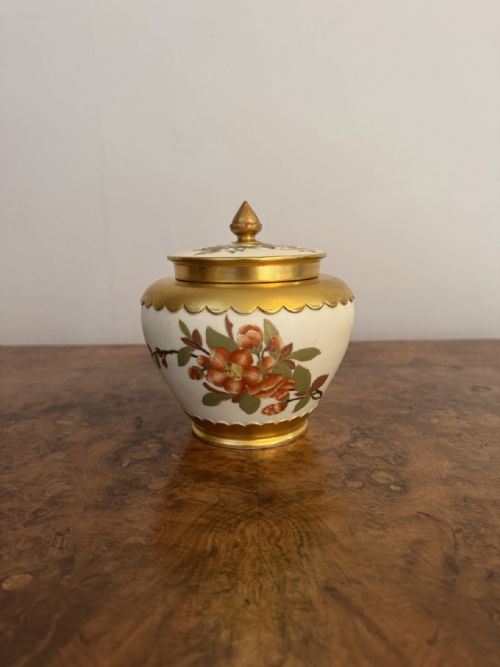
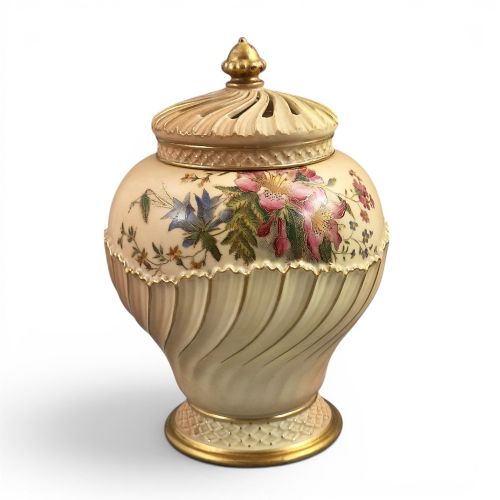


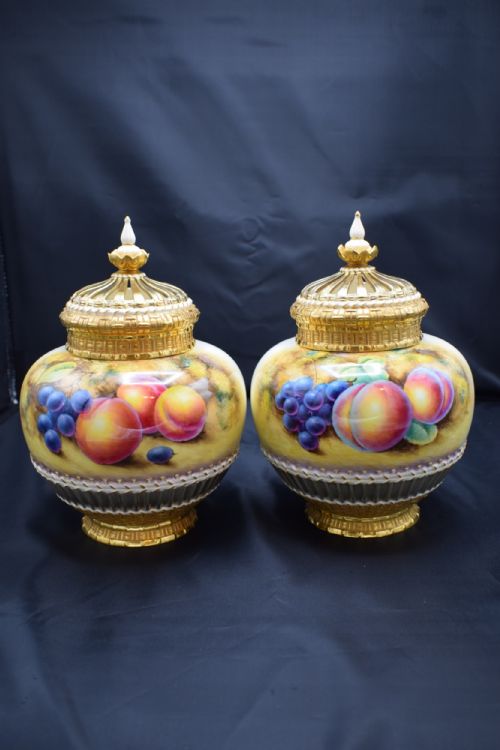


Royal Worcester Urn Jar
When you handle a royal worcester urn jar, you hold fine English porcelain shaped into covered vessels that carry delicate hand-painted motifs and gilded detail.
Royal Worcester Urn Jar
A royal worcester urn jar typically takes the form of a lidded pot pourri pot, a ginger jar, or an ovoid pedestal vase with a pierced crown cover. The selection spans the late Victorian period through the mid-twentieth century, capturing shifts in domestic ornament. You will encounter early blush ivory grounds alongside deeply coloured hand-painted fruit and animal studies.
Vessels range from modest cabinet pieces to large decorative urns designed as focal points for a room. Lidded forms frequently feature internal liners meant to hold scented dried petals. The inventory brings together traditional English porcelain shapes that reflect the steady hand of factory artists over decades of production.
How they were made
Potters shaped fine bone china and standard porcelain into balanced bodies before applying smooth white glazes or soft blush ivory grounds. Artisans then painted naturalistic scenes by hand, often depicting fruit, birds, or delicate foliage. Kiln firing fixed the pigments securely into the surface beneath clear glazes.
Finishing touches involved the careful application of gold leaf and gilding to handles, rims, and pierced crown covers. Skilled decorators signed their work directly onto the ceramic body, recording individual artistry on mass-produced forms. This combination of slip-casting, delicate brushwork, and metallic leaf defined the factory output.
Some nineteenth-century jars still retain faint traces of dried rose petals hidden inside their pierced crown covers.
What varies in quality
The standard of painting determines the upper tier of these pieces, particularly when signed by known hands such as Stinton, Freeman, or Ayrton. Complex fruit compositions and detailed wildlife studies require advanced brush control that separates master works from standard production. The density and precision of the gilding further distinguish finer examples.
Vessel scale and the complexity of the mould also influence the calibre of the piece. Large ovoid jars with intricate crown covers and multiple components demand greater technical skill during firing. Pieces retaining crisp, unblemished blush ivory surfaces and bright gold leaf represent the peak of the maker's output.
Royal Worcester·Hadley Ware
The Royal Worcester Urn Jar Glossary
- Blush ivory
- A soft, matte cream-coloured ceramic ground used extensively by the factory for late Victorian and Edwardian wares. It provides a muted backdrop for floral transfers and hand-painted details.
- Crown cover
- A pierced or domed lid designed specifically for pot pourri jars to allow fragrance to escape. These covers often feature intricate cutouts and gilded finials.
- Gilding
- The application of gold leaf or gold paint to ceramic edges, handles, and raised motifs. It adds a metallic sheen that contrasts with the painted porcelain body.
- Ginger jar
- A ceramic vessel with a wide shoulders and a short neck, originally made for spices but adapted by the factory as a decorative lidded jar.
- Pot pourri
- A mixture of dried petals and spices kept in pierced vessels to scent a room. The jars made for this purpose include internal containers to hold the mixture safely away from the outer walls.
Royal Worcester Urn Jar: Frequently Asked Questions
What is a royal worcester urn jar?
A royal worcester urn jar is a ceramic vessel produced by the English factory, typically featuring a lid, hand-painted decoration, and gilt accents.
These pieces were made as decorative items or functional pot pourri containers, often designed with pierced covers to release scents.
How do I identify blush ivory pieces?
Blush ivory pieces display a characteristic matte, creamy-peach ceramic ground developed during the late Victorian era.
This soft background usually combines with delicate floral painting and subtle gilding rather than bright, glossy colours.
What are crown covers used for?
Crown covers feature pierced openings that allow the aroma of pot pourri to diffuse gently into a room.
They sit atop ovoid jars and vases, adding architectural height and intricate detail to the silhouette of the vessel.
How do I care for antique porcelain?
Keep painted porcelain and gilded surfaces away from direct, harsh sunlight to prevent fading of the delicate enamel colours.
Dust the pieces gently with a soft, dry cloth and avoid using liquid cleaners on the hand-painted or gold leaf areas.