
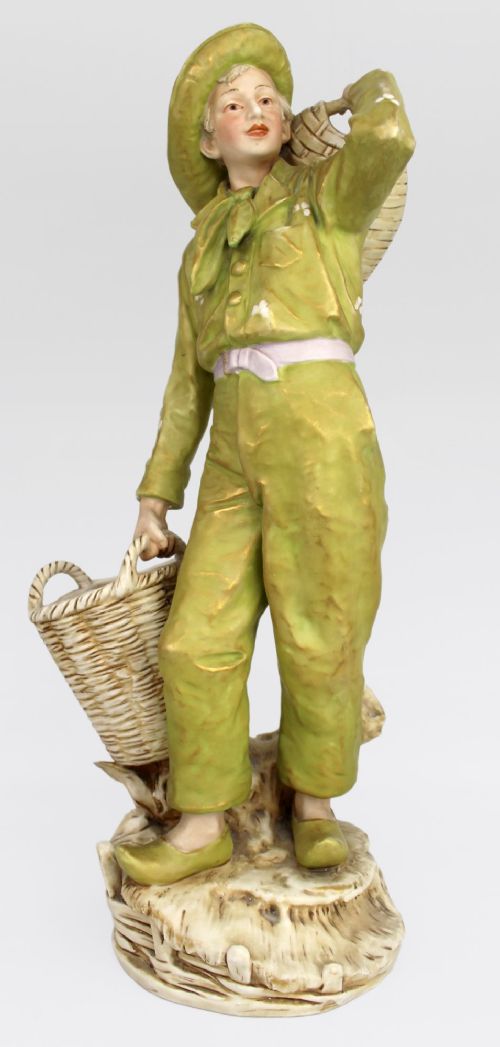


Royal Dux Porcelain Statue
A royal dux porcelain statue brings figurative modelling from the nineteenth and early twentieth centuries into a room.
Royal Dux Porcelain Statue
A royal dux porcelain statue encompasses figural groups, animals, and human subjects produced in Bohemia across the nineteenth and early twentieth centuries. These pieces range from monumental maidens and water carriers to domestic animals, shepherds, and subjects defined by Art Nouveau and Art Deco movements.
Buyers frequently encounter Edwardian and nineteenth-century examples on this page, often styled as individual figurines or paired compositions such as fisherfolk, companions with animals, or classical nymphs. Forms extend from modest table ornaments to large sculptural groups with detailed modelling.
Materials and construction
These figures utilise porcelain, ceramic, and biscuit porcelain as a base, shaped into complex figural forms before firing. Glaze, paint, and enamel are then applied to render flesh tones, garments, and natural settings, frequently accented with gilt or gold leaf.
Makers employed precise moulding techniques to achieve expressive postures in subjects like the female bather, water nymph, or hunting dog. Surface finishes combine smooth glazed areas with matte biscuit portions to create textural contrast across the clothing and skin of the figures.
Listings span periods from the nineteenth century through the nineteen-thirties, encompassing Art Nouveau, Art Deco, and Victorian Orientalist styles.
Judging execution and finish
Quality rests upon the crispness of the modelling in complex areas such as facial expressions, drapery folds, and animal anatomy. Superior examples exhibit precise hand-finishing in the enamel and paint layers, preserving fine details without obscuring the underlying porcelain contours.
Proportion and scale also separate standard production pieces from monumental or prototype figures. Well-executed works demonstrate balanced composition within the figural groupings, whether handling a single water carrier or a paired set of figures carrying puppies and kittens.
H. Schubert·Alois Hampel·Eichwald
The Royal Dux Porcelain Statue Glossary
- Biscuit porcelain
- Unglazed porcelain fired once to create a matte, porous finish resembling marble. It allows fine details in figurative sculpture to remain sharp and unmasked by glossy coatings.
- Art Nouveau
- A decorative style characterised by fluid, organic lines and floral motifs prevalent around nineteen-ten. Figures from this period often feature graceful maidens with flowing hair and natural drapery.
- Art Deco
- A later design movement favouring geometric simplification and stylised human forms prominent by nineteen-thirty. Flapper girls and streamlined nudes represent this aesthetic within the porcelain medium.
- Turn-Teplitz
- The Bohemian region and manufacturing centre associated with the pottery works. Pieces bearing this designation share geographical and stylistic roots with the factory output.
- Figurine
- A small carved or moulded statuette representing a human or animal form. These objects serve decorative functions on mantelpieces, tables, and centrepieces.
Royal Dux Porcelain Statue: Frequently Asked Questions
What subjects do these figures show?
The pieces depict human figures including maidens, water carriers, shepherds, and flapper girls, alongside animals such as setters, hunting dogs, and birds.
Compositions range from single standing models to paired figures and complex multi-figure groups engaged in pastoral or daily activities.
How do I date a piece?
Dating relies on stylistic markers such as Art Nouveau curves from the Edwardian era or geometric lines from the nineteen-thirty Art Deco period. Model numbers and factory stamps also help place the creation within the nineteenth or early twentieth century.
Earlier nineteenth-century works often display distinct Orientalist or classical influences compared to later modernist forms.
Where were they made?
Production took place in Bohemia, a region renowned for ceramic and porcelain manufacturing during the nineteenth and early twentieth centuries. Works from this area often connect with the broader Turn-Teplitz artistic tradition.
Factories in these towns employed skilled modellers and painters to produce both standard catalogue items and larger exhibition pieces.
How should I display them?
These sculptures suit placement on sturdy flat surfaces where their height and detailed modelling can be viewed from multiple angles. Pairs of figures look balanced when placed together on mantelpieces or console tables.
Keeping them away from high-traffic edges protects delicate extremities like fingers, baskets, and animal limbs from accidental knocks.