



Rosewood Parquetry Chest
These rosewood parquetry chest pieces are fine examples of inlaid cabinetry and boxes that bring rich geometric patterning and deep timber tones to a room.
Rosewood Parquetry Chest
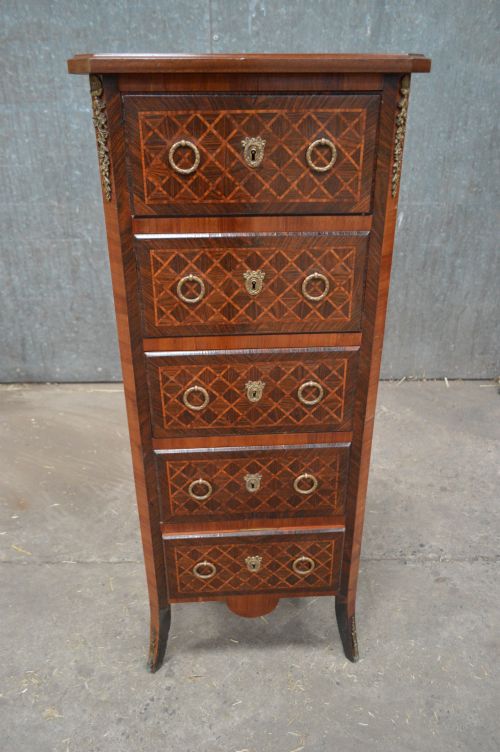
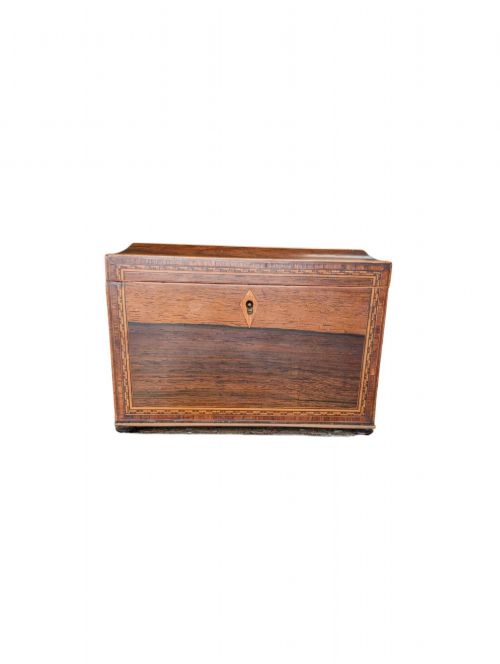
A rosewood parquetry chest encompasses both substantial commodes and compact tea caddies, each displaying precision woodwork. When searching for a rosewood parquetry chest, buyers frequently encounter pieces from the Regency and Victorian eras alongside continental French designs.
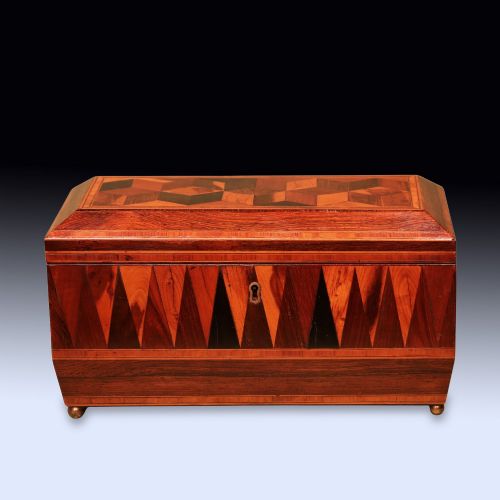
The selection ranges from sarcophagus form tea caddies featuring intricate mosaic work to serpentine commodes topped with marble. English makers often focused on Tunbridge Ware inlay, while French workshops produced elaborate commodes with transitional styling.
Smaller boxes serve to store tea, whereas larger drawer chests function as statement furniture in a study or drawing room. Each variation demonstrates the enduring appeal of contrasting timber veneers arranged in geometric patterns.
How They Were Made
Craftsmen built these pieces by applying thin veneers of rosewood, kingwood, walnut, and satinwood over a stable secondary timber carcass. Parquetry and mosaic techniques required cutting small blocks of contrasting woods such as boxwood to form precise geometric motifs.
Many commodes incorporate shaped marble tops, while finer tea caddies utilise delicate brass fittings and stringing. Ormolu mounts and fine brass details frequently accent the French pieces, complementing the natural grain of the rosewood.
Listings feature pieces spanning the eighteenth to the twentieth centuries, utilising rosewood, satinwood, kingwood, marble, and brass.
What Varies in Quality
The distinction between ordinary and exceptional pieces lies in the precision of the veneer work and the complexity of the geometric layout. Tunbridge Ware examples achieve higher regard when the mosaic perspective and botanical panels display meticulous alignment without gaps.
Structural integrity and the retention of original surface patination dictate the desirability of larger commodes and smaller caddies alike. Original marble tops and authentic brass hardware elevate the standing of a piece considerably.
Henry Hollamby
The Rosewood Parquetry Chest Glossary
- Parquetry
- Geometric mosaic woodwork formed by fitting small veneer tiles together on a surface. It creates structured patterns that contrast different timber species.
- Tunbridge Ware
- English wood mosaic work characterised by tiny tesserae forming pictorial or geometric designs. It is particularly associated with nineteenth-century makers in Kent.
- Sarcophagus form
- A box shape featuring a sloping lid and pedestal base reminiscent of ancient stone coffins. This silhouette was especially popular for Regency tea caddies.
- Serpentine commode
- A chest of drawers featuring a horizontally curving front profile. This sophisticated shape demands high skill in veneer application.
- Transitional design
- A stylistic bridge between the curving lines of Louis the Fifteenth pieces and the rectilinear forms of Louis the Sixteenth furniture. It balances ornate curves with restrained geometry.
Rosewood Parquetry Chest: Frequently Asked Questions
How do I clean a rosewood parquetry chest?
Dust the surface regularly with a soft, dry cloth to prevent grit accumulation in the intricate veneer joints. Avoid modern chemical sprays and moisture, which can damage old polish and lift delicate parquetry tiles.
Feed the timber periodically with appropriate wax polish to maintain the lustre of the rosewood. Apply sparingly and buff gently with a clean cloth to preserve the historical patina.
Where should I place a tea caddy?
Position these small boxes on a sideboard, side table, or desk where their detailed mosaic work can be appreciated up close. Keep them away from direct sunlight and heat sources to prevent the rosewood and inlay from fading or splitting.
Ensure the room maintains stable humidity levels because extreme environmental changes cause timber and veneer to expand and contract. This simple precaution protects the structural integrity of the box.
Are commodes sturdy enough for daily use?
Larger drawer chests function well for storing textiles and lighter items when handled with reasonable care. Avoid overloading drawers, as historical timber runners require gentle treatment compared to modern mechanical drawer slides.
Marble-topped commodes offer a durable surface for display, though heavy objects should be placed carefully onto the stone. Regular domestic use is entirely appropriate provided the piece rests on a level floor.
How can I tell Regency pieces apart from Victorian examples?
Regency pieces often exhibit cleaner classical proportions and restrained brass inlay influenced by archaeological discoveries of the period. The woodwork relies on bold grain contrast and architectural silhouettes.
Victorian examples, particularly those featuring Tunbridge Ware, lean towards complex pictorial mosaics and dense floral motifs. The ornamentation becomes more intricate, reflecting industrial advancements in precision cutting tools.