




Rosewood Music Canterbury Drawer
A rosewood music canterbury drawer combines refined cabinet-making with practical storage for sheets and folios.
Rosewood Music Canterbury Drawer
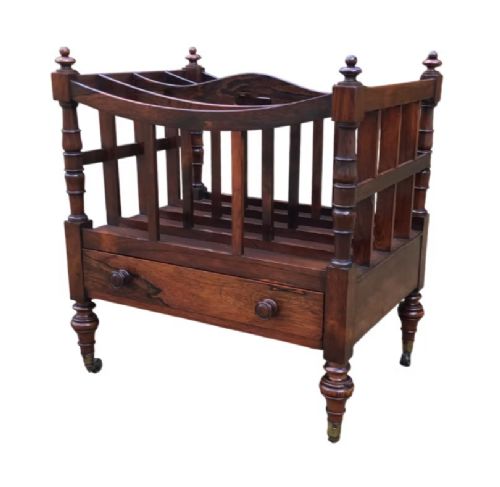
A rosewood music canterbury drawer is a dedicated stand designed to hold scores, magazines, and newspapers within divided vertical compartments, supplemented by a lower drawer for smaller items. When searching this phrase, a buyer encounters pieces originating from the Regency, George IV, William IV, and Victorian periods.
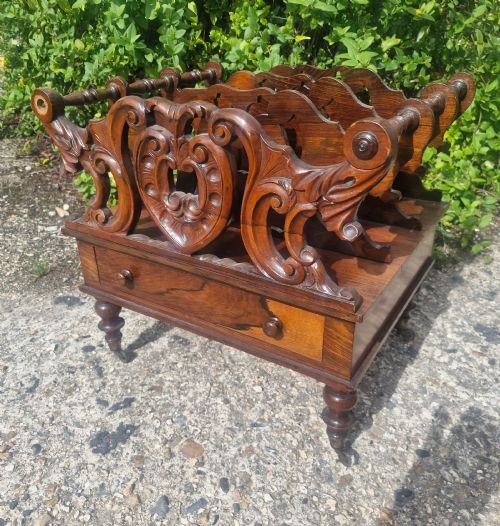
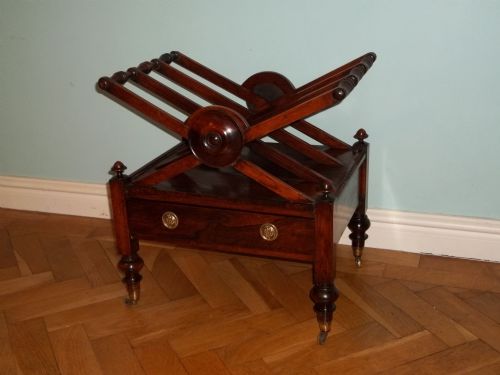
The forms on this page span boat-shaped outlines, multi-division racks, and designs featuring carrying handles or carved details. Most examples date from the nineteenth century, reflecting the domestic demand for organised musical and reading materials in period drawing rooms.
Makers and designers of the era drew inspiration from publications such as those by Loudon, adapting the classic rack to include the characteristic sliding or pull-out drawer. These items function equally well today as freestanding magazine holders or dedicated repositories for sheet music.
Assessing Quality and Execution
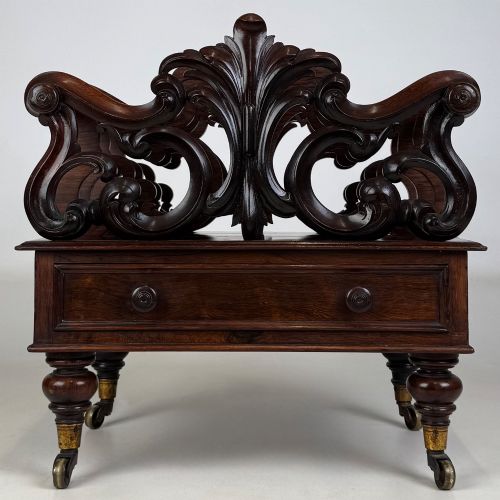
Quality separates through the crispness of carved details, such as foliate work or feathered motifs, and the selection of figured rosewood veneers. Finer examples display balanced proportions, robust division uprights, and smoothly operating drawers fitted into the lower section.
The joinery of the vertical slats and the integrity of the turned handles or carrying uprights indicate the original maker's skill. Superior execution is also evident in the quality of accompanying hardware, including original brass castors and metal fittings.
Current listings feature nineteenth-century pieces spanning the Regency, George IV, William IV, and Victorian periods.
The Rosewood Music Canterbury Drawer Glossary
- Canterbury
- A low stand with upright divisions for holding sheet music, books, or newspapers, usually fitted with a drawer below. The name derives from an Archbishop of Canterbury who reportedly commissioned the first such piece.
- Rosewood
- A heavy, durable timber prized for its dark grain and rich reddish-brown colour. It takes a fine polish and was heavily utilised in high-status nineteenth-century furniture.
- Regency
- A design period spanning the early nineteenth century characterised by classical restraint and influences from ancient Greece, Rome, and Egypt. Pieces from this era often feature clean lines and elegant wood grains.
- Foliate
- Ornamentation modelled on leaves, flowers, or foliage. Carved foliate designs frequently appear on nineteenth-century upright supports and rails.
- Division
- One of the vertical partitions that separates the upper rack into distinct sections for sorting papers. These may be slat-sided, turned, or shaped into solid panels.
Rosewood Music Canterbury Drawer: Frequently Asked Questions
What is a music canterbury?
A music canterbury is a specialised nineteenth-century piece of furniture designed to hold sheet music and folios in upright compartments. They typically feature a low profile with a carrying handle and a small drawer at the base.
In period homes, they sat beside pianos or in drawing rooms to keep scores tidy and accessible. Today, they serve a similar purpose for contemporary sheet music or as elegant magazine racks.
Can I use a canterbury for magazines?
These stands are well suited for holding modern magazines, newspapers, and contemporary journals. The vertical divisions keep reading materials upright and easy to browse.
Placing a canterbury beside a sofa or armchair offers practical storage while adding period character to a room. The lower drawer accommodates smaller reading accessories, notes, or remote controls.
What styles of canterbury are available?
The listings include Regency boat-shaped designs, George IV multi-division stands, and later Victorian carved variants. Some incorporate carrying handles, while others feature specific decorative motifs like Prince of Wales feathers.
Choosing a style depends on the surrounding interior and personal preference for wood turning or carved ornamentation. Each variant maintains the core functionality of divided storage above a base drawer.