




Rosewood Dwarf Credenza
These low-profile rosewood dwarf credenza examples bring rich timber and disciplined Regency or Victorian proportion into a room.
Rosewood Dwarf Credenza
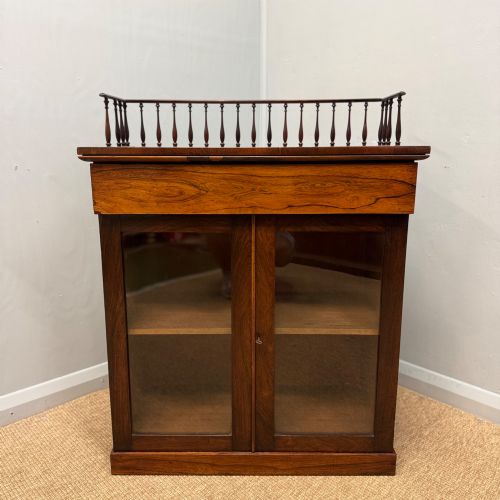
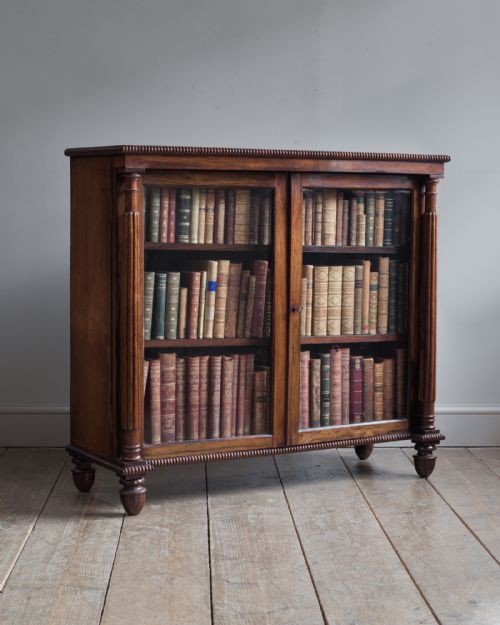
A rosewood dwarf credenza provides low-level storage and display surface, appearing predominantly across the Regency and Victorian eras alongside related side cabinets, bookcases, and chiffoniers. These pieces sit low against a wall, frequently taking the form of side cabinets or waterfall bookcases equipped with doors or open shelving.
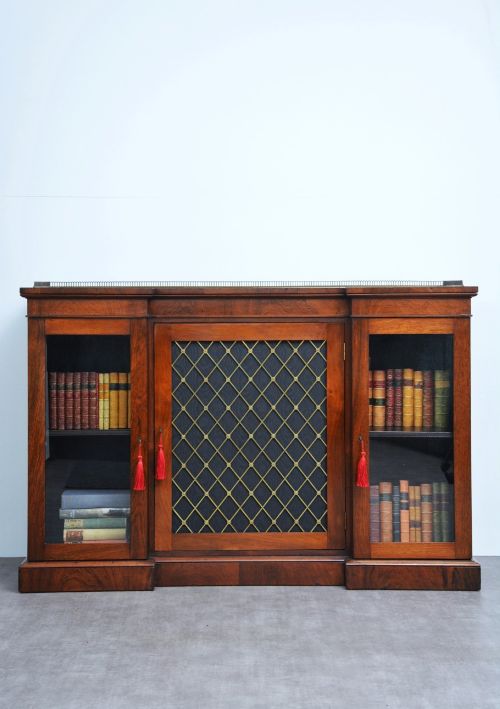
The surviving examples span the early nineteenth century around eighteen hundred through to eighteen fifty, capturing the stylistic shifts from Regency refinement to William IV robustness. Buyers encounter variations including breakfront formats and pairs of cabinets designed to balance a formal interior.
Originating as practical yet decorative furniture for drawing rooms and libraries, a rosewood dwarf credenza functions today to display objects on top while concealing books or collection items behind doors.
How They Were Made
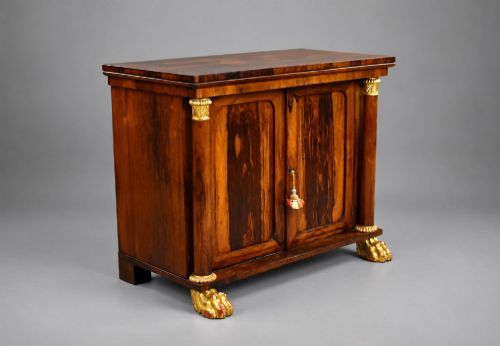
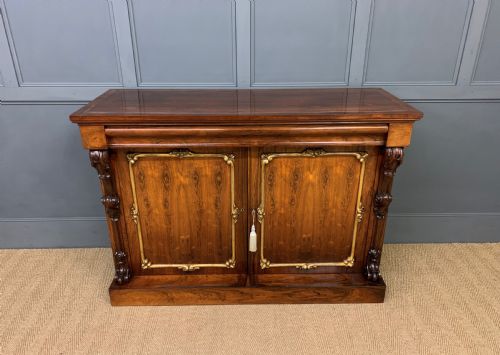
Cabinetmakers constructed these forms using timber frameworks faced with figured rosewood veneers, incorporating Rio rosewood on particularly fine early nineteenth-century examples. The wood grain provides deep colour and striking patterns across the flat door panels and cabinet carcases.
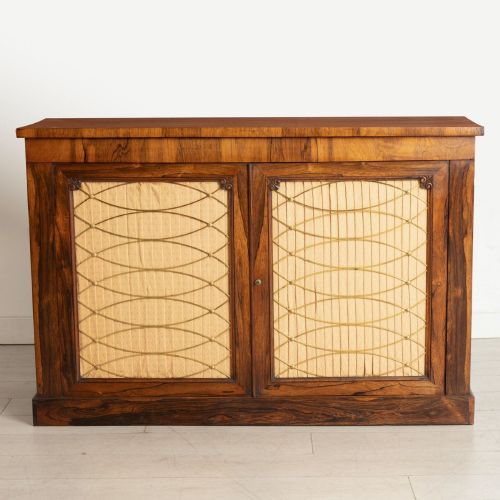
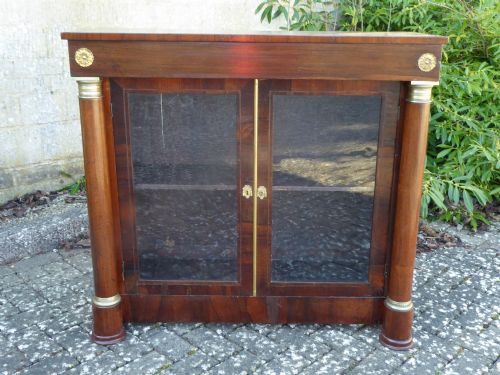
Makers integrated cast and chased or gilt ormolu mounts alongside brass inlay, particularly line work and scrolling motifs set directly into the dark timber surface. Glass doors, mirrored backs, and fabric linings featuring pleated silk panels further enriched the interior and exterior presentation.
Rosewood Dwarf Credenza Retail Price Guide 2026
Typical asking prices for rosewood dwarf credenza among the pieces listed under this phrase on Sellingantiques today, from the lower quarter to the upper quarter. They describe what is for sale here now, not the wider market.
Secret compartments hidden behind brass inlay remind us that nineteenth-century cabinetmakers loved a good puzzle just as much as we do.
What Varies In Quality
The distinction between standard and exceptional pieces rests on the choice of timber and the precision of the brass work. Dense, highly figured Rio rosewood veneer displays superior depth compared to plainer stock, while crisp, flush brass inlay demonstrates the maker's technical confidence.
Proportion and secondary ornamentation dictate the hierarchy of these low cabinets. Finely cast ormolu mounts, intact pleated silk panels, and well-executed breakfront carcases separate ambitious cabinetmaker output from simpler utilitarian storage.
The Rosewood Dwarf Credenza Glossary
- Regency
- An English design period spanning the early nineteenth century, characterised by classical restraint, architectural lines, and classical revival motifs. Furniture from this era often employs dark exotic timbers and brass highlights.
- Ormolu
- Gilded bronze mounts applied to furniture for decorative contrast against dark wood. The technique involves mercury amalgamation or electroplating to achieve a brilliant gold finish.
- Breakfront
- A cabinet facade where the central section projects forward from the flanking wings. This architectural arrangement creates shadow lines and visual depth across the front of the piece.
- Chiffonier
- A compact sideboard or low cabinet introduced in the nineteenth century, frequently equipped with enclosed shelves and sometimes a small gallery or mirrored back.
Rosewood Dwarf Credenza: Frequently Asked Questions
What is a dwarf credenza?
A dwarf credenza is a low-profile storage cabinet designed to sit below dado height, offering a surface for display alongside enclosed shelving. These pieces combine utility with decorative presence in reception rooms.
Originating in the Regency and Victorian periods, they use compact proportions to provide substantial timber presence without dominating the wall space of a room.
How do I date a rosewood cabinet?
Dating relies on observing structural characteristics, decorative motifs, and the specific qualities of the rosewood veneers. Regency pieces display classical restraint and fine brass inlay, whereas later Victorian examples often incorporate heavier mouldings and different framing techniques.
Documentation and physical examination of secondary timbers inside the carcase help confirm whether a piece belongs to the early nineteenth century or the eighteen fifties.
Where were these cabinets placed?
These low cabinets traditionally occupied principal reception rooms, drawing rooms, and libraries where they stood against walls between windows or beneath large hanging mirrors. Their low profile ensured they did not obstruct natural light or wall art.
Today, they serve similar architectural functions in homes, providing surface area for lamps and decorative objects while housing books or collections within easy reach.
What is Rio rosewood?
Rio rosewood, or Dalbergia nigra, is a dense, highly figured tropical timber prized for its dark purple-brown coloration and dramatic black grain patterning. Nineteenth-century cabinetmakers used it extensively for high-status veneer work.
Because of subsequent international trade restrictions and conservation laws, furniture utilising genuine Rio rosewood represents a specific historic era of craftsmanship.