
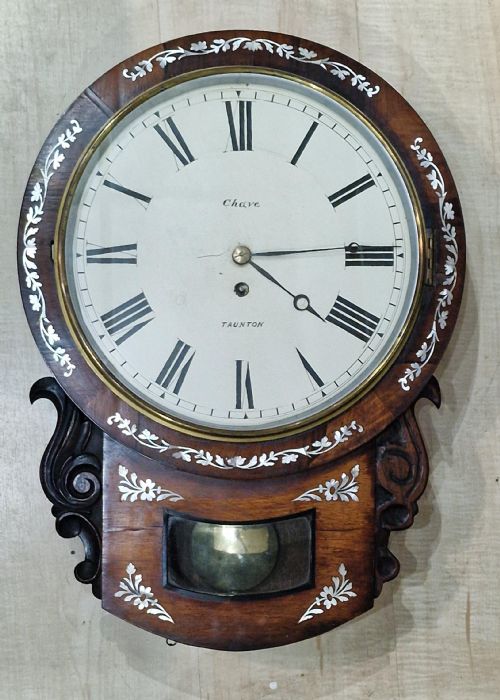


Rosewood Drop Dial
Rosewood drop dial clocks bring striking mechanical precision and rich timber grain to domestic walls.
Rosewood Drop Dial
When you search for rosewood drop dial, you encounter wall clocks built during the nineteenth century, spanning the Georgian, Regency, and Victorian periods. These timepieces combine a distinct circular or octagonal dial head above a trunk designed to house a pendulum.
The pieces listed on this page originate predominantly from the Victorian era, alongside examples from the George IV and Regency periods. Most adopt a wall clock format, occasionally incorporating twin fusee movements or bell striking mechanisms.
Makers and retailers from London, Bath, Taunton, Bridgwater, and Carmarthen stamp their names upon the dial faces or movements. Buyers find both plain timber cases and versions enriched with brass inlay or mother-of-pearl ornamentation.
How They Were Made
Cabinet makers utilised rosewood as a primary timber for the cases, capitalising on its dense grain and deep colour. They often incorporated mahogany as a secondary structural wood behind the dial surrounds and trunk assemblies.
Surfaces frequently receive decorative enhancement through brass inlay or mother-of-pearl details set directly into the timber. Protective glass covers the dial face, shielding the hands and paper or painted chapter rings from damage.
Listings feature nineteenth-century rosewood drop dial clocks incorporating brass, glass, and mother-of-pearl elements across Victorian, Regency, and Georgian periods.
What Varies in Quality
The sophistication of the internal movement dictates much of the standard, separating single fusee timepieces from complex twin fusee striking mechanisms. Clocks equipped to strike bells require intricate gear trains executed by skilled West Country or London makers.
Case execution also marks the division between ordinary production and superior workshop output. Precision in the application of brass inlay, mother-of-pearl, and the selection of figured rosewood veneer distinguish the finest examples.
Samuel Chave Taunton·Halliday And Rich Bridgwater·Kleyser Of London·James Bell Bath·Jenkins And Son Carmathen
The Rosewood Drop Dial Glossary
- Drop dial
- A wall clock featuring an extended lower case beneath the main dial to accommodate a swinging pendulum. This configuration defines the classic profile of these timepieces.
- Fusee
- A conical pulley connected to the mainspring by a cord or chain, designed to equalise the torque as the spring unwinds. This mechanism improves the timekeeping consistency of the clock.
- Twin fusee
- A movement utilising two separate fusee cones, one driving the timekeeping train and the second powering the strike train. Such movements are typically found on higher grade Victorian examples.
- Mother-of-pearl
- An iridescent inner layer of mollusc shell used for ornamental inlay on clock cases. Craftsmen cut thin pieces into geometric or floral shapes to embellish the rosewood surface.
Rosewood Drop Dial: Frequently Asked Questions
How do I hang a drop dial clock safely?
These wall clocks require secure attachment to solid masonry or substantial wall studs using appropriate fixings rated for their considerable weight. The rosewood case must hang plumb to ensure the pendulum swings freely without catching against the interior.
After mounting, listen to the beat of the escapement to confirm the clock is level. Adjust the case position slightly if the ticking sounds uneven.
What is a fusee movement?
A fusee is a mechanical device that maintains steady power to the clock train as the mainspring loses tension over time. It uses a spirgrooved cone and a line to regulate the force delivered to the gears.
This system allows nineteenth-century wall clocks to achieve high accuracy compared to simpler spring-driven mechanisms. It requires careful winding with a matching key.
How do I date a Victorian rosewood clock?
Dating relies on examining the dial signature, the construction of the movement, and stylistic clues within the rosewood case. Victorian examples often display maker details painted on the dial or engraved on the backplate.
Inlay styles also provide guidance, as mother-of-pearl and brass embellishments shift from Regency restraint to more ornate Victorian interpretations by eighteen eighty.
Do these clocks chime the hours?
Many drop dial clocks include a striking mechanism that sounds the hours on a cast bronze bell. Twin fusee variants handle both timekeeping and striking duties independently.
Simpler models function strictly as timepieces without striking trains. Check the movement layout to identify whether a bell and hammer are present inside the case.