
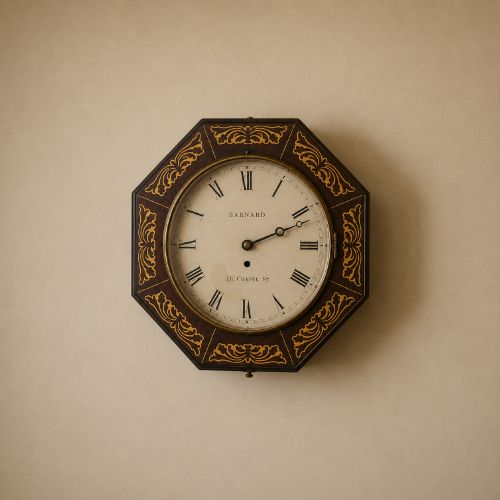


Antique Octagonal Clock
An antique octagonal clock brings architectural geometry to a wall, combining precision timekeeping with rich cabinet woods.
Antique Octagonal Clock
An antique octagonal clock is most frequently encountered as a wall-hanging timepiece or drop-dial clock, designed to display a clear white dial within a geometric timber surround. These pieces emerge predominantly from the nineteenth century, spanning the Regency, Victorian, and later periods with distinct regional British and French variations.
The format ranges from compact mantel clocks in rosewood or mahogany to large fusee wall dials intended for public or domestic spaces. Many examples incorporate a drop-dial box below the octagonal bezel, allowing room for a pendulum swing while maintaining the sharp angles of the primary frame.
Materials and movement construction
Cabinet makers utilised dense hardwoods such as mahogany and rosewood for the cases, frequently enriching the surfaces with brass inlay, mother-of-pearl, or ebonised details. Glass protected the painted dial and bezel, while interior movements relied on brass gear trains and fusee mechanisms to maintain steady power.
Dial faces were typically painted wood or iron, fitted with delicate spade or spade-and-poker hands to read the hours. The combination of heavy timber bezels and robust mechanical movements ensured these timepieces remained accurate fixtures in period interiors.
Some nineteenth-century makers signed their dial faces with such generous flourish that the signature nearly outshone the numerals themselves.
Distinguishing quality in dial clocks
Quality rests significantly in the precision of the cabinet work, particularly the crispness of the octagonal mitres and the finesse of any brass or mother-of-pearl inlay. Timbers chosen for their rich grain patterns, such as figured rosewood or flame mahogany, elevate the physical presence of the piece.
The complexity and execution of the mechanical movement dictate the standing of the clock, with twin fusee striking movements representing a higher order of horological achievement than simple time-only designs. Maker signatures inscribed on the dial or movement backplate provide a further measure of provenance and workshop standard.
Halliday & Rich Bridgwater·Kleyser of London·Walker and Hall·James Bell Bath
The Antique Octagonal Clock Glossary
- Fusee
- A conical pulley used in clock movements to maintain an even pull as the mainspring unwinds. This device ensures consistent timekeeping across the running period.
- Drop-dial
- A clock case featuring an extended box or trunk beneath the main dial to house the pendulum. This form accommodates the drop while keeping the upper bezel compact.
- Ebonised
- Wood treated to imitate ebony through staining or painting. Makers utilised this finish to create stark contrast against brass inlay or mother-of-pearl.
- Bezel
- The ring, often hinged and glazed, that holds the glass protecting the clock face. In these pieces, the bezel forms the core of the octagonal geometry.
Antique Octagonal Clock: Frequently Asked Questions
Where were wall clocks hung?
These clocks typically hung in prominent domestic rooms, hallways, offices, or commercial premises where a clear view of the time was essential for the household or business.
Their robust construction and legible dials suited spaces where daily scheduling relied upon exact mechanical timekeeping.
How do fusee movements work?
A fusee movement uses a spiral-grooved cone connected to the mainspring via a fine chain or cord. As the spring loses tension, the chain moves to a wider part of the cone, balancing the force delivered to the gear train.
This ingenious mechanism compensates for the weakening spring to maintain constant power and steady accuracy.
How do I date an octagonal clock?
Dating relies upon examining the timber choice, dial construction, inlay style, and any maker signatures recorded on the movement or face. Regency and early nineteenth-century examples often feature brass inlay in rosewood, while later Victorian versions display different proportions and wood finishes.
Maker details, where present, help anchor the piece to a specific workshop active during these decades.
Are mantel and wall clocks different?
Mantel clocks are designed to stand independently on a shelf, table, or fireplace mantel, possessing finished timber backs and bases. Wall clocks, conversely, hang securely from vertical surfaces and frequently include drop-dial trunks for pendulum clearance.
While both share octagonal framing motifs, their internal case configurations reflect their distinct intended placements.