


Rose Gold Curb Link
These pieces of rose gold curb link jewellery carry the warm, coppery tone of late nineteenth and early twentieth century work.
Rose Gold Curb Link
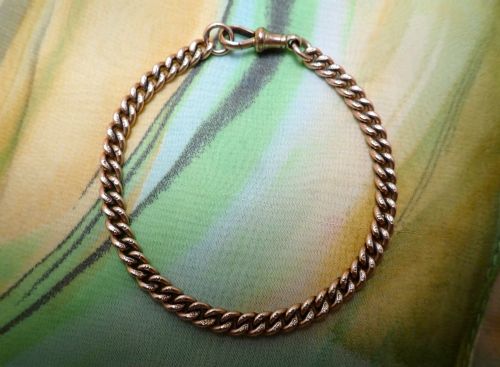
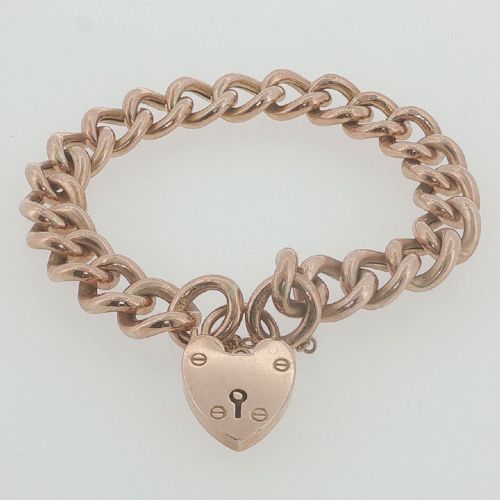
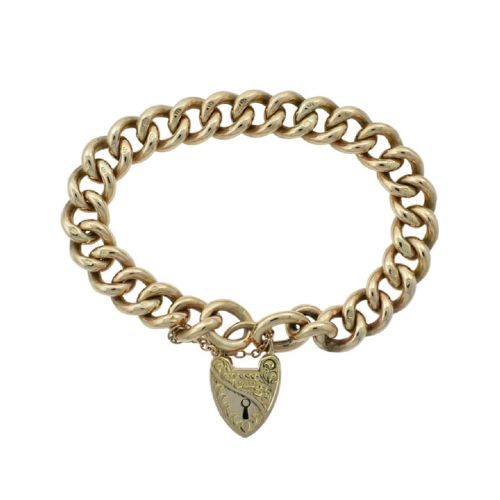
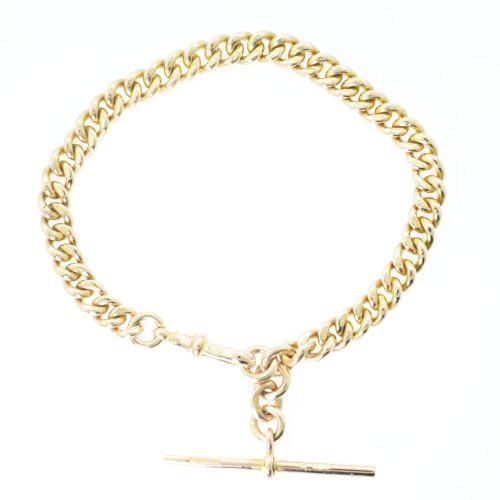
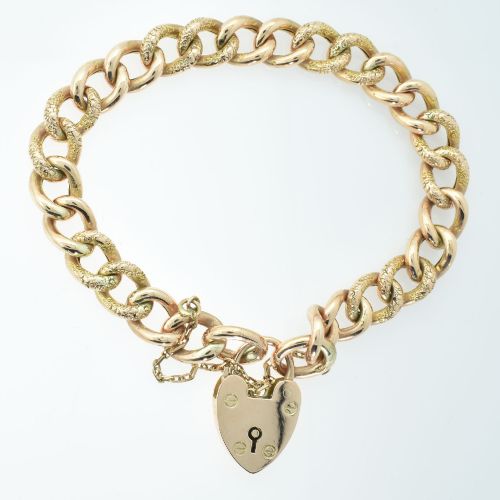
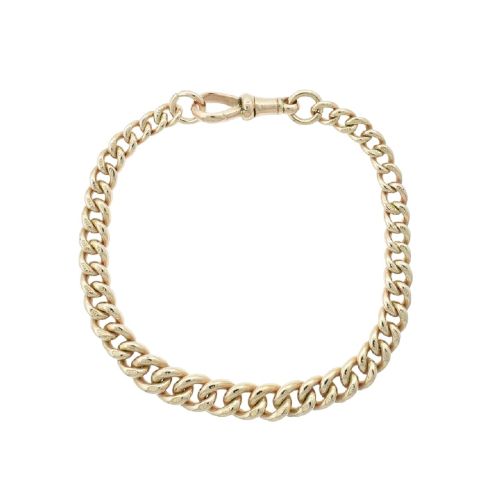
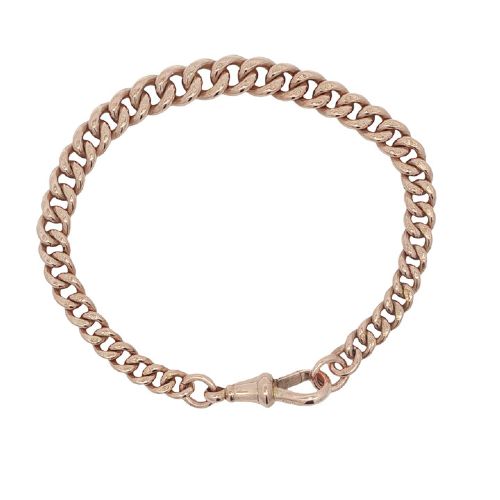
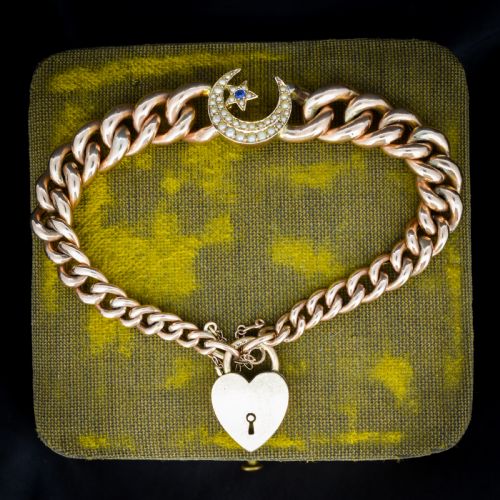
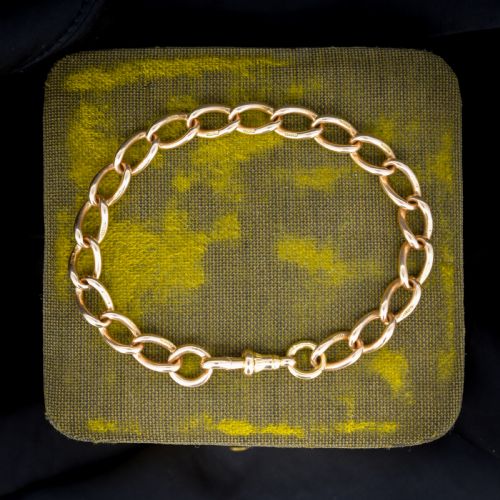
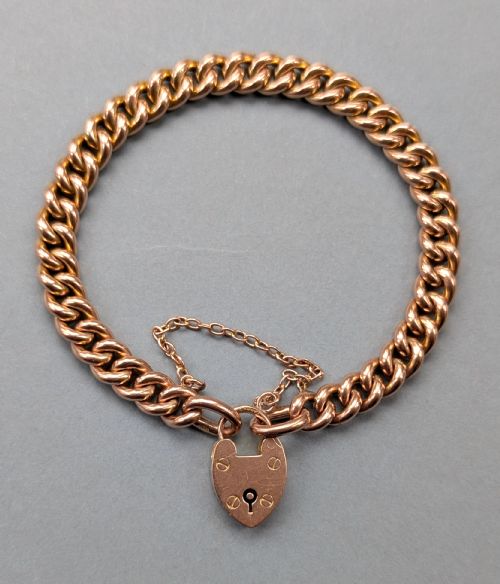
When you search for rose gold curb link, you encounter solid nineteenth and early twentieth century chains fashioned into substantial bracelets and pocket watch chains. These pieces stem predominantly from the Victorian and Edwardian eras, spanning periods such as 1900, 1910, and the wider nineteenth century. The most common manifestations on this page are heavy bracelets fitted with heart padlocks or dog clips.
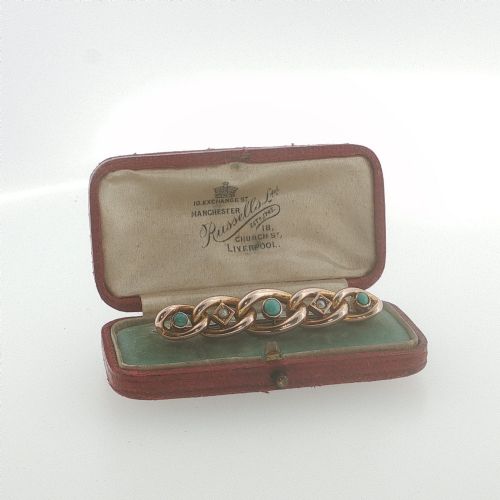
Makers and goldsmiths utilised interlocking uniform links that sit flat against the wrist or vest, often incorporating a T-bar or safety chain. You will find variations including half engraved links, graduated Albert chains, and pieces set with turquoise, seed pearls, and sapphires. Many incorporate specific structural elements like lovers knots or suffragette motifs alongside the standard curb format.
How they were made
The materials recorded in these pieces rely heavily on 9ct rose gold and 15ct gold, yielding that distinct warm alloy composition. Goldsmiths formed the curb links from solid wire or hollow tubes, interlocking each individual segment by hand before soldering and finishing. Many chains received half engraved surface decoration using hand chisels to cut geometric or floral patterns into alternate links.
Functional components such as heart padlocks, dog clips, and T-bars were cast and hand-finished to secure the heavy chains. Gemstones including turquoise, seed pearls, and sapphires were flush or bezel set into associated drops, brooches, or clasp mounts. Hallmarks stamped directly onto the metal record the assay town, such as Chester, alongside the gold purity standard.
Some nineteenth-century gentlemen wore their watch chains so long they required two pockets to manage the hardware.
What varies in quality
The distinction between average and exceptional pieces rests primarily on the gauge of the gold and the preservation of the original links. Heavier weights, often exceeding twenty or thirty grams, indicate a more substantial investment of metal by the original maker. Graduated chains, where the links taper smoothly from centre to terminal, demand greater precision in construction than uniform strands.
Surface crispness dictates visual appeal, particularly on half engraved examples where worn chasing softens the geometric patterns. The presence of original fitted components, such as matching safety chains, fully marked dog clips, and functioning heart padlocks with secure springs, elevates the integrity of the piece. Integrated gemstone elements like turquoise cabochons and seed pearls must remain intact within their original settings without replacement stones.
The Rose Gold Curb Link Glossary
- Curb link
- A type of chain made from interlocking links that have been twisted and flattened so they lie relatively flat against the skin. This design provides exceptional flexibility and durability for daily wear.
- Albert chain
- A pocket watch chain designed to be worn across a waistcoat or adapted as a bracelet, typically featuring a T-bar at one end and a swivel clasp or dog clip at the other. Named after Prince Albert, these chains became standard gentlemen's accessories in the nineteenth century.
- T-bar
- A short transverse bar of metal attached to the centre of an Albert chain, used to secure the chain through a buttonhole on a waistcoat. In secondary uses, it serves as a decorative pendant drop on a bracelet.
- Dog clip
- A spring-loaded swivel clasp resembling a miniature trigger trap, utilised for securing pocket watch chains and heavy bracelets. They often bear partial or full hallmarks denoting the gold standard and assay office.
- Heart padlock
- A hollow or solid heart-shaped clasp fitted with a spring-loaded shackle, commonly used to secure Victorian and Edwardian charm bracelets. They often double as functional locking mechanisms and decorative focal points.
Rose Gold Curb Link: Frequently Asked Questions
What is an Albert chain?
An Albert chain is a specific style of pocket watch chain equipped with a T-bar for buttonhole fastening and a swivel clip at the end.
In modern collecting, these chains are frequently worn as substantial wrap bracelets or necklaces due to their robust weight and length.
How do I date these pieces?
Dating relies heavily on hallmarks stamped onto the links, padlocks, or dog clips, which indicate specific assay offices and production years.
Stylistic cues such as the inclusion of a heart padlock, half engraved patterns, or suffragette stone colours also point toward the Victorian and Edwardian eras.
Are these pieces solid gold?
The listings consist of solid 9ct rose gold and 15ct gold rather than plated or filled alternatives, reflecting the standard manufacturing practices of the period.
Weights vary significantly from lighter strands under ten grams to heavy chains exceeding forty grams.
How do heart padlocks work?
Heart padlocks on these bracelets operate via an internal leaf spring that releases the shackle when pressure is applied to the small internal latch.
They serve both as the primary clasp mechanism and as a decorative pendant feature characteristic of late nineteenth-century jewellery.