


Edwardian Watch Chain Bracelet
An edwardian watch chain bracelet is a robust piece of antique arm jewellery adapted from pocket watch chains for daily wear.
Edwardian Watch Chain Bracelet
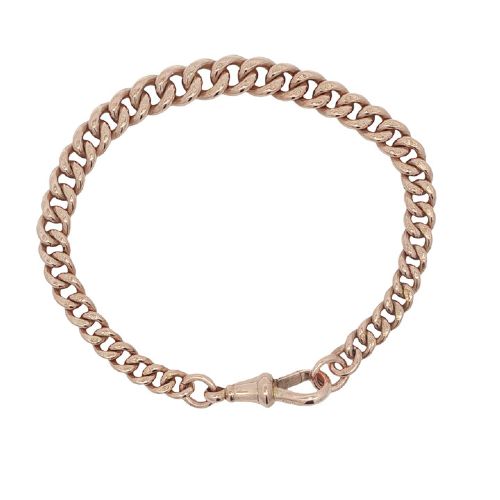
When you search for an edwardian watch chain bracelet, you encounter substantial gold and silver links adapted from traditional pocket watch chains into wearable wrist ornaments. These pieces bridge the late Victorian period and the Edwardian era, carrying the weight and mechanical integrity of working gentleman's accessories into women's fashion.
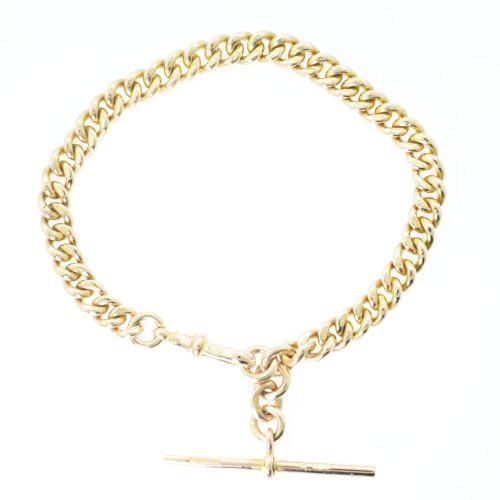
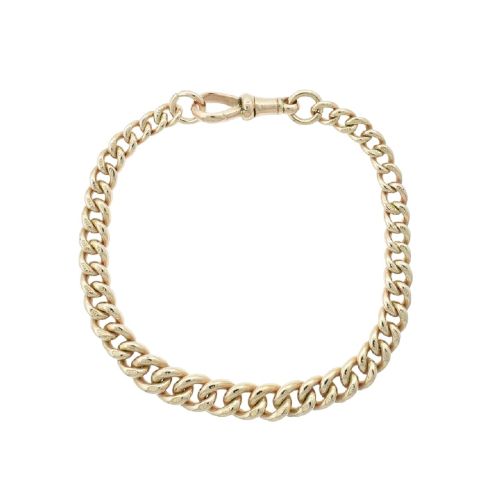
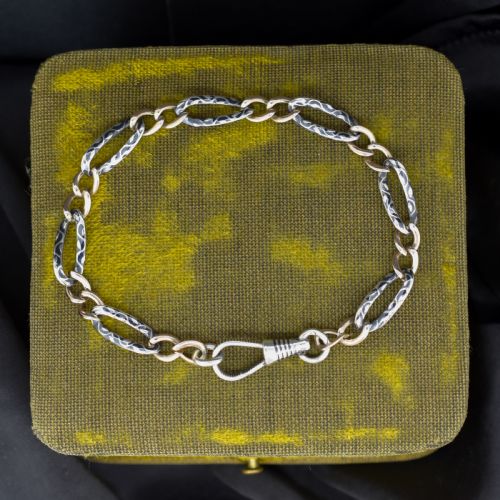
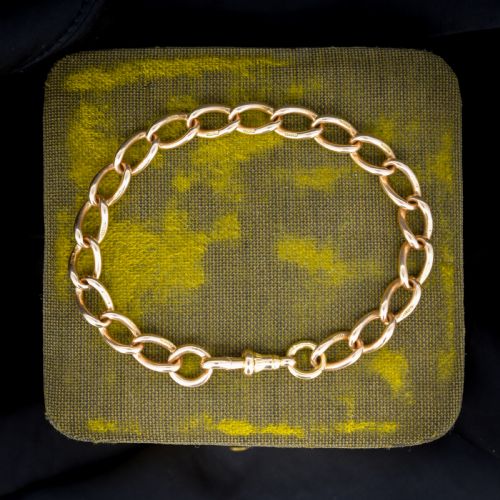
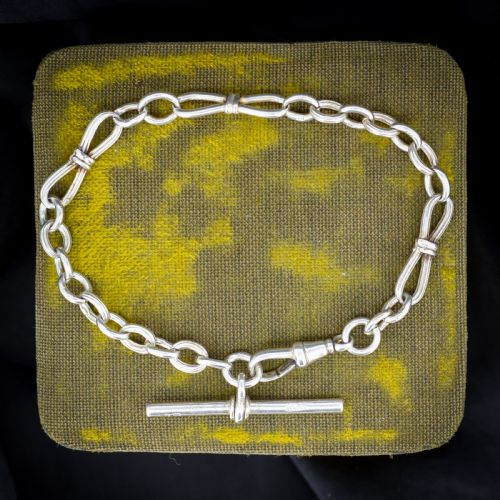
The versions most commonly met on this page are fashioned from nine-carat rose gold or yellow gold, alongside occasional silver and niello examples. They frequently incorporate graduated links, dog clips, and T-bars, echoing their origins as watch guards secured to waistcoats.
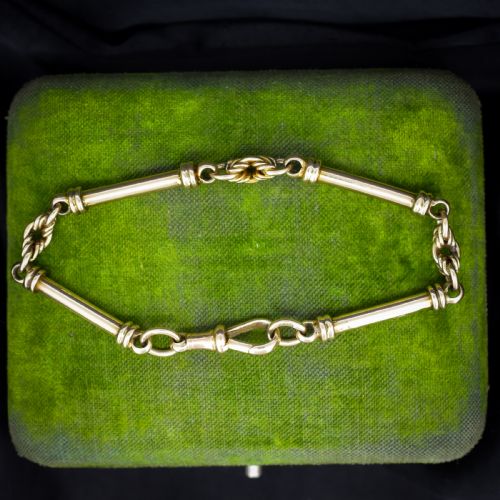
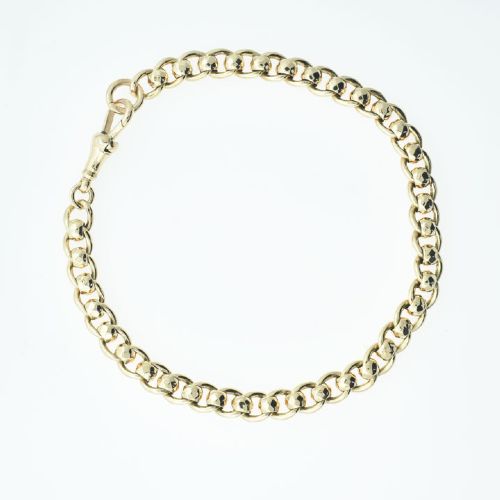
Forms span tubular bar and love knot links, rollerball designs, oval curbs, and heavy Albert styles. Each item retains the secure fastenings and structural honesty of the period, offering a tangible link to early twentieth-century metalworking.
How they were made
The construction relies on solid gold and sterling silver, with nine-carat rose gold dominating the selection alongside fifteen-carat gold and niello silver. Goldsmiths formed individual links by hand or machine, linking tubular bars, love knots, rollerballs, and heavy curb patterns into flexible chains.
Functional components such as dog clips and T-bars were integrated directly into the design, utilising spring-loaded mechanisms for secure fastening. Silver examples often incorporate niello work, fusing dark metallic alloy into engraved designs to create high-contrast geometric or floral patterns.
Wear a dog clip bracelet with confidence, knowing the spring mechanism was originally tested to keep a gentleman's gold timepiece from hitting the pavement.
What varies in quality
The distinction between ordinary and superior examples rests upon metal purity and gauge. Pieces fashioned from fifteen-carat gold sit at the upper end of the material scale, displaying a richer colour and greater intrinsic weight than standard nine-carat alternatives.
Construction heft and link graduation also define distinction. Heavily weighted graded links require meticulous balancing by the maker to taper smoothly from the centre to the clasp, whereas uniform links offer a simpler, repetitive symmetry.
The Edwardian Watch Chain Bracelet Glossary
- Dog clip
- A spring-loaded swivel fastener resembling a small snap hook, originally used to secure a pocket watch to a chain. It serves as the primary clasp on many antique bracelets.
- T-bar
- A short transverse metal bar attached to a short length of chain, designed to pass through a waistcoat buttonhole in watch chains. On bracelets, it hangs decoratively as a drop.
- Niello
- A black metallic alloy of sulphur, silver, copper, and lead used as an inlay on engraved silver. It creates sharp dark contrasts against the bright polished metal surface.
- Rollerball
- A specific form of rounded, cylindrical link found in heavy watch chains. These hollow or solid rounded segments provide flexibility and a smooth tactile feel.
Edwardian Watch Chain Bracelet: Frequently Asked Questions
What is an Edwardian watch chain bracelet?
These pieces are historic pocket watch chains repurposed or originally manufactured as wristwear during the early twentieth century. They carry masculine utility into feminine ornamentation.
Characterised by solid links, dog clips, and T-bars, they represent a direct transition from functional gentleman's attire to decorative jewellery.
How do I wear a T-bar bracelet?
The T-bar hangs freely from a short drop chain attached to the main body of the bracelet. It serves a purely decorative function in wristwear.
You simply let the bar dangle alongside the links, echoing the way it once secured a watch through a buttonhole.
Are these bracelets solid gold?
The listings on this page comprise solid gold and silver examples rather than plated base metals. Purity is marked in nine-carat and fifteen-carat gold.
Rose gold and yellow gold dominate the metal palette, reflecting the prevalent metallurgical preferences of the Edwardian and late Victorian periods.
What makes an Albert bracelet different?
An Albert bracelet specifically mirrors the heavy, graduated link structure of a double or single Albert watch chain. It often includes the characteristic T-bar and dog clip.
Standard link bracelets follow uniform patterns like curbs or fancy twists, whereas Albert styles taper purposefully towards the centre or clasp.