

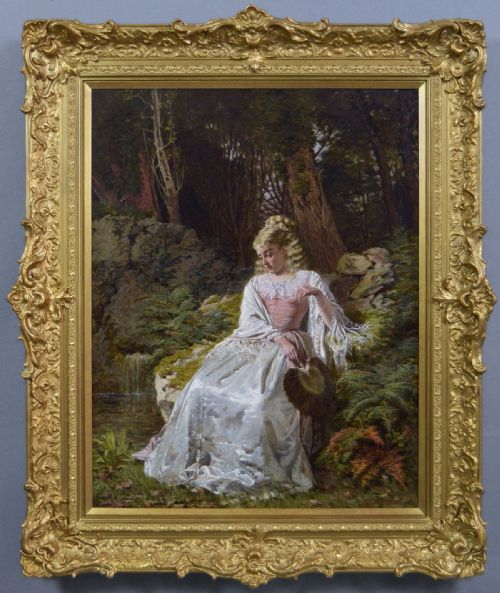


Romantic Victorian Portrait
A romantic victorian portrait captures a mood of quiet introspection through oil paint on canvas, offering an evocative glimpse into nineteenth-century life.
Romantic Victorian Portrait
A romantic victorian portrait typically depicts a seated woman, a young lady with pearls, or an elegant figure placed within a narrative or pastoral setting. These works emerge primarily from nineteenth-century British, French, and Dutch traditions, spanning periods from the 1800s through the Victorian era and 1880.
The subjects range from historical figures like Mary Stuart to anonymous sitters modelled in woodland pools or beside balustrades. Buyers encounter both large-scale oil paintings on canvas and delicate portrait miniatures intended for intimate display.
Beyond standard canvases, the category extends to include oil paintings on board, grisaille studies, and sculptural bronzes depicting poets in a romantic spirit. Each piece reflects the dominant academic and romantic sensibilities of the nineteenth century.
Distinguishing quality
Quality rests upon the subtlety of brushwork in the sitter's facial expression, hands, and drapery, where skilled handling brings depth to the canvas. Finer examples display confident draughtsmanship and careful anatomical proportion rather than rigid adherence to formula.
The integration of the figure with the surrounding landscape or interior setting determines the visual harmony of the piece. Frames matching the period style and retaining original gilding also elevate the overall integrity of the work.
Romantic Victorian Portrait Retail Price Guide 2026
Typical asking prices for romantic victorian portrait among the pieces listed under this phrase on Sellingantiques today, from the lower quarter to the upper quarter. They describe what is for sale here now, not the wider market.
Listings feature works spanning the 1800s, 1860s, 1880s, and the broader Victorian period, executed in oil, charcoal, and bronze.
André Charles Voillemot·Thomas Edward Roberts·Franz Xaver Winterhalter·Christoffel Bisschop·Willem Johannes Martens·Eva Hollyer·Samuel Lawrence·Abraham Cooper·Eugene Verboeckhoven·Alfred Seifert
The Romantic Victorian Portrait Glossary
- Oil painting
- A work created using pigments bound in a drying oil medium, typically applied to canvas or wood panel. This technique allows for rich colour blending and gradual tonal transitions.
- Portrait miniature
- A small-scale painting capturing a person's likeness with minute detail. These intimate works were often designed to be carried or displayed in private spaces.
- Grisaille
- A painting executed entirely in shades of grey or neutral monochrome. Artists often used this technique as a preparatory underpainting or as a finished work in its own right.
- French academic
- A style of painting and sculpture produced under the influence of European academies of art. It prioritises classical composition, polished finishes, and narrative depth.
Romantic Victorian Portrait: Frequently Asked Questions
How do I identify a Victorian portrait?
Look closely at the clothing, hairstyle, and painting medium, which typically point to nineteenth-century conventions. The presence of oil on canvas combined with romantic subjects often confirms the era.
Examine any framing or signatures on the reverse, as these frequently provide clues regarding the specific decade of creation.
What subjects are most common?
Portraits frequently feature elegant women, historical figures, or literary characters set outdoors or within domestic interiors. Artists also recorded genre scenes involving figures by woodland pools.
These subjects reflect the romantic fascination with individual emotion, storytelling, and historical nostalgia during the nineteenth century.
Where were these paintings produced?
Works originate from various European centres, with notable examples stemming from British, French, and Dutch artistic circles. Painters often travelled between major cities like Rome, Venice, and Paris to train and exhibit.
This cross-pollination of styles explains the shared academic and romantic traits found across different national schools.
How should I care for an oil painting?
Keep the canvas away from direct sunlight and extreme fluctuations in temperature and humidity to prevent cracking. Dust the surface gently with a soft, dry brush without applying pressure.
Avoid using liquid cleaners on the paint or the giltwood frame, consulting a professional conservator for deep cleaning.