
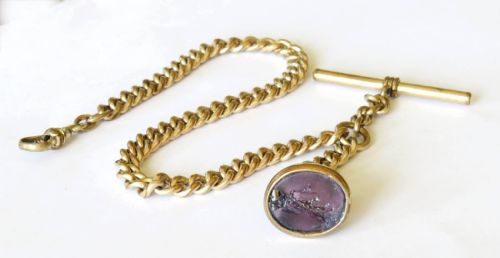


Rolled Gold Watch Chain
A rolled gold watch chain offers the rich gleam of solid metal with practical resilience, connecting pocket timepieces to waistcoats with enduring style.
Identifying a rolled gold watch chain
A rolled gold watch chain is a wearable antique accessory designed to secure a pocket watch, frequently appearing as a double albert or single strand configuration. These pieces span from the Edwardian era through the nineteen-twenties and nineteen-thirties, reflecting the changing dress habits of those decades.
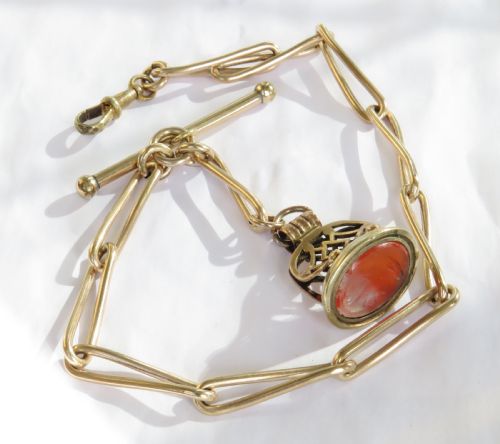
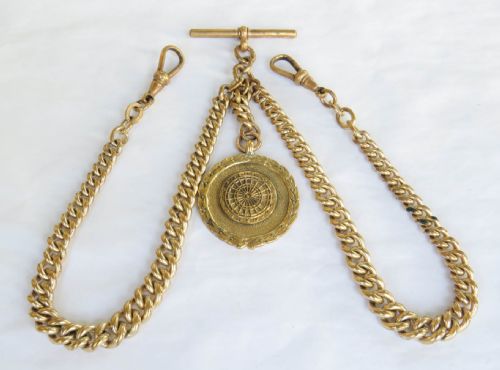
The version most commonly met on this page is the double watch albert chain, often accompanied by a swivel fob, a sovereign holder, or a rifle club fob. Such examples demonstrate the functional role these accessories played in daily attire, securing valuable timepieces and displaying personal insignia.
Materials extend beyond standard yellow metal to include rolled rose gold, alongside subsidiary elements in brass, enamel, and carnelian set within fobs. The styles bridge Victorian design traditions and the cleaner geometry of the art deco period.
Construction and materials
These items are constructed by fusing a layer of genuine gold to a base metal core, providing a durable surface that withstands daily handling. The resulting material mimics solid gold while offering greater structural strength for daily wear.
Individual links, such as fetter patterns, are formed and joined by hand or semi-mechanised processes, then fitted with swivels and spring rings. Additional components like carnelian stones and enamel details are mounted securely into brass or gold-plated settings.
Materials recorded across the archive include rolled rose gold, standard rolled gold, gold plate, brass, enamel, and carnelian.
Assessing quality and craftsmanship
Quality in these items is determined by the thickness of the gold layer and the integrity of the underlying core metal. Superior examples retain their warm hue and crisp link definition despite decades of use against waistcoats and pockets.
The presence of original, matching fobs, sovereign holders, or named maker signatures elevates a piece beyond a standard utility chain. Articulation in the links and smooth operation in the swivel mechanisms also separate the finest workshop output from simpler production.
Hopwood·Ths Hopwood·Cyma
The Rolled Gold Watch Chain Glossary
- Rolled gold
- A composite material made by mechanical bonding a sheet of gold to a base metal substrate. This technique creates a durable layer far thicker than standard electroplating.
- Albert chain
- A specific type of pocket watch chain named after Prince Albert, worn across the front of a waistcoat. It can be single, suspending a watch from one buttonhole, or double, spanning both sides.
- Swivel fob
- A small decorative ornament attached to a watch chain by a rotating clasp. These often feature gemstones such as carnelian or heraldic engravings.
- Fetter link
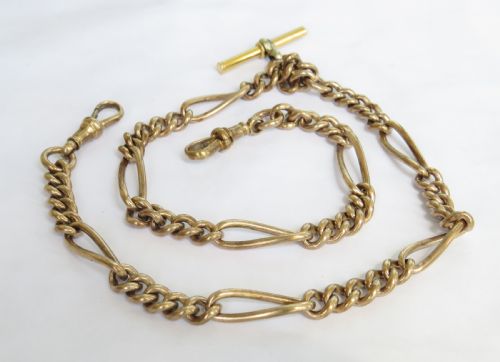
- A chain pattern composed of alternating long and short links. This design provides both flexibility and visual texture.
- Stem winding
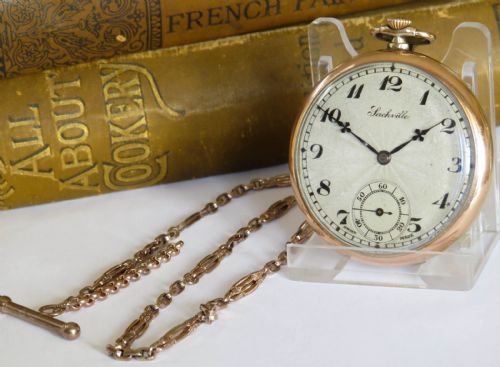
- A mechanism allowing a pocket watch to be wound via the crown at the top rather than a separate key. This method became standard in later Victorian and twentieth-century timepieces.
Frequently Asked Questions
What is an albert chain?
An albert chain is a specific style of pocket watch chain designed to be worn across the front of a waistcoat. It secured the timepiece in a pocket while anchoring decorative fobs.
These chains came in single and double formats, allowing gentlemen to balance a watch on one side and a sovereign case or cutter on the other.
How do I wear a watch chain today?
You can thread the centre bar of the chain through a buttonhole on a waistcoat and slip the watch into the corresponding pocket. The remaining strand and fob hang across the front.
Alternatively, modern collectors attach the chain to belt loops on trousers, securing the watch in a front pocket for contemporary styling.
What is the difference between rolled gold and solid gold?
Rolled gold consists of a thick layer of gold mechanically fused to a base metal core. It provides the appearance and wear characteristics of solid metal at a different weight.
Solid gold pieces are composed entirely of precious metal throughout their structure, marked with specific carat stamps reflecting their precise gold content.
How do I date these chains?
Dating relies on stylistic clues, accompanying components like art deco geometries, and materials such as rolled rose gold popular in specific decades. Twentieth-century examples often pair with stem-winding watches.
Markings on the metal or attached fobs also provide chronological markers, linking the item to Edwardian or interwar manufacturing periods.