
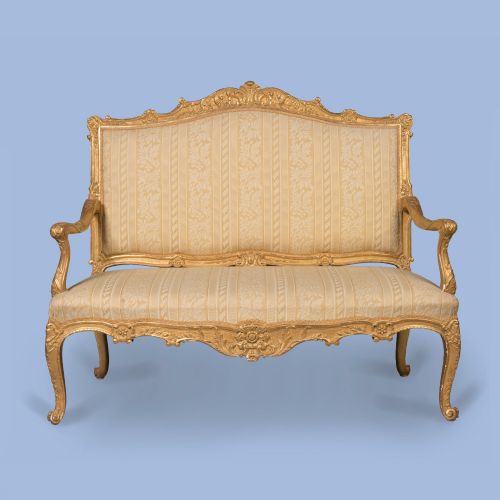


Rococo Giltwood Settee
These rococo giltwood settee examples bring flamboyant curves and rich surface gilding into a room, offering a seat rooted in continental excess.
Rococo Giltwood Settee
A rococo giltwood settee is a grand upholstered seat defined by sweeping carved frames, cabriole legs and asymmetrical scrolls. The examples found here span the nineteenth century and the early decades of the twentieth century, often following the Louis XV style or Rococo Revival taste.
Most pieces encountered on this page originate from French workshops or draw heavily upon French chateau aesthetics, though Italian Venetian and German variations also appear. Forms range from traditional canapés and two-seater window sofas to larger salon suites and love seats.
Buyers seek these settees for formal reception rooms and boudoirs where their opulent carved wood frames and gilded finishes create a commanding visual centrepiece. They function as both historical furnishings and decorative seating options.
How they were made
The structural framework relies on timber such as beech and wood, shaped into flowing contours through skilled hand carving before receiving its surface treatment. Giltwood dominates the finish, alongside occasional polychrome or gold painted elements that highlight the intricate relief work.
Upholstery materials play an essential role in the construction, featuring traditional textiles, damask and silk alongside woven cane panels. These soft components are tailored to fit the undulating wooden contours characteristic of the revival period.
Listings feature periods spanning from the nineteenth century through to 1920, predominantly showcasing giltwood, timber, and fabric materials.
What varies in quality
Quality rests principally in the depth and sharpness of the hand carving upon the timber frame, where crisp floral motifs and scrolling acanthus distinguish superior work from softer, blunter moulding. The application of the gold leaf or gilding also dictates the visual richness of the piece, with smoother coverage and nuanced burnishing standing apart from flat or heavily degraded surfaces.
Structural integrity of the beech framework and the retention of original upholstery materials or period-appropriate textiles influence the overall integrity of the settee. Pieces that maintain their balanced proportions without excessive restoration to the carved wooden joints command greater appreciation.
The Rococo Giltwood Settee Glossary
- Giltwood
- Timber that has been coated with gold leaf or a gold-coloured finish. This surface treatment gives the carved wooden elements a bright, reflective metallic sheen.
- Canapé
- A traditional French-style settee or sofa featuring an upholstered back and seat within an exposed wooden frame. These seats typically accommodate multiple people.
- Cabriole leg
- A furniture leg that curves outward in a convex arc and then bends inward in a concave arc, ending in a pad or scroll foot. This shape is a defining feature of rococo seating design.
- Damask
- A reversible figured fabric woven on a jacquard loom with patterns formed by contrasting warps and wefts. It appears frequently as the upholstery covering on formal nineteenth-century settees.
Rococo Giltwood Settee: Frequently Asked Questions
Where should I place a giltwood settee?
Position the settee away from direct sunlight and strong heat sources to protect the delicate giltwood finish and textile upholstery from fading or cracking over time. A prominent wall in a drawing room or a spacious hallway allows the curved wooden frame to be viewed from multiple angles.
Ensure there is enough surrounding floor space so the piece does not appear crowded by other furniture. Allowing room around the settee highlights its sculptural silhouette.
Are these settees comfortable for daily use?
These historical seats were built primarily for formal entertaining rather than casual lounging, featuring upright backs and firm upholstered cushions. Their comfort level depends heavily on the age and construction of the internal webbing and padding.
Sitting on them occasionally works well, but heavy everyday use may stress the antique wooden joints and historic textiles. Treat them as focal seating options rather than primary daily loungers.
What is the difference between Louis XV and Rococo Revival?
Louis XV style refers directly to eighteenth-century French design principles focused on naturalistic asymmetry, C-scrolls and floral cartouches. Rococo Revival describes later nineteenth-century interpretations that adopted and sometimes exaggerated those same decorative motifs.
Pieces on this page largely represent nineteenth-century revivals of the earlier French taste rather than original eighteenth-century productions. Examining the timber age and construction techniques helps clarify the exact period of manufacture.