
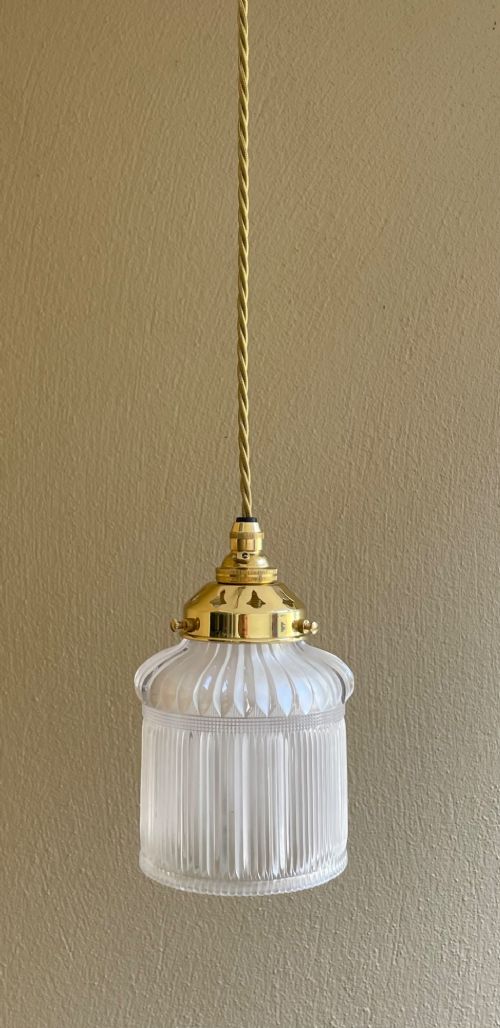
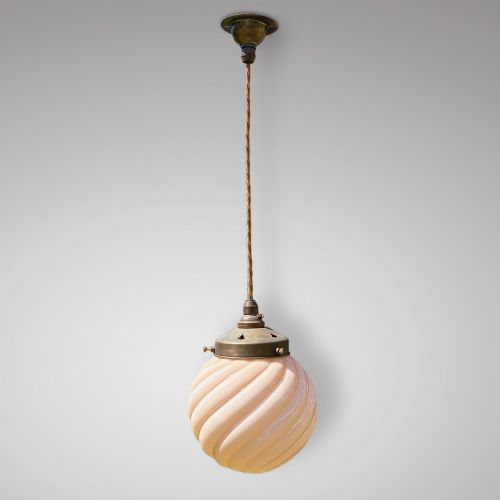


Ribbed Glass Pendant Shade
A ribbed glass pendant shade brings honest industrial light and texture into a room, forged from moulded glass and metal galleries.
Ribbed Glass Pendant Shade
When you search for a ribbed glass pendant shade, you are looking at utilitarian ceiling illumination designed to diffuse light evenly across a workspace or room.
The versions you meet most frequently on this page date from the Edwardian period, the 1910s and 1920s, and the Victorian era, taking the form of pendant lights, ceiling light shades and bell or dish pendants.
Many of these shades carry the distinct prismatic or opalescent optical patterns associated with the Holophane name, alongside plain opaline, moonstone and clear glass variants.
Materials and methods of construction
The shades are produced from heavy moulded glass - often prismatic, opaline, opalescent or moonstone - which directs and softens the bulb's output without glare.
Metal components such as brass galleries, chrome mounts and fabric flex complete the assembly, holding the glass securely from above.
Some diminutive English shades measure just nine inches across, proving that industrial efficiency came in pocket-sized editions too.
Distinctions in quality
Quality rests in the crispness of the glass moulding, where precise prismatic ribs distribute illumination cleanly rather than scattering it in a dull haze.
The weight and finish of the accompanying metal gallery, whether brass or chrome, separates utilitarian hardware from finer period assemblies.
The Ribbed Glass Pendant Shade Glossary
- Holophane
- A brand and patented method of scientific glass manufacture designed to direct and diffuse light efficiently. These shades feature precise exterior prisms that reduce glare while maximising brightness.
- Prismatic glass
- Glass moulded with geometric ridges or prisms on the surface to bend and refract light. It is a hallmark of industrial and institutional lighting from the early twentieth century.
- Opaline glass
- An opaque or translucent white glass that softens light into a gentle glow. It was widely used for domestic and commercial pendant shades.
- Gallery
- The metal collar or ring at the top of a shade that connects the glass to the suspension cord and ceiling rose. Galleries are commonly fashioned from brass or chrome.
- Pendant light
- A hanging light fixture suspended from the ceiling by a flex, chain or rod. In these listings, they are typically paired with glass shades and metal hardware.
Ribbed Glass Pendant Shade: Frequently Asked Questions
How do I hang a pendant shade?
These shades suspend from the ceiling using a fabric flex or cord secured through a metal gallery at the top of the glass.
An electrician should wire the fixture safely to your mains supply using a suitable ceiling rose.
What periods do these shades come from?
The pieces span the Victorian era, the Edwardian period, and the 1910s, 1920s, and 1940s.
Earlier examples often reflect Arts and Crafts or early industrial designs, while later ones lean into Art Deco aesthetics.
Are all the glass shades signed?
Not every shade carries an explicit maker mark or signature on the glass surface. Many rely on distinct prismatic patterns, materials like opaline, and style characteristics to indicate their origin.