
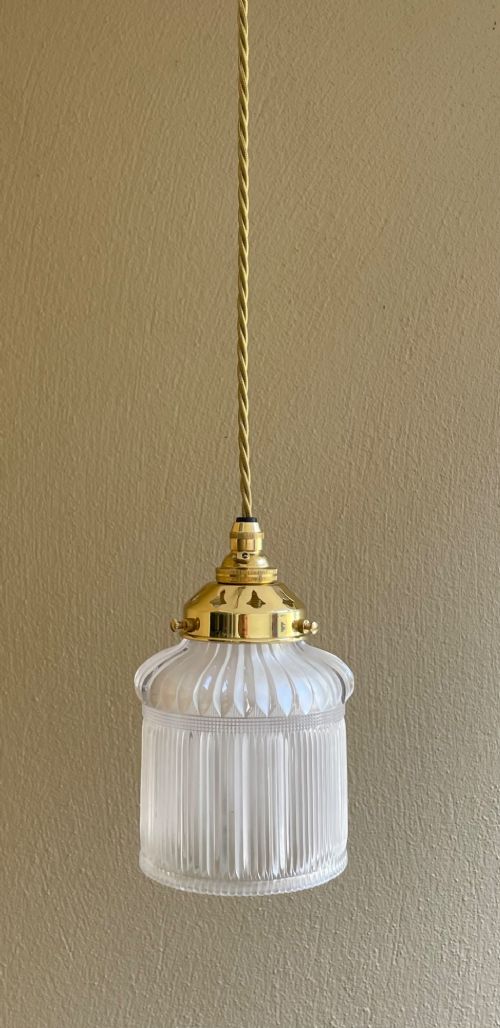


Clear Ribbed Glass Light
These clear ribbed glass light fixtures deliver brilliant refraction and industrial character, making them essential for period interiors.
Clear Ribbed Glass Light
A clear ribbed glass light is a pendant fixture designed to distribute illumination evenly while showcasing distinct linear moulding. You will encounter pendant lights spanning from the 19th Century through the Edwardian era, 1910, 1920, and up to 1940.
The dominant form on this page is the Holophane pendant light, frequently featuring a bell or prismatic shade paired with original hardware. These fixtures bridge industrial utility and domestic refinement, suiting kitchens, hallways, and living spaces alike.
How they were made
These fixtures combine moulded glass shades with durable metal galleries cast from brass, chrome, or cast iron. The distinctive ribbing and prismatic patterns serve to control and amplify light output efficiently.
Makers utilised specialised press-moulding techniques for the glass, ensuring uniform optical performance across bell and prismatic profiles. Metal components were engineered to securely suspend the heavy glass shades.
Holophane translates to 'whole light', a cheerful promise from Edwardian engineers who wanted to make sure no photon went unbent.
What varies in quality
The distinction between standard examples and superior pieces lies in the crispness of the glass moulding and the integrity of the metal gallery. Early 20th century pieces often display sharper prismatic definition and heavier metalwork.
Original hardware, including matching brass or chrome fitments, elevates an example above those altered with modern replacements. The optical clarity of the glass and the absence of heavy surface wear determine the overall desirability.
The Clear Ribbed Glass Light Glossary
- Holophane
- A proprietary type of prismatic glass designed to direct and diffuse light efficiently. This patented glassware forms the majority of the shades seen here.
- Gallery
- The metal collar or mount that grips the top of the glass shade and connects to the suspension cord or rod. Galleries are commonly found in brass, chrome, or cast iron.
- Prismatic glass
- Glass moulded with precise geometric ribs or prisms on the surface to refract light. Double prismatic variations offer enhanced optical diffusion.
- Bell pendant
- A hanging light fixture featuring a shade shaped like a traditional bell. This form provides a wide downward spread of illumination.
- Edwardian industrial
- A style combining early twentieth-century utilitarian function with domestic decorative appeal. These pieces reflect the transition from factory lighting to home interiors.
Clear Ribbed Glass Light: Frequently Asked Questions
What is a clear ribbed glass light?
A clear ribbed glass light is a hanging pendant fixture featuring a moulded glass shade designed to diffuse illumination while exposing the bulb and internal optics.
Most examples utilise Holophane glass and date from the Edwardian period through the 1940s, originating from industrial or commercial settings.
Where should I hang a pendant light?
These pendant lights suit spaces requiring direct yet softened downward illumination, such as kitchen islands, dining tables, and high-ceilinged hallways.
Their industrial heritage allows them to anchor both contemporary minimalist rooms and traditional period properties with equal success.
How do I date an antique pendant?
Dating relies on examining the construction of the metal gallery, the formulation of the glass, and specific stylistic markers recorded in the manufacture.
Pieces from the Edwardian era and the 1910 to 1920 decades often feature heavier cast brass or iron fittings compared to later 1940s iterations.
Are these lights suitable for low ceilings?
Pendant lights hang downward and generally require adequate ceiling clearance to avoid obstructing movement in walkways or living areas.
Shorter suspension drops or bell pendant configurations can help accommodate rooms with more modest vertical space.