
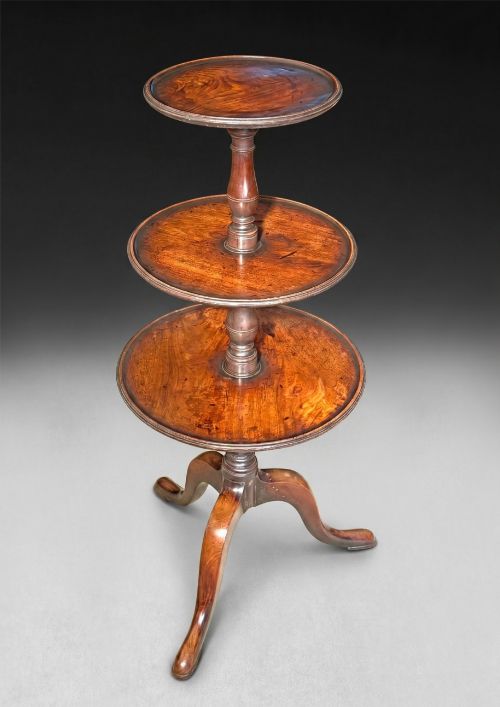


Revolving Dining Server
These revolving dining server pieces are practical table accessories designed to pass food with ease during a meal.
Revolving Dining Server
A revolving dining server groups several forms together, including lazy susans, dumb waiters and breakfast dishes designed to rotate on a table or stand. Buyers seeking a revolving dining server encounter various tiers and configurations intended for passing dishes without reaching across guests.
The selections span multiple historical eras, with George III and Georgian examples appearing alongside Victorian, Edwardian and Art Deco pieces. Mahogany forms dominate the listings, accompanied by silver-plated items and glass elements designed for domestic dining rooms.
Materials and construction
Makers utilised solid timber such as mahogany for structural tiers and surfaces, shaping the wood to withstand frequent rotation and heavy serving vessels. Brass components often reinforced the moving joints and central pivots of these rotating pieces.
Silver plating and EPNS were applied to metal serving dishes and breakfast warmers, providing a durable and polished finish for table service. Glass inserts also appeared within frames, offering a stable surface for food presentation.
Materials recorded across the inventory include solid mahogany, brass, silver plate, EPNS, glass, aluminium and chrome.
Judging quality in revolving dining servers
The distinction between standard examples and finer pieces lies in the precision of the rotating mechanism and the balance of the tiers. Smooth movement without wobble indicates careful historical joinery and alignment of the central pivot.
Superior items display refined timber selection with rich grain patterns, as well as crisp casting on brass mounts and silver-plated fittings. Simpler pieces rely on basic utility, whereas higher-grade servers integrate decorative turning and balanced proportions.
Mappin and Webb
The Revolving Dining Server Glossary
- Lazy Susan
- A revolving tray placed on a table to assist in moving food easily between diners. This rotating device sits flat on the surface or on a low base.
- Dumb Waiter
- A multi-tiered serving stand designed to hold dishes beside a dining table without requiring extra servants. These tall pieces often feature graduating circular shelves.
- EPNS
- Electroplated nickel silver, a common base metal method used for silver-finished serving pieces. This technique provided an affordable alternative to solid silver.
- George III
- The stylistic period spanning the mid to late eighteenth and early nineteenth centuries. Furniture from this era displays classic proportions and quality mahogany timber.
Revolving Dining Server: Frequently Asked Questions
What is a revolving dining server used for?
These pieces assist with serving food around the dining table by rotating dishes so guests can reach them easily. They reduce the need to pass heavy platters across the table during a meal.
Historically, larger dumb waiters held extra courses and wine bottles, while smaller lazy susans sat directly on the table for condiments and breakfast items.
How do I care for a mahogany revolving server?
Keep wooden surfaces away from direct sunlight and excessive heat sources to prevent the timber from drying out or splitting. Polish the wood occasionally with a suitable wax to maintain the finish.
Ensure the central pivot mechanism remains clean and lightly lubricated if necessary, but avoid applying heavy oils that might attract dust to the moving parts.
How do I tell a Georgian server from a Victorian one?
Georgian pieces generally exhibit restrained classical lines, understated bracket feet and rich, dense mahogany timber. They often date from the eighteenth or early nineteenth century.
Victorian examples can feature heavier proportions, more robust turnings, or alternative materials such as silver plate and glass inserts reflecting changing nineteenth-century dining fashions.
Are these servers suitable for modern dining tables?
Table-top lazy susans and smaller rotating trays fit comfortably on contemporary dining furniture while retaining their original function. They offer a practical way to serve shared dishes during family meals.
Free-standing dumb waiters require designated floor space beside the table, functioning as decorative side stands as well as serving helpers.