
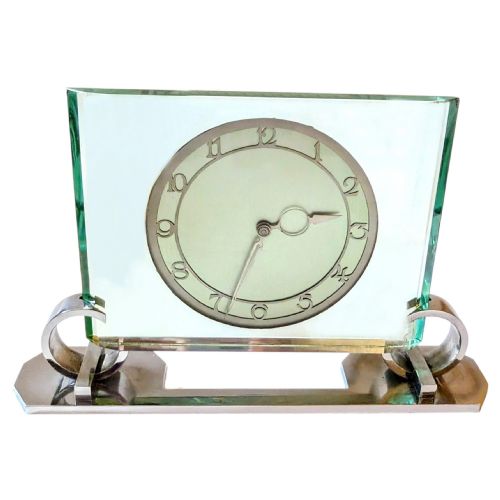


Retro Chrome Clock
A retro chrome clock brings striking industrial polish and modernist geometry to a desk or mantel.
Retro Chrome Clock
A retro chrome clock embodies the geometric lines and industrial materials of the twentieth century. These pieces span desk clocks, mantel clocks, and wall clocks produced during the Art Deco and Mid-Century Modern periods.
The version most commonly met on this page is the Art Deco desk or mantel clock featuring shiny metal finishes and mechanical movements. English and continental workshops produced these timepieces extensively throughout the 1930s.
Makers utilised various housings alongside the bright metal surrounds, including glass, bakelite, oak, and mirrored glass. Forms range from simple octagonal wall clocks to pivoting desk models and automated displays.
What varies in quality
The refinement of the housing construction and the complexity of the movement define the standard of a piece. Finer examples combine chrome with materials like marble, glass, or shaped bakelite rather than relying on plain metal alone.
Some electric models feature a moving ship that rolls as the minutes pass.
Smiths Clockmakers·A.L. Davenport·Bayard·Blangy·Kienzle
The Retro Chrome Clock Glossary
- Art Deco
- A design style characterised by sleek geometric shapes, streamlined forms, and modern industrial materials popular during the 1920s and 1930s.
- Bakelite
- An early form of synthetic plastic moulded into dark, durable clock cases and alarm clock bodies.
- Eight day movement
- A mechanical clock movement designed to run for eight days on a single wind before requiring attention.
- Mantel clock
- A freestanding clock designed to sit on the shelf above a fireplace, often featuring decorative wooden or metal framing.
- Pivoting
- A mounting style that allows the clock face to tilt on its stand for easier viewing from a desk or table.
Retro Chrome Clock: Frequently Asked Questions
How do I wind an eight day clock?
An eight day movement requires a key or built-in winder to tension the mainspring inside the casing. You turn the key gently until resistance is felt, taking care not to overwind the mechanism.
Most models of this type require attention roughly once a week to maintain accurate timekeeping.
Where should I place a desk clock?
A desk clock sits well on flat surfaces like a study table, mantelpiece, or side cabinet where the metal finish catches the light. Pivoting models allow you to angle the dial towards your line of sight.
Keep the clock away from damp areas and direct heat sources to protect the metal plating and internal movement.
How do I identify an Art Deco clock?
Art Deco clocks display geometric symmetry, streamlined shapes, and clean architectural lines. They frequently combine chrome with contrasting materials such as bakelite, glass, or oak.
Dial numerals and hands on these pieces often feature bold, stylised fonts typical of the 1930s aesthetic.
What maintenance do these clocks need?
Mechanical movements benefit from occasional professional servicing to keep the gears running smoothly. Dusting the chrome and glass components regularly with a soft cloth preserves the reflective finish.
Avoid using harsh chemical cleaners on the metal or the plastic casings.