


Reticulated Blue White Dish
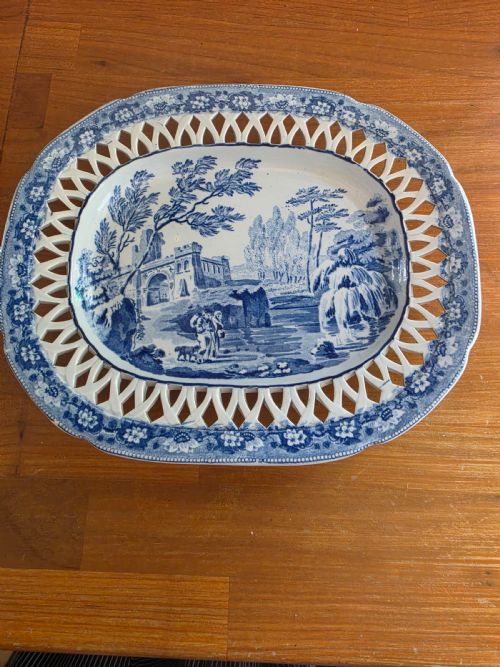
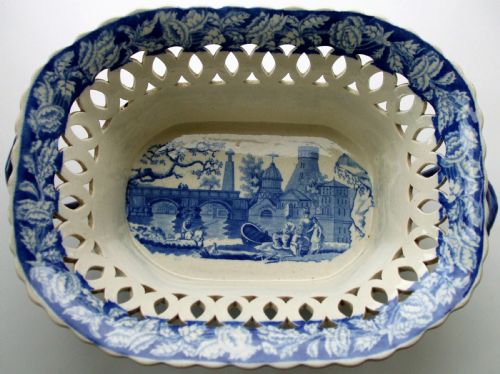
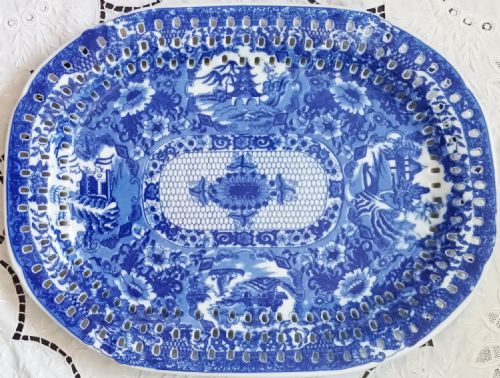
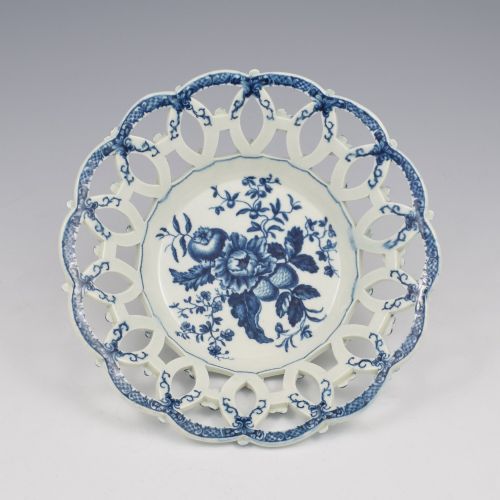
These reticulated blue white dish pieces offer pierced borders and cobalt decoration, combining practical utility with refined table display.
Reticulated Blue White Dish
A reticulated blue white dish serves as a pierced or fretted vessel designed for table service and display. The form encompasses serving dishes, platters, comports, and chestnut baskets intended for fruit or confectionery.
Most examples found here date from the eighteenth and nineteenth centuries, spanning Georgian and Regency periods. Makers and origins include English earthenware and pearlware potteries alongside Chinese export porcelain and French porcelain factories.
The defining characteristic remains the openwork or pierced rim, known as reticulation, paired with cobalt blue painted or transfer-printed decoration. Buyers encounter traditional patterns such as river scenes, nets, and pine cone motifs across these ceramic forms.
How they were made
Potters shaped these objects from earthenware, pearlware, soft-paste porcelain, and ironstone ceramic bodies. Artisans applied cobalt blue pigment beneath a transparent glaze before firing the pieces in kilns.
The distinctive pierced reticulation required careful cutting of the clay while leather-hard, demanding high skill to prevent distortion during firing. Transfer printing and hand painting delivered the intricate blue and white patterns seen across the surface.
Listings feature pearlware, earthenware, and soft-paste porcelain across the eighteenth and nineteenth centuries.
What varies in quality
Quality rests upon the crispness of the pierced reticulation and the precision of the cobalt blue application. Finer examples maintain sharp, clean apertures without glaze pooling, while lesser pieces show blurred cutting.
The clarity of the transfer-printed pattern or the finesse of hand-painted brushwork dictates the tier of the piece. Porcelain versions and early soft-paste bodies generally exhibit greater refinement than later mass-produced earthenware.
Davenport·J. and R. Clews·Sevres
The Reticulated Blue White Dish Glossary
- Reticulated
- Pierced or openwork decoration resembling a net or lattice. This technique forms decorative borders on baskets and serving dishes.
- Transfer printing
- A method of applying complex decorative patterns to ceramics using a copperplate and tissue paper. It revolutionised blue and white production in pottery works.
- Soft-paste porcelain
- An artificial porcelain composition fired at lower temperatures than hard paste. Eighteenth-century factories utilised this material before true hard-paste porcelain formulas became widespread.
Reticulated Blue White Dish: Frequently Asked Questions
What are reticulated blue white dishes?
These ceramic vessels feature openwork pierced borders and cobalt blue decoration, taking the form of baskets, comports, and platters.
Potters produced them across the eighteenth and nineteenth centuries in England, China, and France for dining tables.
How were these dishes used originally?
Households utilised chestnut baskets, serving dishes, and pierced platters for presenting fruit, roasted chestnuts, and sweetmeats at formal meals.
The openwork allowed air circulation or simply added decorative elegance to dessert courses.
How do I care for antique porcelain baskets?
Owners should wash these delicate ceramics by hand using warm water and mild soap, avoiding modern dishwashers entirely.
Display them away from high-traffic edges where the fragile pierced rims might suffer accidental impact.
How do I distinguish pearlware from earthenware?
Pearlware displays a characteristic pale bluish tint in the glaze, particularly where it pools around foot rims and handles.
Standard earthenware bodies tend to show a warmer cream or white tone beneath transparent glaze layers.