


Repousse Brass Wall Mirror
A repousse brass wall mirror brings warmth and reflective depth to a room through beaten metalwork and period charm.
Repousse Brass Wall Mirror
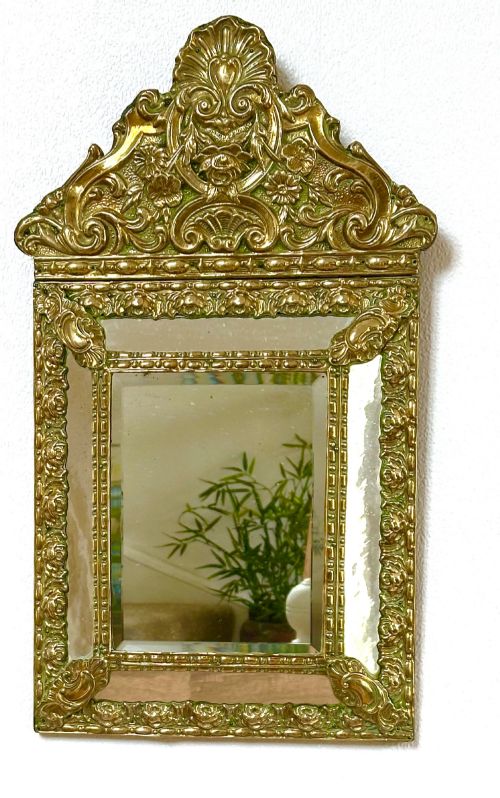
When searching for a repousse brass wall mirror, you are looking at wall-hanging reflective pieces shaped by historical revival styles spanning the Victorian and Edwardian eras. The most frequent examples you will encounter here feature cushion frames or decorative metal mounts executed in brass and copper.
The selection ranges from Flemish Renaissance Revival and Dutch Baroque forms to simpler Arts and Crafts interpretations. These pieces often incorporate bevel-edged mirror glass set within hand-embossed metallic surrounds.
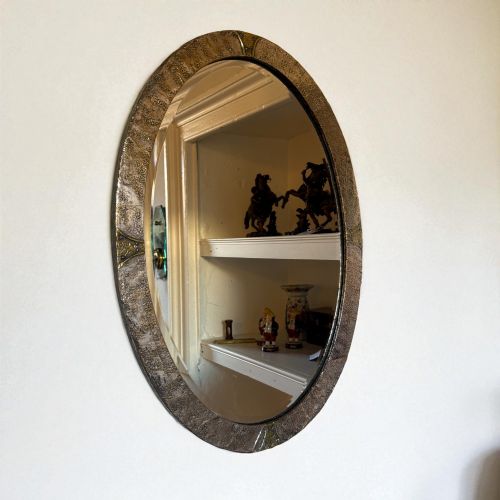
Origins stretch from British workshops to French ateliers and Scottish centres, demonstrating diverse regional interpretations of metalworking. You will find both circular formats and generous oval designs suited to hallways and reception rooms.
Materials and construction methods
Makers utilised sheet brass and copper, working the metal from the reverse side using hammers and punches to create raised relief designs. This repousse or embossed technique allowed artisans to achieve intricate floral, scrolling, and figurative motifs across the frame.
Frames were frequently constructed by mounting the beaten metal panels over a wooden core or supporting structure to ensure rigidity. Ebonised wood and mirror glass complete the construction, with some pieces incorporating patinated finishes to age the metal surface.
Peacocks flank the glass on certain Glasgow School mirrors, watching over your hallway.
Evaluating craftsmanship and detail
Quality in these mirrors rests primarily on the depth and precision of the hand-beaten relief work. Superior examples display sharp, well-defined motifs without excessive thinning of the metal sheet.
The integrity of the underlying wooden structure and the quality of the original bevel-edged glass further distinguish finer pieces. Well-executed patination and intact metal mounts without clumsy repairs elevate the standing of the work.
The Repousse Brass Wall Mirror Glossary
- Repoussé
- A metalworking technique where the artisan hammers metal from the reverse side to form a raised design on the front. This method creates tactile, three-dimensional decorative surfaces.
- Cushion frame
- A frame style with a rounded, convex profile that slopes inward toward the glass. It adds substantial visual depth to wall mirrors.
- Girandole
- A decorative wall mirror featuring attached candle sconces or branches. The polished brass reflects the candlelight to brighten dark interiors.
- Bevel edge
- A sloping edge cut around the perimeter of the mirror glass. This treatment catches the light and adds a refined finish.
- Patination
- The natural or induced ageing of the brass surface over time. It produces varied tones that reveal the age and handling of the piece.
Repousse Brass Wall Mirror: Frequently Asked Questions
Where should I hang a brass mirror?
These mirrors suit hallways, reception rooms, and living spaces where they catch and reflect natural daylight. Their warm metallic tones complement both traditional interiors and modern settings.
Ensure the wall fixings match the weight of the frame, particularly for larger cushion-framed or Scottish Arts and Crafts examples.
How do I date a brass wall mirror?
Dating relies on stylistic clues such as the boldness of Arts and Crafts motifs or the elaborate scrolling typical of Flemish revival pieces. Materials like ebonised wood backs and early mirror glass also provide chronological markers.
Compare the construction techniques and mounting hardware against known periods like the Victorian or Edwardian eras to narrow down the decade.
What is the difference between repousse and embossed brass?
Repousse specifically refers to metal beaten from the reverse side to raise the design, while embossing is a broader term that can include pressing or stamping from the front. Many Victorian pieces use pressed brass machinery alongside hand-finishing.
Close inspection of the relief reveals whether the artisan worked the metal by hand or utilised industrial presses.
How do I clean an antique brass mirror?
Dust the frame gently with a soft, dry cloth to remove surface particles. Avoid abrasive commercial cleaners that strip away the historical patination.
Keep moisture away from the wooden backing and the silvered edges of the mirror glass to prevent deterioration.