



Repeating Travel Clock
A repeating travel clock is a portable timepiece designed for the road that chimes the hours or minutes on demand.
Repeating Travel Clock
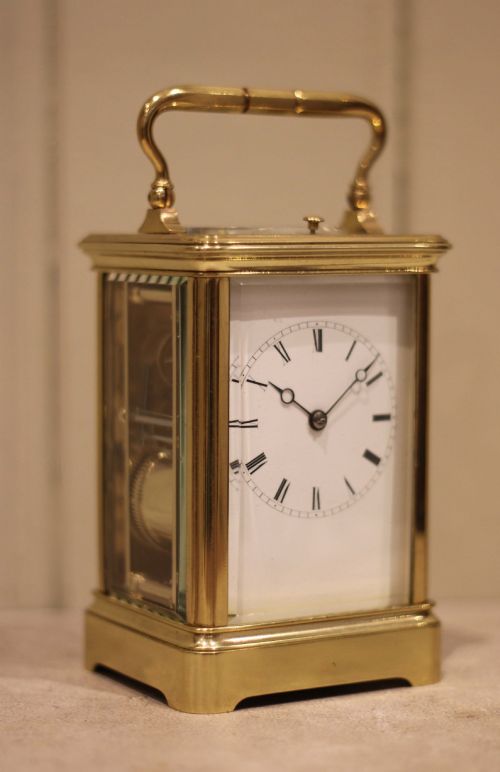
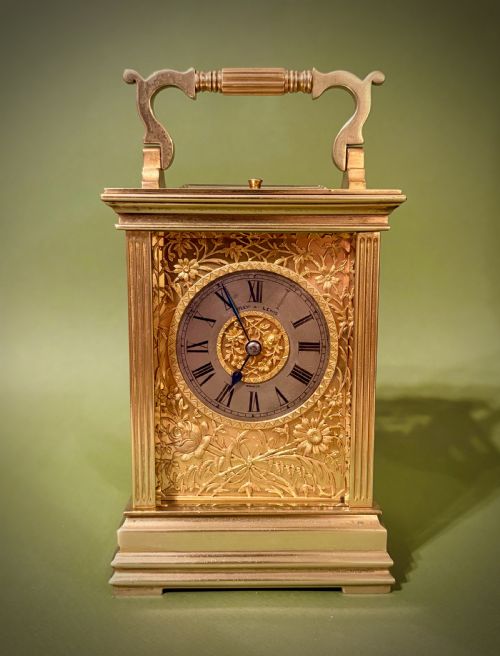
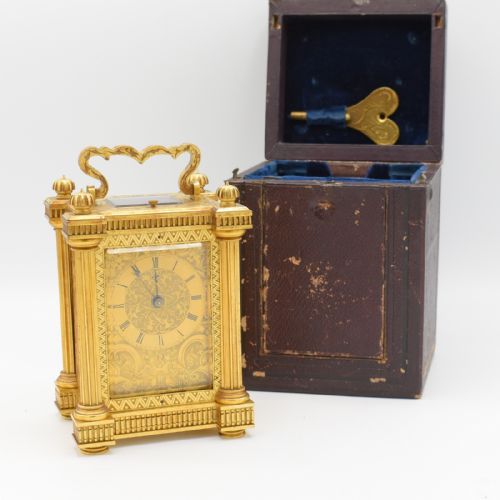
A repeating travel clock is primarily represented on this page by French carriage clocks originating from the nineteenth century, including Victorian examples and works from the Edwardian period. These pieces take the form of freestanding clocks housed in brass, gilt brass, or silver gilt frames with glass panels that reveal the interior mechanics.
Makers and retailers such as Drocourt, Henry Jacot, Howell & James London, and J.W. Benson feature among the inventory, spanning decades from the 1850s to the early twentieth century. The selection ranges from plain cases to fully engraved examples with enamel bands, flower designs, or enamel paintings.
How they were made
The construction relies heavily on brass and gilt brass formed into robust rectangular or gorge cases, fitted with bevelled glass panels to protect the delicate inner mechanisms. Many instances involve steel components within the movement and leather elements for travel cases.
Finishing techniques include gilding, silver plating, and detailed hand engraving across the metal masks and cases. Enamel is applied for dials, bands, and decorative panel paintings, while specialised striking trains incorporate bells or gongs.
Repeating Travel Clock Retail Price Guide 2026
Typical asking prices for repeating travel clock among the pieces listed under this phrase on Sellingantiques today, from the lower quarter to the upper quarter. They describe what is for sale here now, not the wider market.
Some nineteenth-century travellers required specialised mechanisms to remind them of racehorse start times while away from home.
What varies in quality
Quality differences lie in the complexity of the movement, distinguishing standard hour repeaters from grand sonnerie, petite sonnerie, or five-minute repeating mechanisms. The presence of complications such as alarm work, date displays, and ting tang strikes elevates a piece.
The depth and execution of hand engraving on the brass case and dial mask set finer pieces apart from plain production models. Preserved original gilding and signed movements from renowned makers also define the upper tier of the range.
Drocourt·Alfred Drocourt·Henry Jacot·Moser·Howell & James London·J.W. Benson·Captain Henry·Bishop Bournemouth·Ripon
The Repeating Travel Clock Glossary
- Repeating movement
- A mechanism that sounds the last hour or quarter-hour when a button or plunger is pressed. This function allows the user to check the time in total darkness.
- Grand Sonnerie
- A striking train that automatically chimes the hours and quarters as they pass, as well as repeating the hour on demand. It represents a complex level of clockmaking skill.
- Gorge case
- A distinct rectangular carriage clock case style characterised by a stepped top and base moulding. It is frequently seen on high-grade nineteenth-century pieces.
- Platform escapement
- The small horizontal assembly mounted on top of the movement containing the balance wheel and hairspring. This allows portable clocks to keep time accurately despite motion.
Repeating Travel Clock: Frequently Asked Questions
How do I wind a repeating travel clock?
Most pieces utilise a key inserted into the arbours on the backplate to tension the mainsprings for both the time and strike trains.
Care must be taken not to overwind the springs, stopping as soon as resistance is felt.
Why does the clock strike on its own?
Clocks featuring striking trains or sonnerie movements are designed to sound the hours and quarters automatically as time progresses.
Some models permit switching between silent mode, striking, and alarm functions via a lever on the underside.
How should I travel with these clocks?
Original leather outer cases provide essential protection against knocks and temperature changes during transit.
Internal locking mechanisms or platforms should be secured where fitted to prevent damage to the balance wheel.
How do I determine the period?
Stylistic clues such as gorge cases, enamel dial paintings, and case engraving help narrow down the production decade.
Maker signatures and registration numbers stamped on the movement backplate offer further chronological context.