

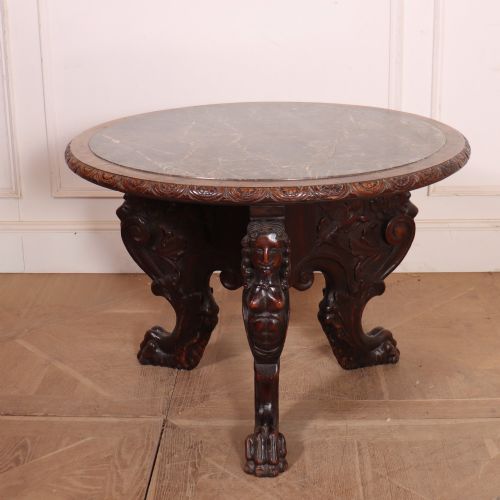


Renaissance Revival Side Table
These renaissance revival side table pieces bring grand historical ornament and heavy timber character straight into a modern room.
Renaissance Revival Side Table
A renaissance revival side table draws on earlier 16th century forms while serving the domestic needs of the 19th century. Buyers seeking a renaissance revival side table will find examples spanning French, Italian, and English traditions, often styled as centre tables, hall tables, or writing tables.
The construction typically dates from the Victorian era, particularly the decades between 1860 and 1900, though earlier Italian influences run deep. Forms range from simple occasional tables to heavy oak and walnut pieces fitted with drawers and intricate carving.
How they were made
Cabinetmakers relied on solid timber construction, primarily using oak, golden oak, and walnut as the structural base for these heavy tables. Decorative surface work often incorporated boxwood and bone inlay, alongside substantial carved wood details.
Many examples feature applied mouldings, turned supports, and leather inserts for writing surfaces. Selected pieces also integrate marble tops and marquetry inlay to add visual weight and texture.
Renaissance Revival Side Table Retail Price Guide 2026
Typical asking prices for renaissance revival side table among the pieces listed under this phrase on Sellingantiques today, from the lower quarter to the upper quarter. They describe what is for sale here now, not the wider market.
Current listings demonstrate a strong presence of oak and walnut construction, spanning from nineteenth century Victorian interpretations back to sixteenth century Italian origins.
What varies in quality
The depth and execution of the carved ornamentation define the upper tier of these tables, particularly figures such as the Green Man or classical motifs. Crisp detailing in the woodwork separates standard production pieces from exceptional workshop creations.
Material selection dictates much of the distinction across the range, with figured walnut, dense golden oak, and intricate bone or boxwood inlay commanding greater visual presence. The integrity of the secondary timbers and the precision of the joinery further establish the standing of each piece.
The Renaissance Revival Side Table Glossary
- Renaissance Revival
- A nineteenth century design movement that reinterpreted sixteenth century architectural and decorative motifs. It appears frequently in heavier Victorian furniture.
- Centre Table
- A freestanding table designed to be viewed from all sides rather than pushed against a wall. These often feature finished backs and all-round carving.
- Marquetry
- The art of applying decorative pieces of veneer to a structure to form geometric or pictorial designs. This technique adds ornamental contrast to walnut surfaces.
- Pier Table
- A table designed to fit against a wall space between windows, often paired with a mirror above. They frequently serve as lamp tables in modern settings.
- Golden Oak
- A bright, warm variety of oak timber favoured during the later nineteenth century. It highlights the grain under clear finishes.
Renaissance Revival Side Table: Frequently Asked Questions
Where should I place a side table?
These tables suit hallways, living rooms, and studies where their carved wooden frames can be fully appreciated. Freestanding centre versions work well away from walls.
Smaller occasional and lamp variants fit easily beside seating or beneath windows to hold lighting and display objects.
How do I care for antique oak?
Maintain the timber by keeping it away from direct heat sources and sudden humidity changes to prevent splitting. Regular dusting with a dry cloth protects the finish.
Apply a traditional beeswax polish occasionally to nourish the wood and preserve the depth of the grain without creating heavy buildup.
Are these tables sturdy enough for daily use?
Solid construction in oak and walnut makes these tables robust for everyday placement in a home. The heavy frames provide a stable base for lamps and books.
Tables fitted with drawers or leather writing surfaces offer practical storage and utility alongside their decorative appearance.
What defines the Victorian period style?
Victorian furniture often revives historical aesthetics, blending sixteenth century revival motifs with nineteenth century manufacturing methods. Heavy proportions and dark woods dominate the output.
Carved details draw heavily on architectural elements, gothic influences, and continental European traditions.