
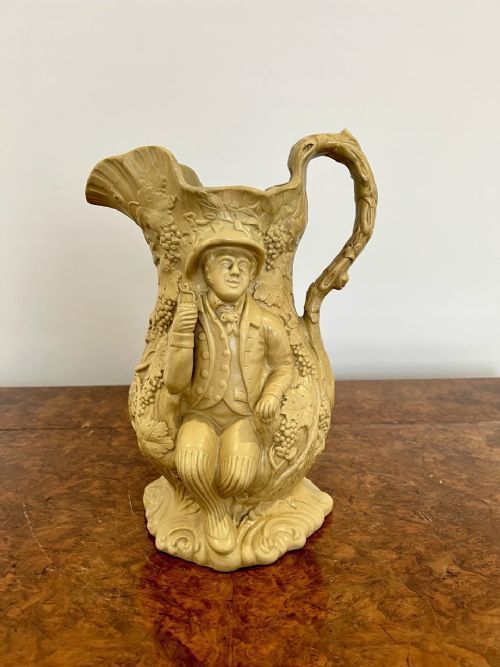


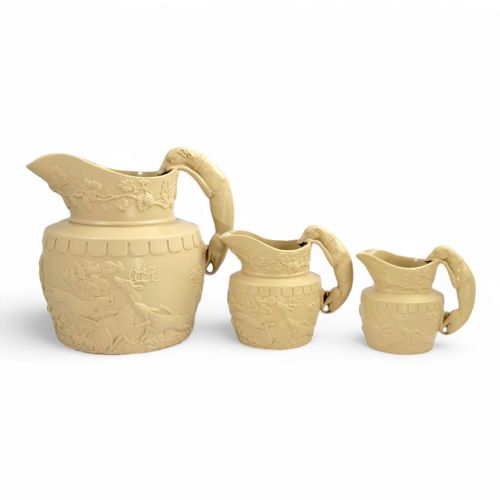


Relief Moulded Ceramic Jug
A relief moulded ceramic jug brings tactile history to the table, offering crisp historical ornament shaped directly in the clay.
Relief Moulded Ceramic Jug
When you search for a relief moulded ceramic jug, you are looking at utilitarian and decorative vessels whose surfaces are defined by raised pictorial and decorative motifs. These pieces emerge predominantly from the nineteenth century, spanning the Georgian, Regency, and Victorian periods.
The versions you are most likely to meet on this page include large pitchers, milk jugs, and decorative jugs taking forms such as the Bacchanalian Dance, the Stag Hunt, and the Victoria and Wellington commemoratives. Styles range from classical revival and Gothic influences to colourful majolica and parian wares.
Makers and makers' marks occasionally identify specific potteries, though many pieces rely on the distinct character of the moulding and the glaze to tell their story. The forms vary from intimate milk jugs to substantial exhibition pieces holding multiple gallons.
How they were made
Potters created these vessels by pressing clay into multipart plaster moulds that carried deeply sunken designs, allowing the intricate patterns to transfer directly onto the body of the jug. Earthenware and stoneware formed the structural base, often complemented by white stoneware, buff stoneware, or black basalt bodies.
Coloured glazes, salt glazing, or rich majolica enamels were then applied to accentuate the depth of the relief work, sometimes paired with applied sprigged decorations or contrasting pewter mounts.
A jovial hound handle peers out from one Regency pitcher, ready to assist your pouring arm with canine enthusiasm.
What varies in quality
The sharpness and definition of the raised motifs separate superior examples from softer, worn castings where the details of the scene have grown muddy. Crisp undercutting in the mould work and careful registration of the design halves determine how successfully the narrative reads across the surface.
The application of the glaze also dictates value, with well-controlled colour washes or even salt-glazed finishes preserving the fine textures beneath rather than pooling in the recesses and obscuring the maker's intent.
Charles Meigh·Ridgway and Sons·Jones and Walley·Minton·Phillips and Bagster·George Jones
The Relief Moulded Ceramic Jug Glossary
- Relief moulding
- A ceramic forming technique where designs are pressed outward from the body of the vessel using carved moulds. This creates a three-dimensional surface texture that catches light and shadow.
- Majolica
- A colourful lead-glazed earthenware style popular in the Victorian era. It uses vibrant metallic oxide glazes over moulded reliefs.
- Parian ware
- A fine white ceramic developed to imitate marble, often cast into classical or figural jugs. It possesses a smooth, unglazed biscuit finish.
- Salt glaze
- A vitreous coating formed by throwing common salt into the kiln during high-temperature firing. This produces a textured, pebble-dash orange-peel surface.
- Sprigged ware
- Small moulded clay ornaments applied separately to the damp body of a jug using slip as an adhesive. These create a contrasting raised decoration against the background.
Relief Moulded Ceramic Jug: Frequently Asked Questions
What were relief moulded jugs used for?
These vessels served both practical and decorative purposes in nineteenth-century households, functioning as pitchers for ale, water, or milk at the dining table. Many larger examples were also displayed on sideboards or used as commemorative display pieces.
Over time, their rich figural and botanical scenes shifted their role from everyday kitchenware to prized decorative ornaments collected for their sculptural detail.
How do I date a relief moulded ceramic jug?
Dating relies heavily on the stylistic clues of the period, such as Victorian Gothic revival motifs, Regency classical figures, or Georgian shapes. The type of body clay, from buff stoneware to majolica earthenware, also points toward specific decades of production.
Maker marks, registration diamonds, and named subjects like the Victoria and Wellington commemoratives provide precise historical anchors for when the piece was manufactured.
Are these jugs safe to use daily?
While many of these vessels were originally made for functional dining use, antique ceramics with historical glazes and delicate relief work are generally best reserved for display. Age can render the historic bodies and historic handles vulnerable to thermal shock or impact.
Handling them with care ensures the crisp moulded details and original glazed surfaces remain undamaged for future appreciation.
What is the difference between stoneware and earthenware jugs?
Stoneware is fired at a much higher temperature until the body vitrifies, making it dense, heavy, and naturally waterproof without requiring an interior glaze. Earthenware uses a more porous clay body that relies entirely on glazes to hold liquids.
In these jugs, stoneware often yields crisper salt-glazed or sprigged details, while earthenware forms the vibrant coloured canvas seen in majolica pieces.