


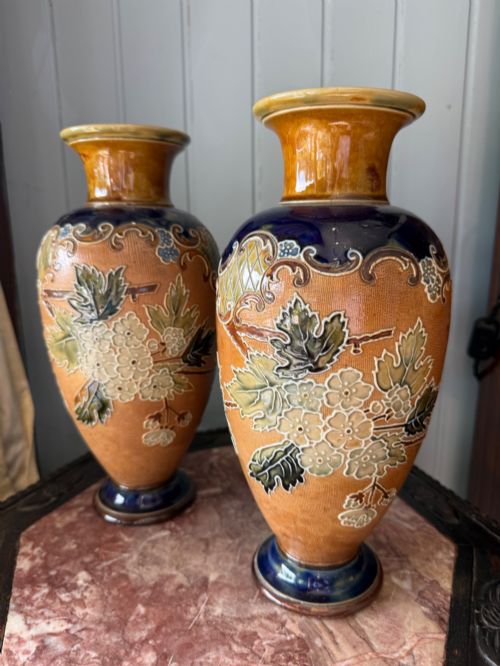



Relief Decorated Ceramic Urn
A relief decorated ceramic urn brings layered texture and classical form into a room, offering distinct tactile interest.

Relief Decorated Ceramic Urn
A relief decorated ceramic urn encompasses vessels shaped from clay and finished with raised ornamental detailing that catches the light and adds depth. The selection includes nineteenth century pieces, Victorian creations, and Regency examples, spanning forms from garden planters and water filters to decorative vases and jardinieres.
Buyers encounter earthenware, stoneware, porcelain, and terracotta, often enriched with glaze, enamel, and gold leaf. Styles range from Victorian and Arts and Crafts to Japanese Meiji and Victorian Chinoiserie.
Most items on this page lean towards nineteenth century production, reflecting the period's preference for ornamental vessels suited to domestic display or garden settings.
How they were made
Potters shaped these vessels using traditional methods in clay, terracotta, earthenware, and stoneware, applying raised surface designs before firing. Many pieces received a protective ceramic glaze or enamel finish to seal the body.
Detailing often included applied ornamentation or moulded relief work, occasionally highlighted with gold leaf to emphasise the raised patterns on the ceramic body.
Relief Decorated Ceramic Urn Retail Price Guide 2026
Typical asking prices for relief decorated ceramic urn among the pieces listed under this phrase on Sellingantiques today, from the lower quarter to the upper quarter. They describe what is for sale here now, not the wider market.
One listed nineteenth century water vessel proudly carries a patent name, proving that even domestic plumbing once aspired to grand sculpture.
What varies in quality
Quality rests in the crispness of the moulded relief work and the control evident in the glaze or enamel application. Sharper definition in the raised motifs and more disciplined brushwork distinguish finer pieces from simpler domestic wares.
The sophistication of the ceramic body, whether dense stoneware, refined porcelain, or porous terracotta, dictates the durability and visual weight of the vessel.
Royal Doulton·Makuzu Kozan II·Bernhard Bloch·Burmantofts Faience·Royal Worcester·Mason
The Relief Decorated Ceramic Urn Glossary
- Stoneware
- A robust ceramic fired at high temperatures until semi-vitrified. It holds water naturally and accepts salt glazes readily.
- Terracotta
- Fired unglazed earthenware with a warm brownish-red colour. It remains porous unless sealed.
- Jardiniere
- An ornamental pot designed to hold a plant or flowers. These vessels often sit on floors or sturdy tables.
- Baluster
- A architectural form characterised by a swelling lower body tapering to a narrow neck. Many vases adopt this profile.
Relief Decorated Ceramic Urn: Frequently Asked Questions
What periods do these urns come from?
The listings include pieces from the nineteenth century, including Regency, Victorian, and later periods up to nineteen twenty.
Maker attributions and stylistic clues help determine the specific era of manufacture.
Are these urns suitable for outdoor use?
Terracotta and heavy stoneware vessels are typically suited to garden environments, provided winter frost is managed.
Porcelain and delicate earthenware pieces require indoor placement to protect the glaze and body.
What materials are commonly used?
Construction materials span earthenware, stoneware, porcelain, and terracotta, depending on the maker's intention.
Surfaces are frequently enhanced with enamel, gold leaf, and traditional ceramic glazes.
How do styles differ across the pieces?
Styles range from Victorian and Arts and Crafts to Japanese Meiji and Regency interpretations.
Each aesthetic brings distinct decorative motifs and surface treatments to the ceramic form.