

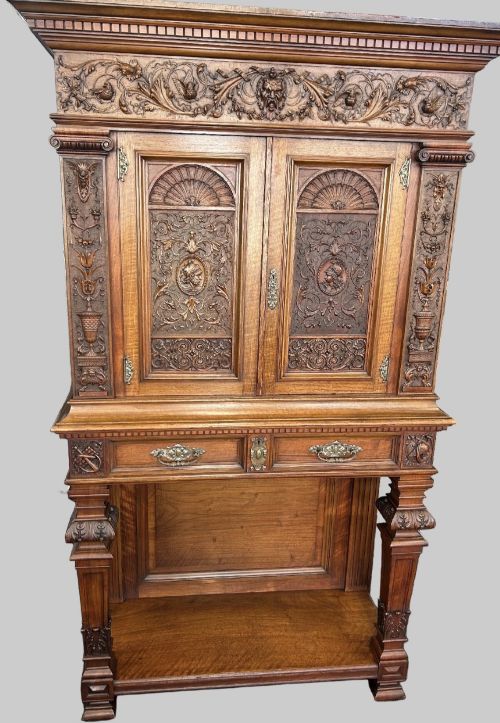
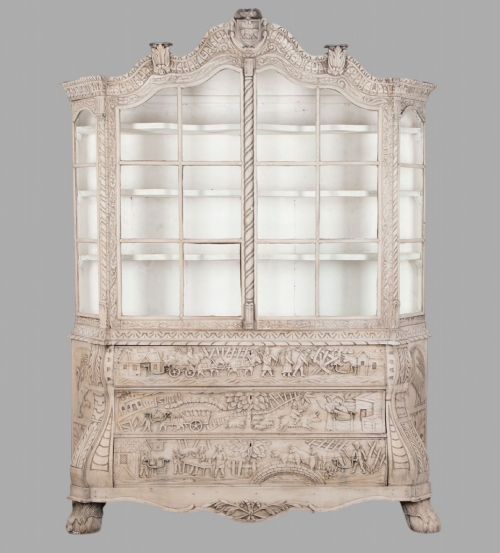
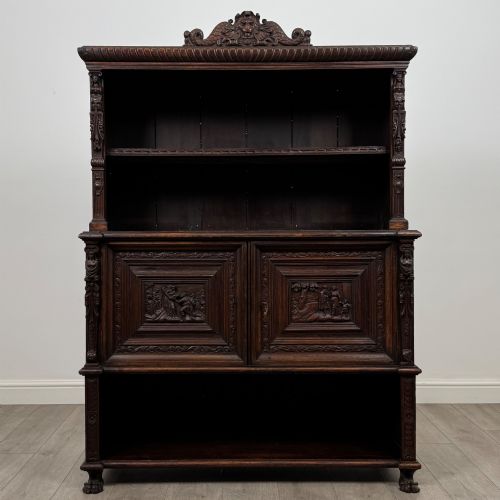


Relief Carved Oak Cupboard
A relief carved oak cupboard brings heavy timber and dense historic ornamentation straight into a room.
Relief Carved Oak Cupboard
When you search for a relief carved oak cupboard, you encounter substantial storage furniture shaped by centuries of revivalism and regional continental tastes. The examples present on this page span several eras, reaching from the sixteenth century through the Georgian period and deep into nineteenth-century Victorian production.
Most pieces you meet here belong to the nineteenth century, often reflecting French, Dutch, or Flemish revivals rather than the earliest centuries of domestic joinery. These larger items take various forms including sideboards, hall cupboards on stands, corner cabinets, and display cabinets on chests.
Makers and workshops working across the nineteenth century drew heavily on earlier vocabularies, producing heavy oak pieces fitted with brass, iron, and glass. The resulting selection ranges from rustic French provincial sideboards to impressive Dutch bombé display units.
How they were made
Construction relies primarily on solid oak, selected for durability and finished with deep surface carving executed by hand. Joiners worked the timber to form large carcasses for sideboards and cabinets, integrating heavy panels designed to display intricate sculptural motifs.
Metalwork plays a functional and decorative role, incorporating iron hinges and brass fittings that secure heavy doors and drawers. Glass panels appear on specific display variants to enclose the upper sections while protecting the interior.
Relief Carved Oak Cupboard Retail Price Guide 2026
Typical asking prices for relief carved oak cupboard among the pieces listed under this phrase on Sellingantiques today, from the lower quarter to the upper quarter. They describe what is for sale here now, not the wider market.
Object forms on this page include sideboards, hall cupboards on stands, corner cabinets, and bombé display units.
What varies in quality
Quality reveals itself in the depth and sharpness of the carved detail across the oak panels, distinguishing spirited handwork from mechanical repetition. The crispness of Renaissance and Gothic revival motifs defines the visual success of each cabinet.
Proportion and structural integrity separate simpler provincial items from ambitious continental showpieces like bombé display cabinets and large Flemish hall cupboards. The integration of heavy timber with functional brass and iron hardware dictates the lasting coherence of the piece.
The Relief Carved Oak Cupboard Glossary
- Bombé
- A swelling, outward-curving profile found on case furniture such as display cabinets. This bulging form requires advanced woodworking skill to shape from solid timber.
- Buffet de Corps
- A large, two-tier continental storage piece featuring upper and lower cupboard sections. These substantial dining room items typically showcase prominent surface carving.
- Gothic Revival
- An architectural and decorative style drawing on medieval ecclesiastical forms. Pieces in this idiom feature pointed arches and tracery carved directly into the oak.
- Renaissance Revival
- A nineteenth-century movement emulating sixteenth-century classical ornament. Furniture in this style displays heavy architectural mouldings, figures, and strapwork.
- Hall Cupboard
- A tall storage piece designed for an entrance hallway to hold garments and household goods. These items often stand on raised bases or integrated frames.
Relief Carved Oak Cupboard: Frequently Asked Questions
How do I date a relief carved oak cupboard?
Dating relies on examining the construction methods, secondary woods, and stylistic revival indicators present in the carved motifs. Sixteenth-century pieces differ fundamentally in joinery from nineteenth-century revivals that imitate earlier aesthetics.
Hardware such as iron hinges and brass pulls also help establish the chronological context of the cabinet. Comparing the specific revival style, whether Flemish, French, or Gothic, clarifies the period of manufacture.
Where were these cupboards made?
The listings show pieces originating from various European workshops, including French provincial makers, Dutch cabinetmakers, and Flemish workshops. Continental influences dominate the surviving selection of nineteenth-century revival furniture.
Regional preferences dictate whether a piece takes the form of a French game cupboard or a Dutch bombé display cabinet. These geographic origins shape the specific carving vocabulary seen on the oak surfaces.
How do I care for historic oak furniture?
Maintaining heavy oak furniture involves keeping pieces away from direct heat sources and sudden humidity changes to prevent timber movement. Regular dusting with a soft cloth preserves the dry finish of the carved surfaces.
Applying appropriate wax occasionally helps nourish the oak without building up heavy residues. Checking brass and iron fittings ensures doors and drawers continue to operate smoothly.