




Regency Rosewood Sheet Music Rack
A regency rosewood sheet music rack brings refined elegance to a room, holding folios and papers with timeless grace.
Regency Rosewood Sheet Music Rack
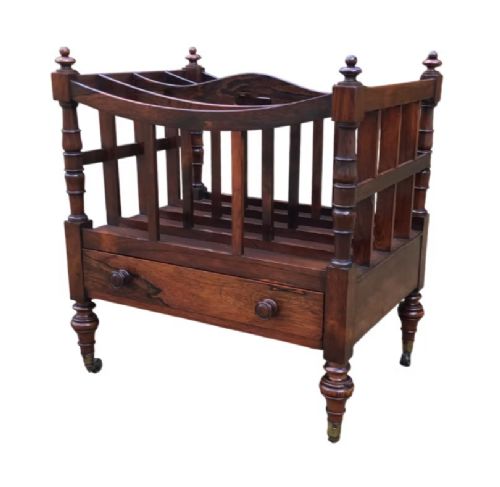
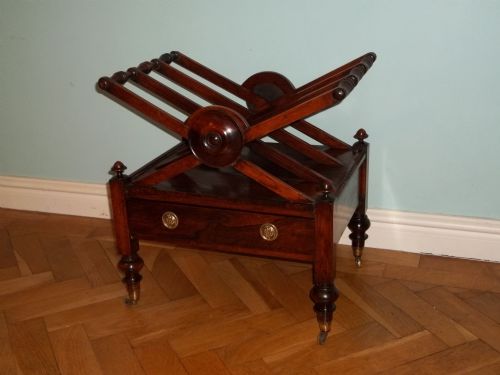
A regency rosewood sheet music rack, often known as a canterbury or magazine rack, serves as a designated stand for organising scores and periodicals. These pieces frequently appear in forms featuring multiple divisions, carrying handles, and occasionally lower drawers.
The pieces on this page span the Regency, George IV, and William IV periods, alongside the broader 19th-century era. Originating primarily as English country house furnishings, they reflect the refined tastes of the early nineteenth century.
Makers and designers of the period, such as J C Loudon and Gillows, heavily influenced these functional stands. Buyers will encounter both standard single or double-tier formats and grander folio stands designed for larger proportions.
How They Were Made
Craftsmen utilised rich rosewood veneers and solid timbers, often incorporating mahogany elements within the internal structures. Decorative inlay and intricate carved details, such as Prince of Wales feathers, frequently adorn the framework.
Brass fittings, including castors and carrying handles, provide both mobility and structural accentuation. The divisions are constructed with slender vertical slats, balanced upon turned supports or robust plinth bases.
Some models feature carrying handles so eager musicians could easily haul their sheet music from the drawing room to the parlour.
What Varies in Quality
The distinction between standard examples and finer items rests upon the crispness of the carving and the grain figure of the rosewood. Pieces associated with notable workshops display superior joinery and more refined proportions.
Subtleties such as integrated lower drawers, double-size proportions, or sophisticated brass castors elevate the complexity of a piece. The integration of thoughtful design elements, reminiscent of Loudon or Gillows, marks the upper tier of quality.
J C Loudon·Gillows
The Regency Rosewood Sheet Music Rack Glossary
- Canterbury
- A low stand with upright divisions, originally designed for holding sheet music and folios. It often includes a carrying handle and a small drawer beneath.
- Regency
- A stylistic period spanning the early nineteenth century, characterised by classical restraint and elegance. Furniture from this time often draws inspiration from Greek, Roman, and Egyptian motifs.
- Rosewood
- A dense, heavily figured timber prized for its dark grain and rich colour. It was the material of choice for fine decorative furniture during the nineteenth century.
- Folio stand
- A larger variant of the music stand or canterbury designed to hold oversized papers and folios. These are typically found in country house proportions.
Regency Rosewood Sheet Music Rack: Frequently Asked Questions
What is a canterbury used for?
A canterbury was originally designed to hold sheet music, folios, and unbound papers near a piano or seating area. Today, they function equally well for organising modern magazines and periodicals.
Their compartmentalised design keeps reading material upright and sorted, preventing damage to delicate pages while remaining accessible.
How do I identify a Regency piece?
Regency furniture is typically dated between the early nineteenth century and the reign of William IV, reflecting classical design influences. Look for clean lines, dark rosewood timbers, and restrained classical ornamentation.
Details such as brass castors, turned uprights, and precise joinery help distinguish pieces from this specific stylistic window.
What is the difference between a music stand and a canterbury?
While both serve to hold paper and folios, a traditional music stand often incorporates an adjustable reading surface or table top. A canterbury is defined primarily by its vertical partitions forming distinct slots for storage.
Some hybrid forms combine elements of both, functioning as combined tables and racks.
Are these stands sturdy enough for daily use?
These pieces were built from dense timbers like rosewood and mahogany, designed to withstand the active demands of a nineteenth-century household. Their robust construction makes them well-suited for holding contemporary magazines and heavy books.
Care should be taken when moving them, particularly models fitted with original brass castors.