
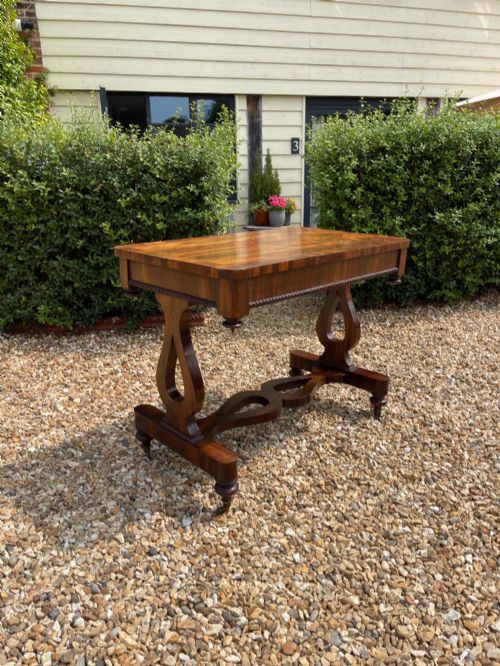
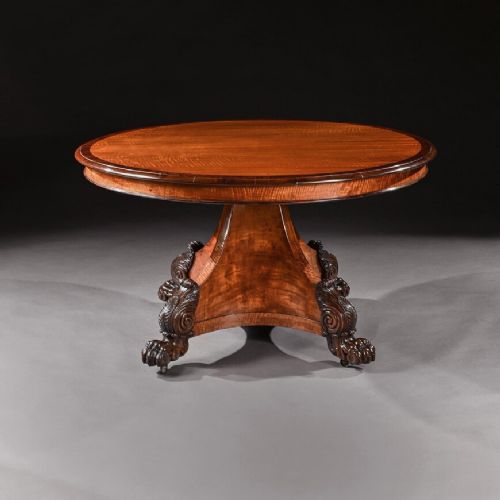
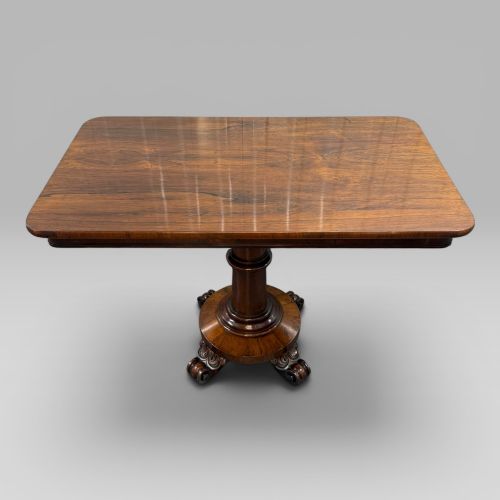


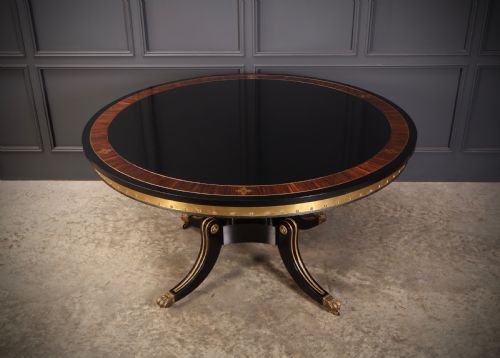


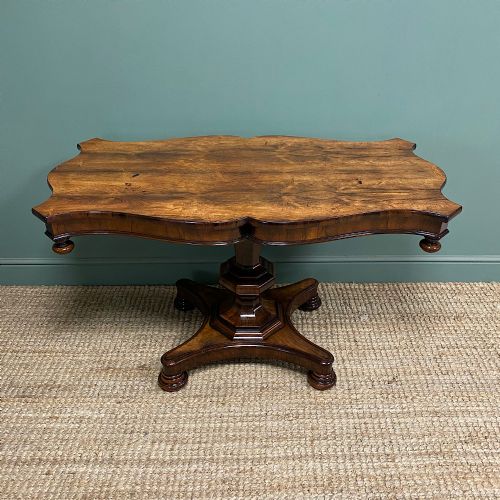

Regency Rosewood Foyer Table
These pieces known as a regency rosewood foyer table are substantial centre tables designed to anchor an entrance hall with rich dark timber and classical proportion.
Regency Rosewood Foyer Table
When you search for a regency rosewood foyer table, you are looking at substantial freestanding tables placed centrally in a hall or principal room. The examples found here span the nineteenth century, including the Regency, George IV, and William IV periods, alongside later interpretations.
Most pieces encountered take the form of round or occasional centre tables, often featuring tilt-top mechanisms or sturdy pillar bases. Alongside domestic English workshops, the selection includes Anglo-Indian craftsmanship and continental work such as the satinwood and rosewood pieces from Genoa.
These tables served grand architectural interiors where a commanding first impression mattered. Their circular tops and pedestal supports allowed them to sit comfortably in the middle of a space rather than against a wall.
How they were made
Cabinet makers utilised dense rosewood veneers laid over secondary timbers to achieve deep figuring across the broad circular surfaces. Carpenters frequently selected contrasting woods like satinwood or incorporated marquetry inlay to frame the central grain.
Metalwork played a structural and decorative role, with brass inlay set flush into the timber and parcel gilding highlighting carved elements. Heavy pillar supports relied on robust internal framing to bear the weight of large stone or timber tabletops.
Some nineteenth-century tables hide ingenious folding mechanisms designed solely to hide them against a wall when the hallway needed to host dancing.
What varies in quality
The distinction between ordinary and exceptional tables rests upon the selection of the timber and the crispness of the carving on the pedestal base. Master workshops achieved seamless veneer matching across expansive tops, whereas simpler pieces show less uniform grain selection.
Precision in brass inlay and the integration of secondary woods separate standard production from high-status commissions. The structural integrity of the tilt-top mechanism and the weight of the central column also indicate the standard of the original workshop.
Peters of Genoa·James Winter of Wardour Street
The Regency Rosewood Foyer Table Glossary
- Centre table
- A freestanding table finished on all sides designed to stand in the middle of a room rather than against a wall. These pieces formed a focal point in nineteenth-century entrance halls and libraries.
- Tilt-top
- A hinged tabletop mechanism allowing the surface to fold vertical when not in use. This clever engineering saved floor space in busy domestic interiors.
- Parcel gilt
- The practice of applying thin gold leaf to specific carved details while leaving the surrounding wood exposed. This technique accentuated architectural mouldings and classical motifs.
- Goncalo alves
- A dense exotic hardwood sometimes utilised alongside or in place of traditional rosewood. It displays striking dark contrasting figuring.
- Ebonised
- Wood treated with a chemical stain or dark finish to imitate ebony. This dark surface provided a sharp contrast to inlaid brass or gilt details.
Regency Rosewood Foyer Table: Frequently Asked Questions
Where did these tables stand?
These tables stood prominently in the middle of large entrance halls or reception rooms where guests arrived. Their circular design allowed movement around the entire perimeter.
In daily use, they held decorative bowls, lamps, or calling card trays, serving both practical and ceremonial functions in a grand household.
What is brass inlay?
Brass inlay involves cutting delicate channels into the dense rosewood surface and hammering thin brass strips or motifs flush into the grain. Artisans used this technique to create geometric patterns or classical borders.
Over time, the differing expansion rates of wood and metal can cause minor lifting, which reveals the age of the piece.
Are these tables solid rosewood?
These tables are constructed from timber veneers applied over stable secondary woods like mahogany or pine. Using veneers allowed cabinet makers to display symmetrical grain patterns across large tabletops without risking the splitting associated with solid exotic timber.
Solid sections were reserved for structural elements such as the central pedestal, pillar supports, and moulded trim.