
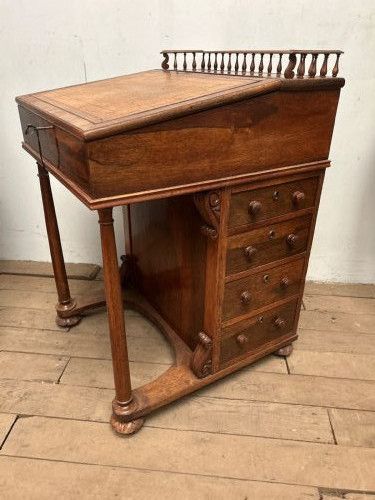


Regency Period Davenport
A regency period davenport is a compact writing desk built for clever storage and elegance, prized for its refined proportions and rich timbers.
Regency Period Davenport
When you search for a regency period davenport, you encounter small writing desks built primarily during the early nineteenth century and the wider Regency era. These pieces combine a sloping writing surface with sets of side drawers, designed specifically for domestic correspondence.
The versions most commonly met on this page span the Regency and late Georgian periods, often constructed from figured rosewood or mahogany. They appear in forms ranging from standard slant-front desks to sliding-top variants and diminutive proportions tailored for smaller spaces.
How they were made
Cabinetmakers built these desks using dense tropical hardwoods such as rosewood and mahogany, frequently enhanced by decorative veneers like satinwood, burr walnut, and burr elm. These timbers were selected for their rich grain patterns and polished to a deep lustre.
Construction details include working brass hardware, inset tooled leather writing surfaces, and functional side drawers that often incorporate clever locking mechanisms. Fine examples demonstrate precise cabinetwork suited to the demands of polite correspondence.
Some models hide stationery drawers behind secret panels that spring open with a hidden brass catch.
What varies in quality
The selection of timber grain and veneer symmetry dictates the visual impact of a piece, with striking burr walnut or figured rosewood marking out superior examples. Plain or heavily altered surfaces sit lower down the scale.
The sophistication of the mechanism, such as sliding tops and original brass fittings, distinguishes standard workshop production from pieces bearing attributed workshop mastery.
Gillows·Gillow
The Regency Period Davenport Glossary
- Davenport
- A small pedestal desk featuring a sloping, hinged writing surface above a bank of drawers. The form became popular in the early nineteenth century for writing letters in a drawing room.
- Regency
- An architectural and decorative style spanning the early nineteenth century, characterised by classical restraint and refined proportions. Furniture from this era often utilises dark exotic woods and subtle brass inlay.
- Sliding top
- A writing surface that moves forward to reveal storage compartments beneath. This mechanical feature allows the user to sit closer to the desk.
- Satinwood
- A lustrous, yellowish timber imported from the tropics, frequently used for veneers and stringing during the Regency period. Its pale colour offers a sharp contrast against darker hardwoods.
Regency Period Davenport: Frequently Asked Questions
What is a davenport desk?
A davenport is a compact writing desk featuring a sloped, leather-inset top for correspondence. It typically includes a set of drawers accessed from the side.
These pieces were originally designed for domestic use in drawing rooms where space was valued. Their small footprint allowed writers to work comfortably without occupying an entire room.
How do I date a davenport?
Dating relies on timber choices, construction methods, and stylistic markers such as turned legs or brass mounts. Pieces from the Regency era often display characteristic classical restraint and use rosewood or mahogany.
Cabinetmakers of the period employed specific dovetailing and secondary woods that help establish chronology. Comparing hardware styles also aids in confirming the decade of manufacture.
Were these desks used by women?
Many examples are described as lady's desks due to their diminutive proportions and intimate scale. They suited the lighter correspondence of the household.
The smaller size made them portable enough to move between private chambers and public rooms. Their fitted interiors kept stationery neatly organised.
What woods were used?
Makers relied heavily on dense tropical hardwoods like rosewood and mahogany for the primary structure. Decorative veneers such as satinwood and burr walnut added visual contrast.
Secondary woods like oak or pine appear in the interior drawer construction. Brass fittings provided functional strength and decorative accent.