
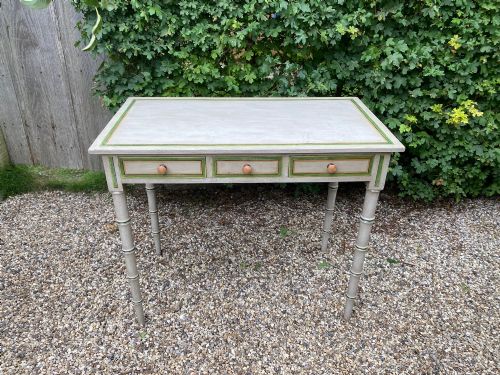
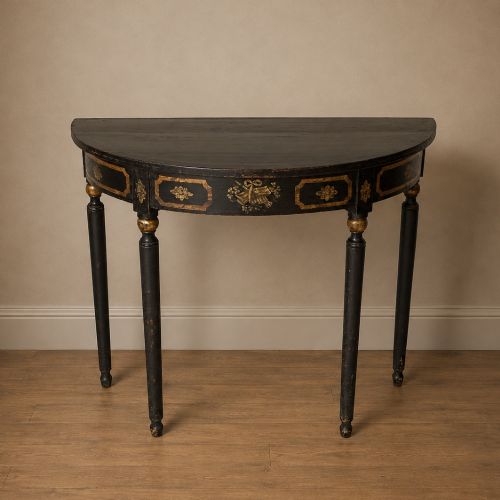
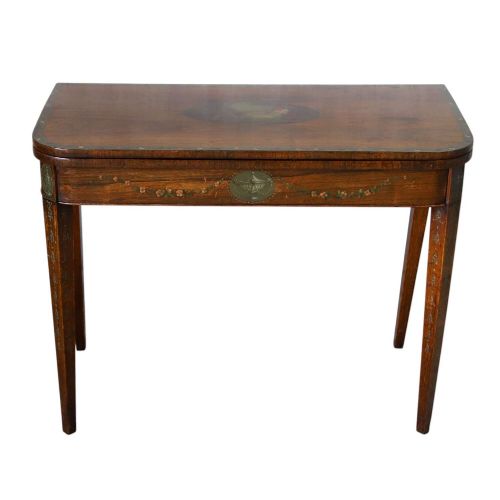
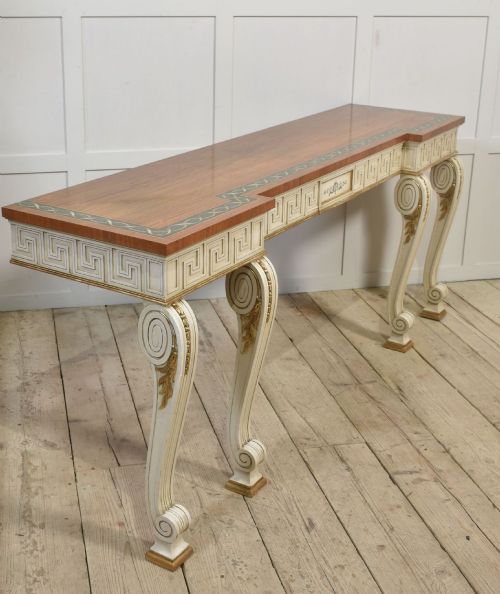

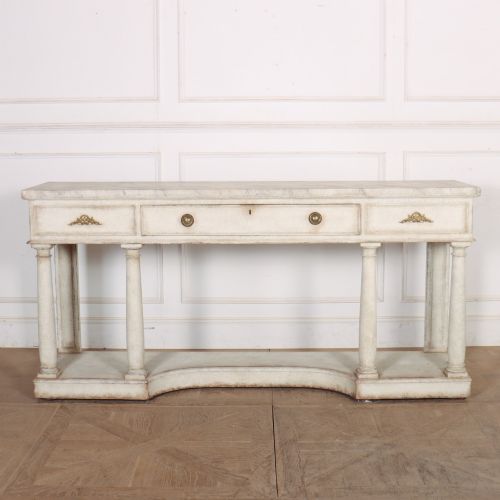


Regency Painted Console Table
A regency painted console table brings architectural grace to a hallway, defined by classical lines and decorative painted surfaces.
Regency Painted Console Table
A regency painted console table sits against a wall, often featuring half-moon or rectangular tops supported by slender legs. These tables draw on neoclassical and grand regency styles from the nineteenth century, alongside later revivals.
Most examples found here date from the nineteenth century or the georgian period, though later twentieth century interpretations also appear. They span various forms including side tables, serving tables, and card tables adapted for display.
Makers utilised softwood, beech, satinwood, and rosewood beneath painted finishes, sometimes pairing the wooden frames with marble tops or brass accents. The overarching aesthetic embraces both English regency restraint and more decorative continental influences.
How they were made
Craftsmen shaped solid timbers such as softwood, beech, and satinwood, often applying layered paint schemes directly to the wood. Original finishes ranged from monochrome ground colours to intricate hand-painted geometric or faux bamboo details.
Giltwood and gold leaf accents frequently highlight carved details, framing panels or edges to catch the light. Marble tops and brass mounts provide contrasting textures, while gesso forms the base for delicate moulded ornament.
Listings feature nineteenth century pieces alongside 1900, 1910, and 1920 examples, incorporating painted wood, marble, brass, and giltwood.
What varies in quality
The integrity of the painted surface dictates much of the visual appeal, separating pieces with original ochre or grey pigment from those bearing later decoration. Original hand-painted motifs display a sureness of brushwork that mechanical reproduction misses.
Timber selection and structural joinery define the underlying build, distinguishing sturdy hardwood frames from lighter softwood carcases. Finer items integrate subtle carved elements, parcel gilding, or inset plaques that elevate the piece beyond standard joinery.
Gillows
The Regency Painted Console Table Glossary
- Demi-lune
- A half-moon shape characteristic of console table tops designed to sit flush against a wall. This format maximises floor space in narrow hallways and reception rooms.
- Faux bamboo
- A decorative turning technique that mimics the segmented joints of bamboo cane. Craftsmen carved or shaped wood to achieve this exotic botanical effect popular during the regency period.
- Parcel gilt
- Partial gilding applied to specific carved details, mouldings, or highlights on a painted surface. It creates contrast between the gold leaf and the underlying paint colour.
- Neoclassical
- A style drawing inspiration from classical antiquity, featuring symmetrical forms, straight lines, and restrained ornament. It heavily influenced regency furniture design and architectural motifs.
- Gesso
- A plaster-like mixture applied to wood surfaces as a smooth base for gilding and fine paintwork. It allows crisp relief details to be modelled before the application of gold leaf.
Regency Painted Console Table: Frequently Asked Questions
Where should I place a console table?
These tables traditionally anchor narrow entrance halls, reception rooms, and stair landings where floor space is at a premium. Their shallow depth allows them to sit against walls without obstructing pathways.
Pairing a console table with a wall mirror or a pair of lamps creates a balanced focal point in an interior scheme.
How do I care for painted wood?
Painted surfaces require gentle dusting with a soft, dry cloth to prevent abrasion. Avoid chemical cleaners, moisture, and direct sunlight, which can cause historical paint layers to fade or lift.
Maintaining a stable room temperature protects the underlying timber and gesso from seasonal expansion and contraction.
Are these tables sturdy enough for daily use?
Console tables were historically designed for display rather than heavy weight-bearing tasks. Most rely on wall attachment or balanced proportions for stability.
Lighter tasks such as holding correspondence or decorative objects suit them well, while heavy daily loading should be avoided.
How can I tell original paint from later decoration?
Original paint surfaces show natural craquelure, wear patterns, and integration with the underlying wood that match the age of the piece. Scientific analysis or close inspection under magnification often reveals historic ground layers.
Later decoration may sit uniformly on top of older timber without the expected signs of historical oxidation and handling.