
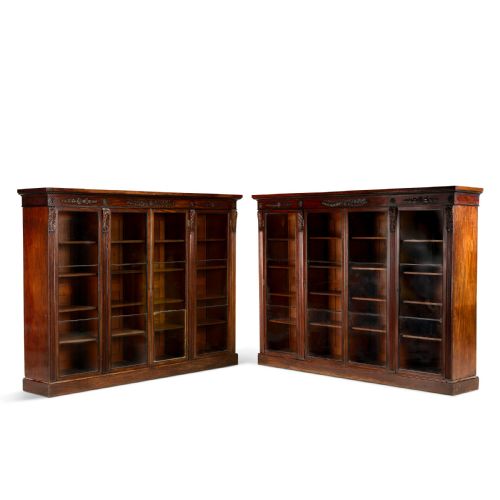
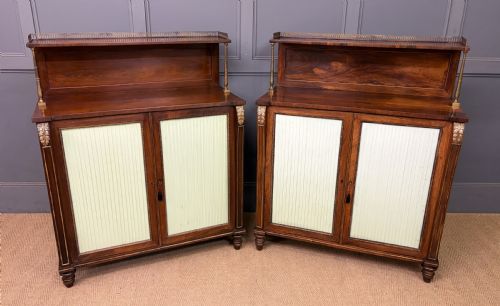


Regency Low Bookcase Pair
These regency low bookcase pair items bring architectural dignity and low-slung symmetry to a room, offering both display space and grounded elegance.
Regency Low Bookcase Pair
A regency low bookcase pair brings matched symmetry to a room, offering low-slung display space without dominating the wall. These twin pieces appear most often in rich timbers, spanning the true Regency period alongside later revivals from the nineteenth and early twentieth centuries.
The form stretches across various configurations, taking in open bookshelves, waterfall tiers, and glazed or solid side cabinets. Many examples incorporate architectural details like breakfront facades and tailored proportions designed to fit beneath window sills or along panelled walls.
How they were made
Cabinet makers relied primarily on dense, figured hardwoods such as mahogany and rosewood, often enhanced by contrasting burr walnut or teak. These timbers provided a stable, dark canvas suited to the understated lines of the period.
Metalwork played a defining structural and decorative role, with cast brass inlays, delicate ormolu mounts, and glazed doors adding subtle reflection to the dark wooden surfaces.
Materials appearing across the inventory range from traditional mahogany and rosewood to teak, burr walnut, glass, brass, and ormolu mounts.
What varies in quality
The sophistication of the timber selection dictates the visual weight of the piece, with richly figured grain and well-matched grain patterns across both halves of a pair setting superior examples apart. Simpler variants rely on plainer woods and more restrained construction.
Hardware and secondary detailing separate standard production from master craftsmanship. Finely chased ormolu mounts, precise brass stringing, and integrated silk or fabric linings within glazed cabinets indicate a higher tier of workshop execution.
The Regency Low Bookcase Pair Glossary
- Breakfront
- A cabinet design where the central section projects forward from the flanking outer sections. This arrangement creates depth and breaks up the linear expanse of long walls.
- Ormolu
- Gilded bronze applied as decorative mounts to furniture. It provides metallic contrast against dark woods like rosewood and mahogany.
- Waterfall
- A tiered shelving format where each shelf steps back progressively from the one below. This style creates a cascading silhouette popular in open bookcase designs.
- Regency Revival
- A later nineteenth or twentieth-century period of design that reinterprets classic Regency proportions and motifs. These pieces emulate earlier forms using contemporary workshop methods.
Regency Low Bookcase Pair: Frequently Asked Questions
Where should I place a low bookcase pair?
These matched cabinets suit placement beneath large windows or framing a fireplace, where their low profile maintains sightlines across the room.
They also work effectively in hallways or libraries to balance symmetrical interior layouts without crowding the vertical space.
How do I care for rosewood and mahogany?
Keep these timbers away from direct sunlight and radiators to prevent the wood from drying out or splitting. Dust regularly with a dry cloth and apply occasional high-grade wax to maintain the finish.
Avoid liquid polishes containing silicone, which can build up and dull the natural grain over time.
Are these bookcases suitable for heavy books?
Open bookshelves and cabinets from this period handle standard volumes comfortably, though long shelves can sag under immense weight over decades. Distribute heavy folios evenly and check internal shelf supports if housing large collections.
Enclosed cabinets usually feature fixed or adjustable wooden shelving designed for mixed display and storage.
How do I distinguish Regency from revival pieces?
Original pieces from the early nineteenth century typically exhibit period construction methods, hand-cut dovetails, and timber ageing consistent with genuine age. Revival pieces from later decades often show standardised secondary woods and machine tooling beneath the surface.
Examining the internal drawer linings and backboards helps clarify the exact era of manufacture.